About
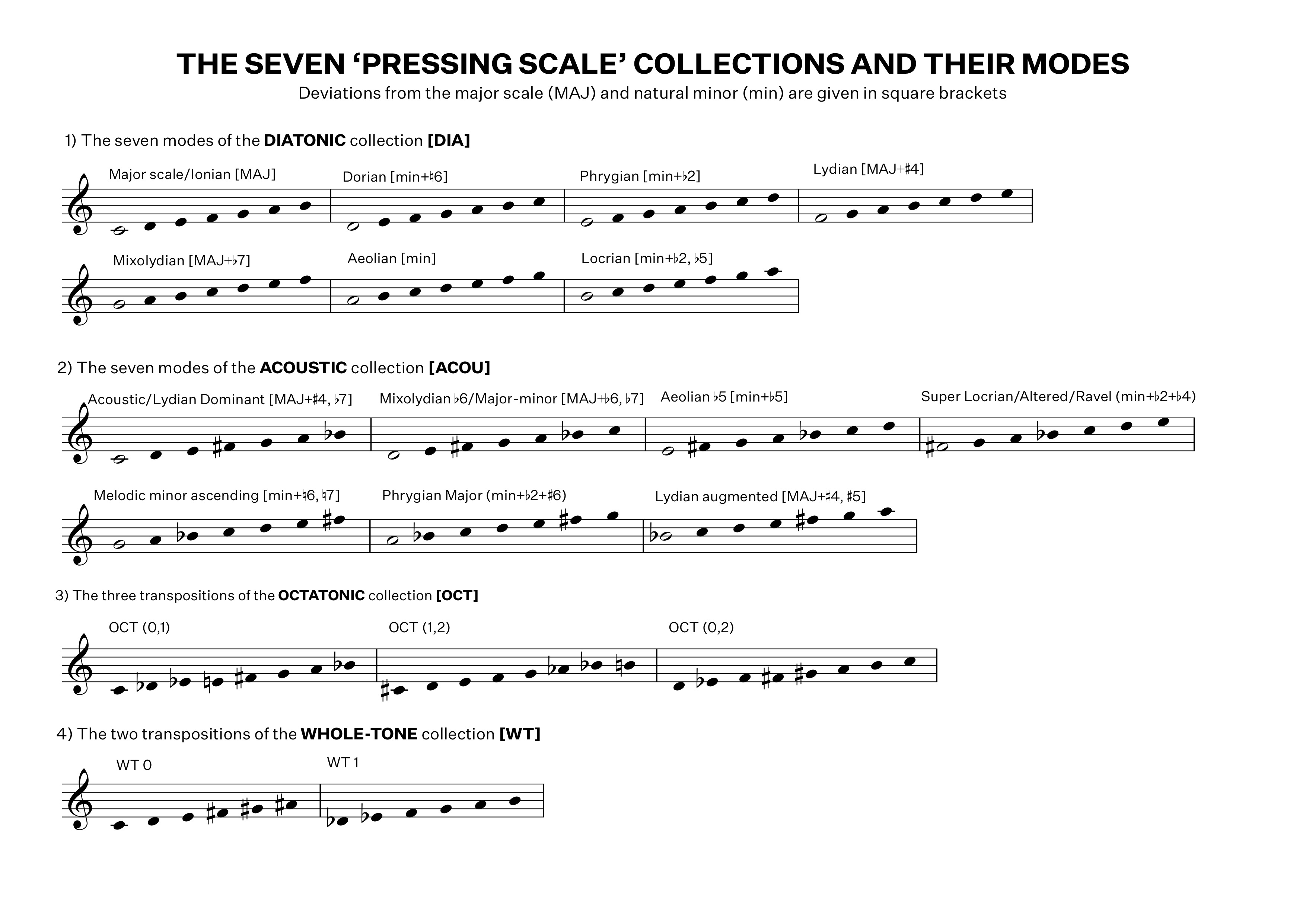
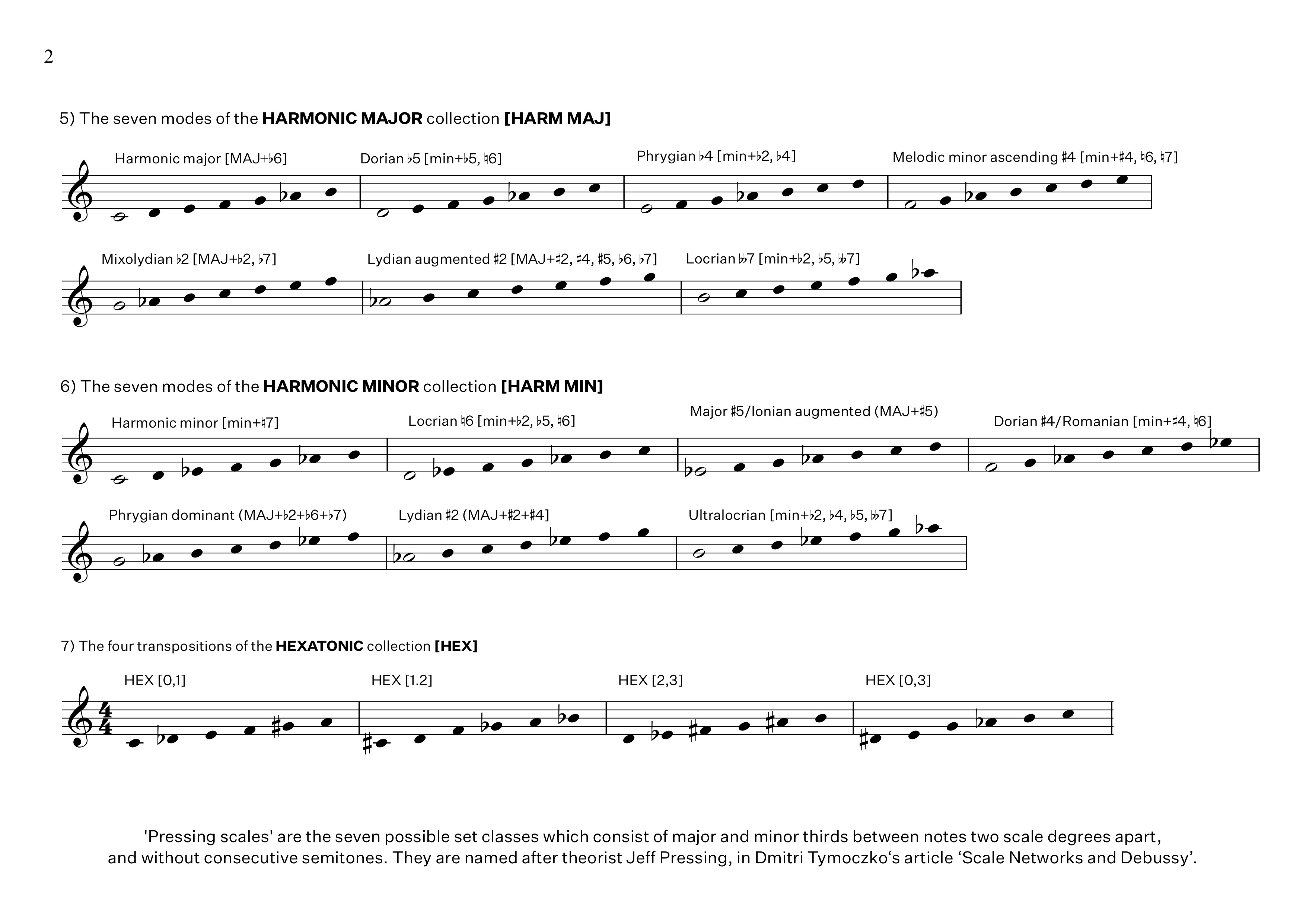
In the article ‘Scale Networks and Debussy’, Journal of Music Theory, Vol. 48, No. 2 (Fall 2004), pp. 219–294, music theorist Dmitri Tymoczko introduces the term ‘Pressing Scales’. The seven ‘Pressing scale collections’ plus their modes are shown to be amongst the most predominant scales that formed the expanded set of scales used particularly by Franco-Russian composers (such as Debussy, Ravel, Stravinsky, Rimsky-Korsakov, Satie, etc.) at the end of the nineteenth and beginning of the twentieth century.
It is useful for all composers and musicologists to learn the Pressing scale collections.
Forming the scales
The scales are formed by observing the following the following two constraints:
- No Consecutive Semitones (NCS) — no scale may contain two consecutive semitones between scale steps
- Diatonic thirds (DT) — any two notes that are two scale steps apart must be either a minor or major third (so that you can form a minor, major, augmented or diminished triad from every degree)
With these two constraints, the following seven collections can be formed The pattern of semitones is given in square brackets, i.e 1 = minor second, 2 = major second, 3 = minor third/augmented second*
| Collection name | Abbreviation | Interval pattern |
|---|---|---|
| Diatonic | DIA | [2-2-1-2-2-2-1] |
| Acoustic | ACOU | [2-2-2-1-2-1-2] |
| Octatonic | OCT | [2-1-2-1-2-1-2-1] |
| Whole-tone | WT | [2-2-2-2-2-2] |
| Harmonic minor | HARM MIN | [2-2-1-2-2-2-1] |
| Harmonic major | HARM MAJ | [2-2-1-2-2-2-1] |
| Hexatonic | HEX | [3-1-3-1-3-1] |
The asymmetrical scales — DIA, ACOU, HARM MIN and HARM MAJ — also have seven modes, formed by selecting different tones as a tonic. Because OCT, WT and HEX are symmetrical, they can’t form a clear sense of mode/tonic.
Below is a list of the main modes of the Pressing scales. You can also interactively explore the connections between different Pressing scales on the Pressing Scale Explorer page.