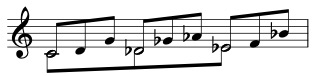
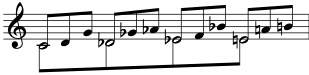
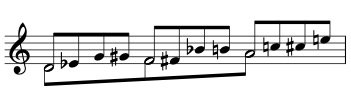
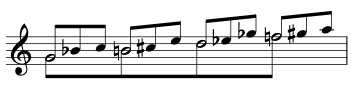
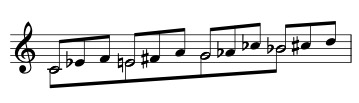
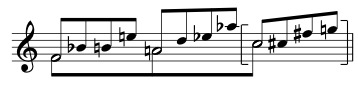
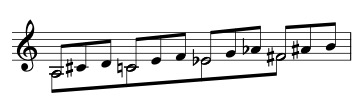
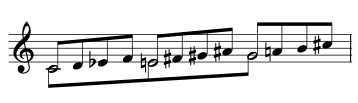
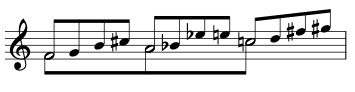
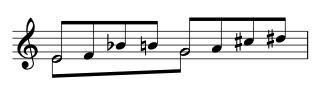
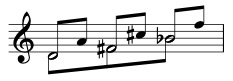
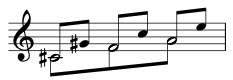
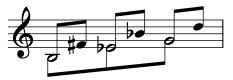
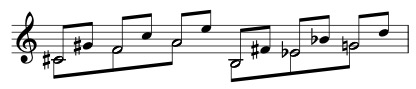
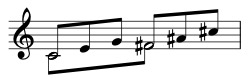
Crystalline Aphorisms: an introduction to tone-clock theory, with analysis of Jenny McLeod’s Tone Clock Pieces I–VII
This article was originally published in Canzona 2006. It was revised in 2026, to improve some of the analysis, while also acknowledging the completion of the set of 24 pieces in 2012, as well as noting the passing of Jenny McLeod in 2022. It is strongly recommended that this article is read in conjunction with the official scores from Wai-te-ata Music Press (available as both hard copies and digital downloads), as well as the recordings of the works on Rattle Records by Diedre Irons and Michael Houstoun.
Introduction
The 24 Tone Clock Pieces by New Zealand composer Jenny McLeod are a series of short preludial works for solo piano composed between 1988–2012.1 They are important milestones in New Zealand composition, as McLeod was the first New Zealand composer to have developed and articulated, like her mentor Olivier Messiaen before her, a fully-fledged compositional theory resulting in a highly individual musical language. This theory, called tone-clock theory, is a post-tonal system first developed by Dutch composer Peter Schat.2 After meeting Schat in the late 1980s, McLeod discovered its connections to her own compositional approaches, as well as to those of her musical idols Claude Debussy and Olivier Messiaen. In addition, she saw significant relationships with Allen Forte’s pitch-class set theory, and spent several years extending both Schat’s and Forte’s ideas well beyond their initial conceptions.3 The 24 Tone Clock Pieces have since become important exemplars for composers, musicologists, improvisors and educators in Australasia, and are becoming more widely known around the globe, along with interest in the underlying theory. This short paper seeks to introduce readers to the basics of tone-clock theory, providing the first seven Tone Clock Pieces as analytical models.
Tone-clock theory is, at heart, a vocabulary and grammar for chromatic post-tonal composition. It can be thought of as reconciling early twentieth-century Austro-Germanic developments, such as serialism and dodecaphony, with the exploitation of exotic scalar and symmetrical pitch collections in Franco-Russian music of the same period. While Schat’s original formulation adhered to the principle of using all twelve chromatic pitches (the ‘aggregate’), his pitches are generated in a specific way that is highly economic in the number and type of constituent intervals, typically only featuring two main intervals. McLeod subsequently generalised Schat’s underlying concepts to focus less on attaining the twelve-tone aggregate, and more on achieving a general chromaticism while still upholding the principle of ‘intervallic economy’. This means that, even though they are highly chromatic, pieces written using tone-clock principles attain a very clear sense of harmonic ‘colour’ or ‘character’, thanks primarily to this ‘intervallic frugality’: the same intervals are heard constantly, even though the pitches vary greatly, giving each piece a clear sense of harmonic unity. This results in a musical language where the harmonic structure seems surprisingly clear and is able to be immediately audibly ‘parsed’: in other words, listeners may well notice if a performer plays a wrong note, even if they are unfamiliar with the piece, something that could not necessarily be said about dodecaphonic works.
The 24 Tone Clock Pieces
The soundworlds that McLeod creates in the 24 Tone Clock Pieces might be best described as ‘crystalline’ or ‘jewel-like’. I mean this to be more than just a pictorial description, as this metaphor can be traced to four specific, inherent characteristics of the music:
the nonfunctional, nonteleological harmonies that result from the use of chromatically saturated pitch collections and symmetrical divisions of the octave;
their articulation through a relatively free, often ametric rhythmic scheme; (both 1 and 2 discouraging a linear narrative in favour of an interpretation governed by ’events’ or ‘sound objects’ articulated in resonant space);
the high degree of internal order and prevalence of symmetrical pitch and rhythmic forms mimic the internal patterning of a crystal’s symmetrical structure, a similar metaphor to that found in works such as Varèse’s Hyperprism or Messiaen’s ‘Liturgie du Cristal’ from Quatuor pour la fin du temps;4
the fixed attack-decay character of the piano’s timbre, the relative brightness and ‘clarity’ of its overtone spectrum (particularly given the stretched, slightly inharmonic relationship between partials), allied with its strictly mechanical nature, further suggest a non-organic metaphor.5
These hazy, undirected musical events are sequenced in a somewhat episodic manner, similar to Messiaen’s formal approach. Unlike Messiaen’s harmonic language, however, the 24 Tone Clock Pieces tend to use perfect and major intervals, particularly seconds, thirds and fourths. At times, this gives the music a slight jazz inflection—indeed, tone clock theory has been picked up by a number of jazz improvisors and incorporated into their harmonic language.6
Although the 24 Tone Clock Pieces do not systematically explore harmony in a graduated fashion, as do other famous collections of keyboard music such as Bach’s Das Wohltempierte Klavier, Bartók’s Mikrokosmos or Ligeti’s Musica Ricercata, they do, from piece to piece, display different levels of sophistication and complexity in the application of tone-clock theory. Tone Clock Piece I, for instance, features the most straightforward application of tone-clock principles, while Tone Clock Piece III is based on a highly detailed harmonic scheme. Despite the variety in tone-clock approaches, however, the pieces share a number of unifying commonalities, discussed in later sections.
Tone-clock Theory vs. Pitch-Class Set Theory
McLeod’s development of tone-clock theory is based primarily on taking Schat’s original terminology and post-serialist techniques, and expanding them to all possible combinations of chromatic notes, by drawing on Allen Forte’s idea of the ‘set class’.7 A set class is a family of all possible unordered chromatic collections that through transposition and/or inversion map onto the same set of pitch classes (pc). Using this idea, we can compare chords or melodic cells and demonstrate relationships in their intervallic construction. Because constituent interval classes do not change under transposition or inversion, the set class became a key tool in analysing atonal and post-tonal repertoire, especially that of the Second Viennese School, for whom intervallic relationships were an important force in creating musical coherence.
Forte has two ways of cataloguing and labelling a set class: the first, prime form notation, uses the most compact form of both the set and its inversion, listed as a series of pc integers transposed to pc 0.8 The set of pitches {C, D, E♭, G} would, for example, be labelled [0237]. The second method involves looking up the prime form in Forte’s table, and using its catalogue number, or ‘Forte name’. In this case, the previous tetrachord [0237] has the (admittedly somewhat insipid) title ‘Set Class 4-22’.
In total there are 220 set classes in Forte’s theory. While mathematically speaking, there should be 223 prime forms, Forte ignores three of the ’trivial’ cases: the ‘singleton’ set, its complement the single 11-note set, and the 12-note aggregate.) In tone-clock theory, we ignore the singleton set, as it does not contain any intervals, but we do include the 11-note and 12-note sets, making a total of 222 set classes that we can study.
Amongst the 222 groups are 12 three-note classes or trichords: the origins of tone-clock theory lay in the discovery by Peter Schat that of these 12 trichords, 11 can be transposed and/or inverted in such a way that every note of the chromatic scale is generated once and once only (see ‘12-note tone-clock steerings’ below).9 After exploring Schat’s ideas, McLeod discovered this property in other-sized set classes as well. In fact, she systematically examined every set class in Forte’s list, annotating whether or not it had this property, as well as noting many other transpositional and symmetrical properties that were not included in Forte’s lists of set classes. In addition, she also cross-referenced her findings with other chromatic techniques and theories, notably those of Messiaen, Boulez and Xenakis.10 This table—her ‘chromatic map’—is an extremely important, if little-known contribution to chromatic musical theory. The results of these years of study were set forth in an unpublished manuscript called Chromatic Maps (work is currently underway to edit, expand and publish this manuscript).
The Intervallic Prime Form (IPF)
McLeod’s considerable maturation of Schat’s tone clock is, therefore, also a development and repackaging of pc set theory, with extensive additional observations and information. She also set out to improve on certain aspects of pc set theory—firstly, by abandoning Forte’s often confusing nomenclature and, secondly, by including tabulated information about transpositional attributes of chromatic collections. Instead of Forte’s rather cumbersome Forte name and prime form notation, tone-clock theory uses a single label derived from the list of interval classes (ic) between subsequent pc of the prime form. Using the pc-set above, {C, D, E♭, G}, we could relabel this using only the intervals between subsequent notes: 214—that is: major 2nd (2 semitones), minor 2nd (1 semitone), major 3rd (4 semitones). (The actual process for arriving at this number is a little more complicated, but is simplified by various online calculators). This notation is known as the Intervallic Prime Form, or IPF for short.11
IPF notation, written as a sequence of intervals, has the immediate advantage that it allows both composer and musicologist to instantly see the intervals between neighbouring pc, neither requiring mental subtraction (as does prime form notation), nor the use of lookup tables (as does the Forte name), making it both more easily comprehended and hence more useful for the composer. It also provides clear ‘clues’ as to the sort of ‘flavour’ of the prime form.12 For instance, instead of having to look up what Set Class 4-22 is, we can immediately see that IPF 214 contains a major second, a minor second and a major third, leading us to draw certain conclusions about the relative dissonance of the chord before we even hear it played (for example, the two seconds will give the chord a certain modal ‘spice’, though not, perhaps, the percussive bite of a true tone-cluster). In order to get the same information from ‘Set Class 4-22’ or even [0237], Forte’s nomenclature requires extra steps of ’lookup’ and/or ‘mental unravelling’ — or at least subtraction, to determine the intervallic content from the list of pc.
Tone-clock theory was conceived by a composer as a compositional strategy, first and foremost, to be used while composing. It shows us ways we might create harmonic structures that have aurally and conceptually fruitful properties. Pitch-class set theory, on the other hand, was primarily conceived as an analytical tool, and does not really promulgate any particular approach for how set-classes might be used compositionally. We might say, then, that tone-clock theory is a conceptual tool for composers working in an equal-tempered, post-tonal context, a tool that not only provides us with more ‘user-friendly’ naming conventions than pc-set theory, but also provides tools for creating larger fields of pitches from which whole sections of music might be composed (see ‘Fields, steering and steering groups’ below).
Major and minor forms
There is one property of Forte’s set classes (and hence, IPFs) that has always been somewhat difficult to accept. Because all groups of pitch-classes that relate to each other through inversion share the same prime form, this leads to the somewhat counterintuitive position that, say, major and minor triads are considered ’equivalent’. If you were to ask an average musician their thoughts on this, they are likely to say that it is prima facie ludicrous to consider, say, C minor and C major as in any way ‘equivalent’: it would be like claiming that Beethoven’s 5th would have the same raw emotional force and impact if it were, in fact, rewritten in C major.
It could therefore be argued that this is a fatal flaw of the whole concept of set class equivalence: inversions are clearly not the same as each other. My feeling on the matter is, however, that this objection misses the point about what set classes are trying to say. If we consider common-practice tonality as merely one small subset of the entire chromatic universe available to composers (which is what set-classes are attempting to categorise), then the fact that major and minor triads ‘belong together’ in this way demonstrates, to some degree, the success of the theory.
Nevertheless, the objection remains that Forte’s theory does not sufficiently recognise the obvious cognitive difference between major and minor triads, and ever since the publication of The Structure of Atonal Music, music theorists have tried to find a way to nuance Forte’s concept of the set-class to better capture both the sense of relatedness and obvious aural difference between pitch-class sets that are inversionally related.
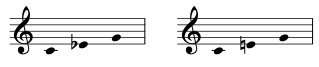
In my opinion, McLeod deals with this in a rather elegant and conceptually satisfying fashion. While she retains pitch-class set theory’s concept of inversional equivalence, she adds a simple qualifying label of ‘major’ and ‘minor’ to all IPFs that contain two different interval classes in a repeating pattern, such as 1-2, 414 or 2323. The ‘major form’ of the IPF, then, is the one voiced with the larger interval on the bottom (e.g. 2-1, 414 or 3232), while the ‘minor form’ has the smaller interval on the bottom (e.g. 1-2, 141 or 2323). This is not just conceptual: if you listen to these different groups, there is a distinct affective quality about them analogous to the difference in feeling you get from a standard major and minor triad.
The twelve hours
At the heart of tone-clock theory is the recognition of the primacy of the ‘interval-pair’: a pair of intervals, such as minor second and major third, that together form three notes (a ‘triad’ in tone-clock parlance).13 If these interval pairs are used throughout a work, they will imbue that work with a particular ‘flavour’ or ‘perfume’. In fact, we could make a sweeping statement that the entire history of Western common-practice tonal music rests on the use of the interval-pair of a minor third and major third (3-4 or 4-3 in IPF notation) from which most triadic harmony is typically drawn.
In the late nineteenth and early twentieth century, however, composers such as Debussy, Stravinsky and Bartók started experimenting with other interval pairs: Debussy’s String Quartet in G minor and La Mer, for instance, are based on the interval-pair of a major second and a minor third (2-3 or 3-2); Bartók’s Fourth String Quartet is fixated on the interval-pair of a minor second and perfect fourth (1-5 or 5-1).
In pitch-class set theory terms, a pair of any two intervals (which can be the same interval or two different ones) will always form one of twelve possible ‘chromatic triads’ (‘trichords’ in Forte’s pitch-class set theory). These triads are the molecular building blocks of much post-tonal music, as our ears seem to be able to readily hear and appreciate even quite small differences between the triads, unlike some of the larger groupings which may be harder to tell apart. Composers also ‘chained’ these triads together to form larger groupings, such as the diatonic, hexatonic, whole-tone and octatonic scales, groupings that retain key aural characteristics of their constituent triads.
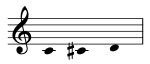
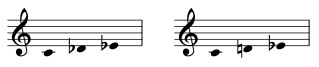
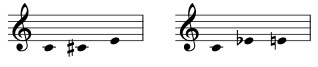
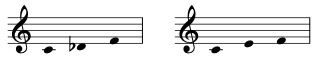
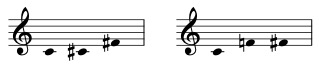
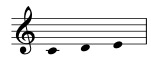
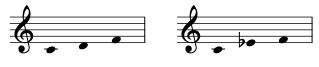
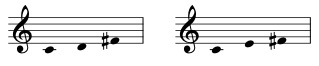
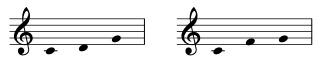
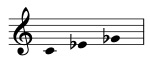
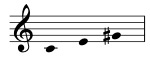
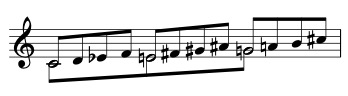
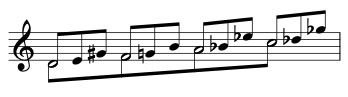
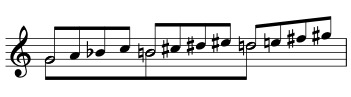
Schat and McLeod recognised the primacy of these twelve ‘chromatic triads’ by calling them ‘the hours’, and giving each a Roman numeral, in the same way that hours might be written on a clock face. They start with the most compact hour (I = two consecutive semitones) all the way up to the most ‘open’ hour XII (an augmented triad). In the ‘Label’ column, I have provided both the IPF notation (the sequence of intervals), as well as the hour label (a Roman numeral from I–XII, as well as the major (M) and minor (m) forms for the asymmetrical hours).
Hour
IPF Label (Hour Label)
Musical Notation
Common musical description
I
1-1
cluster triad
II
1-2 (IIm) / 2-1 (IIM)
diatonic/octatonic triad
III
1-3 (IIIm) / 3-1 (IIIM)
hexatonic triad
IV
1-4 (IVm) / 4-1 (IVM)
pelog triad
V
1-5 (Vm) / 5-1 (VM)
chromatic triad
VI
2-2
whole-tone triad
VII
2-3 (VIIm) / 3-2 (VIIM)
pentatonic triad
VIII
2-4 (VIIIm) / 4-2 (VIIIM)
dominant seventh triad
IX
2-5 (IXm) / 5-2 (IXM)
quartal triad
X
3-3
diminished triad
XI
3-4 (XIm) / 4-3 (XIM)
major/minor triad
XII
4-4
augmented triad
As can be seen from the table above, hours represent a gradual intervallic ‘opening up’ from the tightly chromatic hour I (1-1) to the open augmented chord of the hour XII (4-4).
Proximity and segmentation
As Forte remarks, ‘the process of segmentation… determining which musical units of a composition are to be regarded as analytical objects… often entails difficulties in the case of an atonal work.’14 Forte seems to opt for a largely intuitive approach to deciding which pc ‘go together’, although he does draw on conventional musical concepts of ‘distinctiveness’ (for instance, rhythmic distinctiveness, rests, beam groups, and other clustering and individuation mechanisms).
If we are composing with prime forms, however, as opposed to analysing them, then a simple principle of proximity is sufficient to ensure the effect of intervallic relationships is audible and perceptually salient. In other words, we need to place the constituent pc of each IPF within a short enough span of time such that our short-term aural memory is able to perceive the relationships between them. If notes are strung too far apart in time or register, or interspersed too drastically with notes from other transpositions, then essential intervallic characteristics of the prime form can be lost.15
Of course, the question that arises here is: exactly how proximate do pc need to be? And, what is the perceptual continuum on which the effects of proximity operate? Unfortunately, these questions are too rooted in the field of psychoacoustics and perception research for me to try and tackle them in this article. It is interesting, nevertheless, to see that in the 24 Tone Clock Pieces, there is often deliberate and clear partitioning and clustering of constituent pc, making segmentation, even under Forte’s criteria, reasonably straightforward.16
Relationship to serialism
Due to tone-clock theory’s emphasis on creating twelve-note aggregates, it might be conflated with serialism.17 While there is some superficial similarity, there are also significant differences. The ordering of a set of pc is not part of tone-clock theory; in fact, tone-clock theory has no concept of order, only using the terms ‘collections’, ‘groups’ and ‘fields’ rather than ‘rows’. An IPF may appear in any order, as long as its fundamental intervallic flavour is preserved (through the proximity principle mentioned above). In this sense, tone-clock theory is less constrictive than serialism, and, it could be argued, more ‘integrated’ due to the emphasis placed on the perceptibility of intervallic content as a primary unifying force.
While it is true that, in one sense, serialism also preserves the perceptibility of intervallic content, if we concede that serial operations of transposition, inversion and retrograde do not change the proximity of the intervals to each other, composers (particularly Schoenberg) would often construct their rows from a variety of different intervals. This would lead to an ‘overabundance’ of intervallic flavours.18
Tone-clock theory, on the other hand, operates on smaller collections, typically triads or tetrads, which ‘saturate’ the larger collections. Within each small collection, there is no limit placed on order, but there is specific emphasis placed on intervallic consistency. Proponents of tone-clock theory argue, therefore, that it creates a lower-level, more perceptible harmonic structure than serialist techniques, while allowing for greater freedom in the way the generative material is treated.
It is interesting, however, that in McLeod’s serialist Piano Piece 1965, which predates Schat’s own tone-clock experiments, her tone row, {C♯, C, E, B, D♯, D, F♯, F, A♭, A, G, B♭), can be seen as a ‘12-note dual tonality’ featuring two second-hour and two third-hour triads. In addition, there are four third-hour triads hidden within the row
Terminology
Before embarking on the analysis and commentary of the first seven Tone Clock Pieces, I will need to introduce some important terms used throughout the remainder of the text. Space does not permit more than a rudimentary explanation of these terms, so for further information the reader is referred to [McLeod, unpub.]
Hour groups
Larger groups can be built from the basic 12 hours. For instance, we can extend IPF 2-3 (VII) by repeating the alternating pattern of intervals to form the IPF 232, which we label as VIIm4. Note the lower-case ‘m’ refers to the ‘minor form’, where the smaller interval comes first. The ‘4’ indicates it is a four-note group, named a ‘tetrad’ in tone-clock theory. It is also possible to create an hour group from the major form of VII — IPF 323 — which would notate as VIIM4, with an upper-case M. Where possible, the analyses below will use this hour-group notation for simplicity’s sake.
Fields, steering and steering groups
One of the central planks of tone-clock theory is the idea of using one group of notes to transpose or invert another group of notes in order to form a larger set of notes (a ‘field’) from which to develop harmonic and melodic material. This sense of ‘guiding’ the transpositional levels is captured in the term ‘steering’. In this metaphor, the group of notes doing the guiding is called the ‘steering group’, which is responsible for transposing the other group of notes (the ‘steered group’).
12-note tone-clock steerings
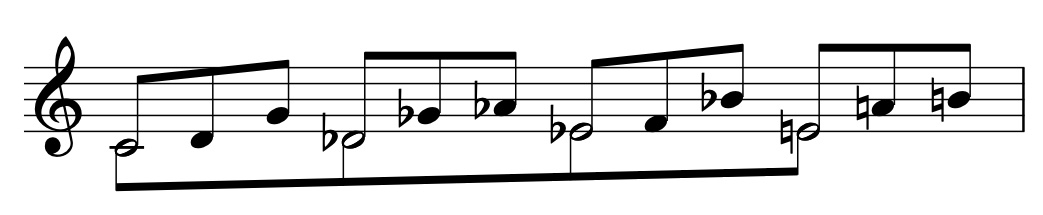
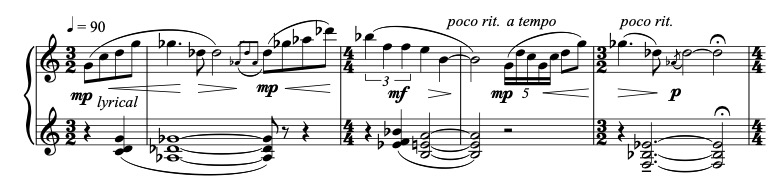
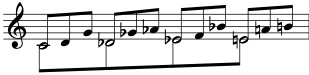
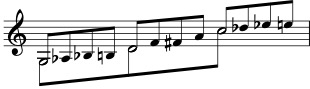
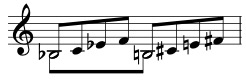
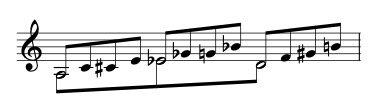
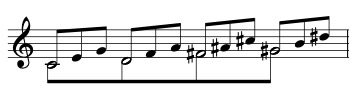
One of tone-clock theory’s special techniques is the special case of steering where all twelve chromatic pitch classes are generated without repetition. McLeod calls this technique ‘12-note tone-clock steering’ or a ‘12-note chromatic tonality’, and it was a central part of Schat’s practice. The example below, from Tone Clock Piece I, shows a set of three pc — (C♮, D♮, G♮), which form hour VII (2-3) — transposed and inverted so that every note of the chromatic scale is generated once and once only:
Ex. 13: An example of tone-clock steering, where a triad is transposed/inverted to create every note of the chromatic scale once and once only
This technique has the potential to generate a rich, chromatically-saturated harmonic language, while simultaneously economising intervallic content.
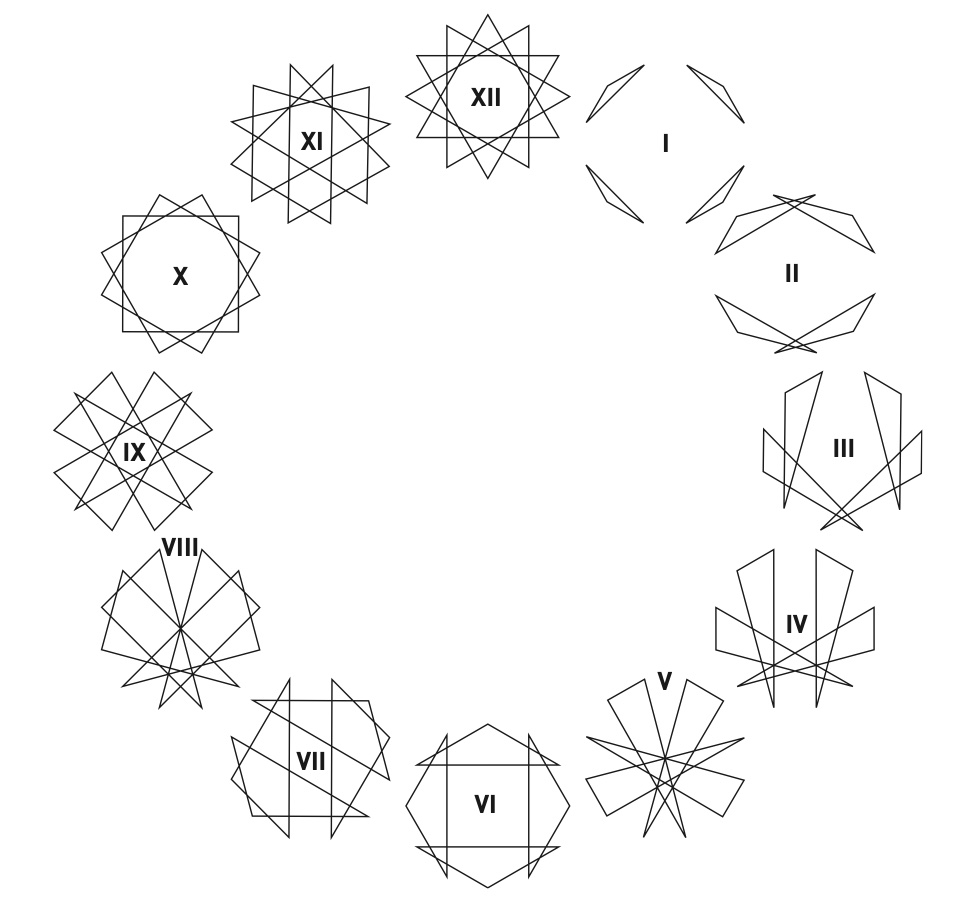
Of the 222 possible IPFs, however, only 44 possess this mathematical characteristic.19 Eleven of these are triads: that is to say, all of the twelve hours except for X can be tone-clock steered, by being transposed and inverted four times to form the chromatic aggregate. Ex. 2 captures this in an elegant diagrammatic form: Schat created this diagram to represent how each of the twelve hours (here represented as a triangle — with the exception of X for which Schat ‘cheats’ by using the tenth-hour tetrad instead — where each point is a pitch-class on the chromatic circle) can be rotated (transposed) and reflected (inverted) without any vertices coinciding.
The twelve tone-clock steerings are then arrayed in a circular fashion, as if on a clock face.20 The diagram clearly demonstrates both the inherent symmetry of tone-clock steering, as well as the gradual ‘opening-up’ of the hours. Schat coined the term ’the zodiac of the hours’ to refer to this diagram:
Ex. 14: Schat’s Zodiac of the Hours
Reverse steering and anchor forms
McLeod uses the principle of steering and tone-clock steering in every aspect of the harmonic organisation of the 24 Tone Clock Pieces. The clearest example is found in Tone Clock Piece I: the entire harmonic structure, except for the last two bars, is reducible to the tone-clock steering above: IX steered by IIm4.
The last two bars of the piece, however, are different. Here she deploys a special tone-clock technique, known as ‘reverse steering’, where the ‘steering group’ and the ‘steered group’ swap places. In other words, the field that is to say, IIm4 steered by IX (see Appendix I)
Note, however, that IIm4 is incapable of being tone-clock steered. Instead, McLeod has to use a form of steering where a second IPF is used to complete the twelve notes. She uses two complementary transpositions of IIm4, with the aggregate completed by using the ‘remainder’, IIIm4.21 This kind of steering, dubbed an ‘anchor form’ by McLeod, is often deployed throughout the 24 Tone Clock Pieces (this will be covered in more depth shortly).
The concept of the steering group as a specific group of notes controlling transpositional levels in the piece raises interesting psychoacoustic questions: does the brain subconsciously register the presence of the steering group, and if so, in what way? Is it something we could articulate, even if we had not heard the steering group on its own? Or is the link between the two quite arbitrary in practice?22
While answering these questions is beyond the scope of this article, I will draw attention, within these analyses, to certain surface features that arise as a result of steering. The codetta-like expression of the steering group in Tone Clock Piece I can be thought of as the bringing to the surface an otherwise ineffable force—the sudden awareness of a previously sublimated sound. This reification of a ‘deep structure’ is not dissimilar to a final I-V-I cadence of a Classical tonal piece echoing Schenker’s notion of the Bassbrechung, the large-scale 1̂–5̂–1̂ bass motion that he claims controls overall harmonic motion. The ‘mirror effect’ of this functional reversal between macro- and micro-structure is also an attractive conceptual feature for McLeod, recalling Messiaen’s preoccupation with musical symmetry.
Fields
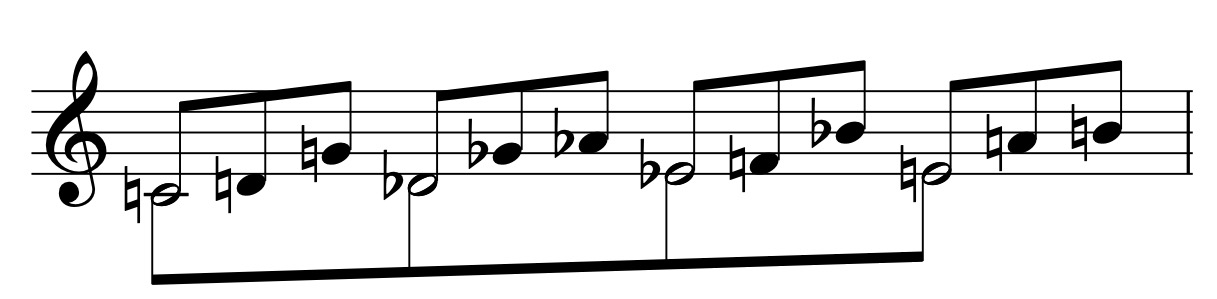
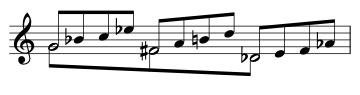
The term ‘field’ is used by McLeod to indicate a group of prime forms that, like key areas in common-practice tonality, define the harmonic content of some segment of the work (typically a phrase, section, and sometimes an entire piece). A field is usually defined by one or two IPFs undergoing transposition and inversion, the resulting pitch collections used repeatedly to form a sense of ‘chromatic tonality’ or, more abstractly, a ‘compositional pitch space’.23 Ex. 3 shows an example of a triad that has been transposed and inverted repeatedly to form a set of pitches from which we might compose a section of a work (McLeod uses this particular field extensively in Tone Clock Piece I).
Ex. 15: An example field
Many of the fields in the Tone Clock Pieces comprise transpositions and inversions of an hour or hour-group that together form the twelve-note chromatic collection, although there are instances of fields that contain, for example, thirteen or sixteen notes. Twelve-note chromatically saturated fields are normally formed either by symmetrical transpositions of a single IPF (this technique is discussed in the ‘tone-clock steering’ section above), or by non-saturating transpositions of an IPF plus the chromatic complement of the aggregate (this technique is discussed in the section below). It turns out that tone-clock steering does not, in fact, appear in every Tone Clock Piece. This circumstance is surely due to the overly limited intervallic construction of tone-clock steerings, not to mention the fact that only a few IPFs can be tone-clock steered. Because of that, McLeod uses so-called ‘anchor forms’ more frequently, as any IPF can be used to create them.
Anchor forms
Only a relatively small number of IPFs can form a complete tone-clock steering. Of the 29 tetrads, for instance, only 7 are able to be tone-clock steered. To reach chromatic saturation, most IPFs require another IPF to complete saturation without repeating pcs. The use of two IPFs to reach saturation, in which one IPF appears multiple times and the second only once, is called an ‘anchor form’.
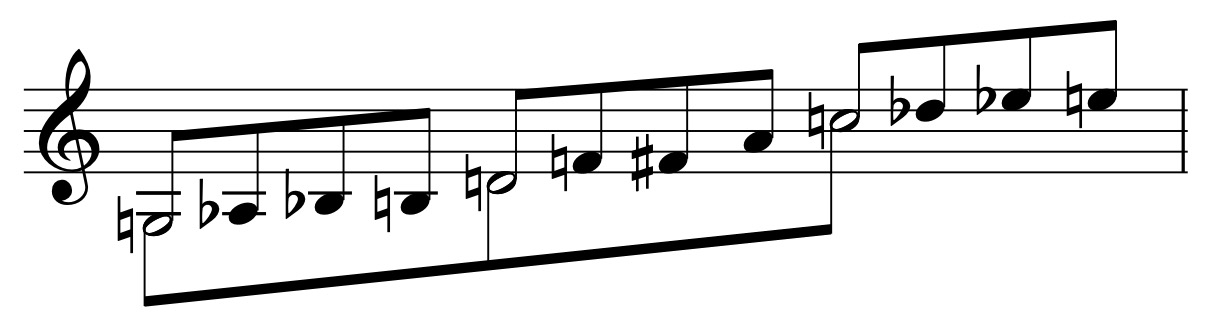
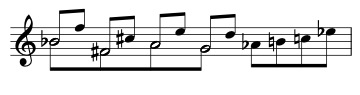
Ex. 4 shows an anchor form that is used in the final bars of Tone Clock Piece I, comprising IIm4 (121) steered by the interval class 5, which leaves the chromatic ‘remainder’ IIIM4 (313, or the ‘minor-major chord’). When presented in the form given in Example 1B of Appendix I, we can see that this remainder IPF (the ‘anchor’) forms an axis of symmetry around which the transpositions of IIm4 (the ‘shells’) are arrayed in a mirror-like fashion.24
Ex. 16: The anchor form from the end of Tone Clock Piece I: note the central group (313 = IIIM4) is a different IPF than the outside groups (121 = IIm4)
It can be shown that an anchor form can be derived from any IPF by following the following strategy:
If an IPF is symmetrical, then an anchor form can be created by steering the IPF with a symmetrical steering group of any size. If the IPF is asymmetrical, however, then you must steer it with a symmetrical steering group that contains an even number of pc, and you must use symmetrical inversions of the IPF when transposing (for instance, mmMM, MMmm, MmMm or mMmM) As long as these criteria are followed, then the aggregate of the transpositions (the shell) will be symmetrical, as will be the chromatic complement (the anchor). Although a complete generalised mathematical proof of this is beyond the scope of this article, a sample proof for the case where the IPF is a triad and the steering group is a symmetrical tetrad—a case commonly seen in the Tone Clock Pieces—is given in Appendix II.
Developmental procedures
IPF superposition/aggregation
In the most straightforward application of tone-clock theory, found in Tone Clock Piece I, the triad IX is used exclusively except, as previously noted, for the final two bars. The result is a high degree of intervallic coherence—the major second and perfect fourth plus their respective inversions, the minor seventh and perfect fifth, saturate the harmonies. This has the disadvantage, however, of potentially limiting musical variation, as the set of intervals is essentially static. McLeod therefore uses a fairly simple procedure to extract a greater variety of intervallic material from a single IPF: by superimposing and revoicing two or more transpositions of a single IPF, she forms a larger superset out of which new intervallic configurations can be emphasised. Ex. 5 shows how this strategy is used in b. 22 of Tone Clock Piece IV, where the main IPF we hear earlier in the piece, VIIm4 (232) is transposed twice to form (G, A, C, D) and (C♯, D♯, F♯, G♯), which is then aggregated, split and revoiced to form two transpositions of V4 (G, C, C♯, F♯) and (D♯, G♯, A, D).
Ex. 17: the field on the left contains two transpositions of VIIm4; the field on the right shows the same pitches reordered to form two transpositions of V4
The ability for two different IPFs (VIIm4 and V4) to share a superset (111-3-111) is a useful tool for the development of the harmonic structure, and is regularly used by McLeod.
Harmonic stability/instability
From the Renaissance on, composers have sought to develop harmonic tension and release through varying the degree of ‘harmonic stability’ in their music. There are two primary ways in which composers can control this: firstly, the length of time over which we hear the same ‘collection’ of pitch classes (i.e. the ‘harmonic rhythm’); secondly, the relative ‘distance’ between successive collections—that is to say, the number of new pc introduced by the new set (for instance, in tonal harmony, ‘close’ modulations to the subdominant, dominant or relative minor involve changing only one pc, while more significant, unexpected modulations would involve a shift in at least 3 pc).
As the Tone Clock Pieces tend to work primarily with chromatic aggregates that are created in a fairly short space of time, these pieces never really attain a sense of ‘unfolding’ harmonic structure, in the sense of gradually shifting from one collection to another. The chromatic aggregate becomes the collection, creating a somewhat nonteleological (non-goal-oriented) musical language. Subtle uses of ‘common tones’—pc kept in common between subsequent transpositions of an IPF—can give a fleeting impression of a more goal-oriented unfolding of harmony, and McLeod occasionally draws on these. In addition, by focusing on a subset of the aggregate for longer periods of time, a sense of ‘collection’ can be established.
Formal considerations
Although pitch structures are the focus of this analysis, they do not, of course, provide a complete picture of a piece’s construction. Having said that, there is a very close relationship between the harmonic structure of the Tone Clock Pieces and large-scale form-defining properties such as texture, tempo, motif, and rhythmic materials.
This is borne out when we examine the boundaries between different tone-clock collections. In Tone Clock Piece VII for instance, there is a clear division of material between the sedate homophonic quaver/quaver triplets ‘chorale’ of Field A (bb. 1–12) and the sprightlier, more angular semiquaver material of Field B (bb. 13–23), that becomes increasingly contrapuntal in texture. This close alliance between tone-clock field and the other non-pitch parameters is found throughout the Tone Clock Pieces. By creating this alliance, McLeod engenders a clear and unambiguous sequence of structural landmarks.
The clarity of the fairly conventional formal designs is presumably intended as a counterpoint to the more complex chromatic harmonies. By deliberate non-pitch signalling of changes in IPF, we can safely assume that McLeod wants the listener to appreciate the different ‘flavours’ of the tone-clock collections. If we could respond synaesthetically to the intervallic construction of tone-clock collections—if one could ‘hear’ colours in response to aural stimuli, as Messiaen famously did—then we might imagine a visual analogy: rather than Messiaen’s stained-glass effect of multiple refracted colours at once, McLeod’s tone-clock collections—carefully partitioned areas of intervallic colour—would be heard as a sequence of ‘colour fields’.
The Analyses
The Alexander Turnbull Library at the National Library of New Zealand holds a number of unpublished analyses of the Tone Clock Pieces by McLeod herself, primarily intended to assist presentations and lectures on her working methodologies. These are not reprinted here, and I did not examine these analyses in advance of writing this article. This fact turned out to be quite useful in examining the relationship between her detailed compositional strategies and the resulting musical outcome and my own perceptual segmentation of that. By avoiding McLeod’s own analyses, except for reading her introduction to tone-clock theory, I was able to compare my own hunches and intuitions with her specific compositional choices. This resulted in a number of deviations between her intentions and my interpretations. In the analyses below, I note these deviations and attempt to give possible explanations for them.
Analytical notation
Due to the recurrence of certain principles and procedures throughout the composition of the Tone Clock Pieces, I will use a shorthand notation in my analyses of the pieces–some of this notation is based on McLeod’s own usage, while others I have developed for the purposes of this article.25
A = IX / II
Steering/field: the slash indicates that an IPF (in this case IX, the steered group) is steered by another IPF (in this case II, the steering group) to create a field. (The slash can be read as ‘steered by’.) In this case, as both IX and II are triads, the resultant field will contain 3 ✕ 3 = 9 pitch-classes (though, depending on the steering, there may be duplicated pc). In the notated field above, the ‘steering group’ is shown as downstem notes with hollow noteheads, while the ‘steered group’ is shown as upstem notes.
A = [ IX / IIm4 ]
12-note tone-clock steering: the square brackets here indicate that Field A is a complete twelve-note aggregate, in this case formed so that each of the twelve chromatic pitch-classes appears once and once only (see ‘12-note tone-clock steering’ above). Thus, in this case, IX is transposed four times to complete the chromatic scale, with IIm4 providing the transposition levels.
A = [ ( IVm4⤫2 + IIIM4 ) / XI ]
‘Anchor’ form: here the square brackets indicate the same as before—a 12-note aggregate field—except that in this case, two different IPFs are required in order to complete the chromatic scale: the ‘shell’, formed by two transpositions/inversions of one IPF (in the example above, IIm4—note the ‘times’ symbol, ⤫2, indicates that there are two different transpositions of this IPF), and the symmetrical ‘anchor’ (in the example above, IIIm4). The parentheses indicate that all three IPFs are steered by XI. (See ‘anchor form’ above).
A = [ ( VII ⤫2 + III ⤫2 ) / 233 ]
12-note dual tonality: similar to the 12-note tone-clock steering, except that two pairs of two different hours are used. (In the example above, the first two triads are hour VII, while the second two are hour III.)
A = { VIIm4 / IIm4 }
General aggregate field: the curly brackets indicate that although a complete twelve-tone aggregate is formed, some pc appear more than once (i.e. the field contains more than 12 notes in it). In the example above, a tetrad is steered by another tetrad, therefore forming 16 notes.
B = A1 + A2
Field addition: identifies Field B as being the combination of Fields A1 and A2
B = A+5
Field transposition: identifies Field B as being a transposition of Field A, in this case by 5 semitones (a perfect fifth) up
B = A!
Field reordering: identifies Field B as being a clear reordering of Field A, usually through aggregation and revoicing (see section on aggregation above). In the example below, pairs of IPFs are aggregated and then reordered, to form groups of hour I.
B = A⇄
Reverse steering: identifies Field B as being the ‘reverse steering’ of Field A (see previous discussion)
B = ✂ A
Field subset: identifies Field B as being a subset/portion of Field A
Tone Clock Piece I
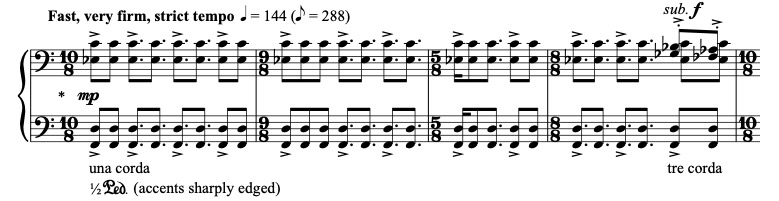
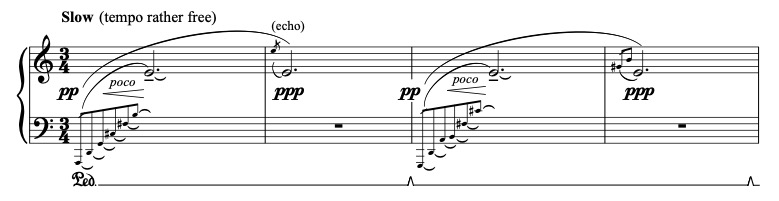
Tone Clock Piece I is the most straightforward of the Tone Clock Pieces. A clear ‘theme and accompaniment’ texture predominates, with the harmony drawn from a single ‘12-note tone-clock steering’ of IX, and a final two-bar ‘coda’ based on its reverse steering anchor-form, IIm4 steered by IX:
Bars
Field
Field notation
1–29
A = [ IX / IIm4 ]
30–31
B = A⇄ = [ ( IIm4✕2 + IIIM4 ) / IX ]
Due to the relative simplicity of the application of tone-clock theory, the piece is saturated with a small number of intervals: open intervals of perfect fourths and fifths and major seconds are particularly prevalent. This saturation remains fairly much in force throughout, although resulting voice-leadings often hint at other intervallic constructions: the triad 1–2 appears in the tenor voices of 8–9 and 13–14, and its related tetrad IIm4 in the same voice in 1–3 and 15–16 (a result, of course, from the underlying steering). IIIm4 appears in the bass voice of 1–3, subliminally relating to the anchor group IIIM4 of Field B, while the triad 2–3 appears in the tenor voice in b. 10 and 22–25.
The rhythmic material displays a great deal of the ‘written rubato’ approach, primarily through flexible subdivisions of minim beats into patterns of 2 (crotchets), 3 (crotchet triplet), 4 (quavers), 5 (quaver quintuplet), 6 (quaver sextuplet), and 7 (quaver septuplet), as well as similar subdivisions of the crotchet beat. These subdivisions often appear next to each other to give the impression of expressively accelerating or decelerating music. A good example appears in the right hand of b. 8: crotchet triplet–quaver quintuplet–quavers (3–5–4). Interestingly, the ‘written rubato’ is coupled with a high number of written tempi changes, primarily rits at phrase endings followed by a tempos.
Registral distribution is fairly conventional, with low bass resonances being used either as emphasis of structural arrival points (such as in b. 15) or cadential phrase-endings (such as in b. 29). The extreme high registers of the piano are not explored in this piece, with the exception of a single chord in the right hand at b. 12. The overall spectral breadth of the piece, therefore, is contained within a span of about 3½ octaves—an almost chorale-like distribution of voices, an unsurprising distribution given McLeod’s background in choral composition.
Tone Clock Piece II
Tone Clock Piece II is of particular interest as it demonstrates that a listener can arrive at quite a different interpretation from that intended by the composer. This is particularly the case here because of McLeod’s intuitive approach to voicing and aggregation, which can sometimes lead to unexpected and unintended groupings. My analysis of Tone Clock Piece II was written before I had consulted the composer’s own sketches, and I discovered that it appeared to vary quite considerably from the actual steering plan used. This might seem like a flaw of tone-clock theory, or, more likely, of my analytical skills, but I think on closer inspection the variation is perhaps not so surprising.
McLeod’s own sketches and analyses illustrate that the piece derives from two fields: Field 1, which, similar to Tone Clock Piece I, features triad IX, this time being steered by IIIm4 (131). Unlike Tone Clock Piece I, however, the steering is not a complete 12-note tone-clock steering: the tritonal anchor A–E♭ is needed to complete the chromatic aggregate, and these pitch-classes feature prominently. Field 2 features exactly the same steering, but with the triadic inversions reordered (mmMM instead of mMmM). It too does not complete the aggregate, this time requiring only a single pc F♯ to form the anchor.
My own analysis interprets the same set of notes differently. I hear an aggregate being formed over the first four bars: IPF 212-212, otherwise known as the diatonic collection26. Indeed, if we take F♯ as being the tonal centre, which it appears to be given its prominence in the opening bars, then we could say the opening passage is in F♯ Dorian (the second mode of E Diatonic). While IPF 212 seems to have a second-hour nature—McLeod calls it a second-hour gemini—it is a multiple-nature hour group, and can be written simply as IX7 (i.e. a stack of seven fourths), which explains its relationship to McLeod’s own original derivation of the set.
To my ears, this larger aggregate is more perceptually ‘audible’ from a structural point-of-view than the lower-level steering of IX, which I do not hear so deliberately articulated on the surface level. In any case, the ambiguity between the two readings is typical of a more complex use of tone-clock theory, where the composer is obscuring the true nature of the original steering.
My analysis, then, is much simpler than McLeod’s. I hear the entire piece as reducible to a single field, formed from the steering of a diatonic scale by a diminished seventh triad:
Bars
Field
Field notation
1–30
A = { IX7 / X4 }
This also gives us some interesting points of note: between the transpositions in bb. 1–2 and 3–4, there are two pc in common (a tritone). These common tones feature at prominent moments, often fulfilling a ‘pivoting’ role between the different transpositions, in much the same way Debussy often uses common pc to ‘pivot’ between different diatonic or modal collections.27
The primary flaw in my analysis is that it fails to recognise the degree to which IX does in fact control much of McLeod’s partitioning and voicing of 212-212. This discrepancy between segmentation of a superset and a subset points to an area of future research: is there a perceptual tendency to collate smaller surface forms into larger background patterns, and, if so, under what conditions does this occur?
Incidentally, McLeod’s analysis demonstrates the use of a permutational technique which she calls ‘intrinsic spin’; discussion of this technique, and the particular perceptual properties of it, are unfortunately beyond the scope of this article.
Tone Clock Piece III
Tone Clock Piece III is by far the most complex of the collection. All twelve hours, except I and IX, are deployed in a kaleidoscope of shifting chromatic colours. The form is tied together primarily by rhythmic and textural means: the additive rhythmic homophony of Section A (bb. 1–29), the open, spacious arpeggios of Section B (bb. 30–35) the chorale-like ‘melody + accompaniment’ of Section C (bb. 36–41, which later incorporates aspects of Section A), and the ‘floating’ quintuplets of Section D (bb. 78–81).
Using this simple segmentation, the form can be summarised as:
ABC–ACB–DBCD–A
Section A opens with the following anchor form, which develops secundal harmony as a key force:
[ ( VI4⤫2 + IIM4 ) / XI ]
The presence of many minor and major seconds imbues the piece with a constant ‘clang’ that only in brief developmental passages unfurls into wider, non-secundal hours (X, XI and XII).
While I undertook my own analysis of this Tone Clock Piece, I couldn’t figure out the relationship between the various fields in the piece. That is because underlying the harmonic structure of this work is a ‘found object’—one that I would have been hard-pressed to have discovered on my own. The steering-groups of this piece are derived from an abstraction of the harmonic structure of Bach’s famous Prelude no. 1 in C major from Das Wohltemperierte Klavier.28
The analysis below—a ‘merger’ between mine and McLeod’s—demonstrates at a glance the complexity and richness of the piece as it traverses almost the full range of hours. As can be seen, McLeod not only uses 12-note tone-clock steerings and anchor forms to generate chromatic saturation, but also so-called ‘dual tonalities’. These are twelve-note sets generated from two transpositions of two different IPFs. (This technique only appears in Tone Clock Piece III.)
Column 1 identifies the range of bars in which the field is used; Column 2 gives the Field name and its tone-clock derivation; Column 3 gives the name of the steering group in conventional Western triadic terms; and Column 4 refers to the bar in the original Bach Prelude from which the chord is derived.
Bars
Field
Field notation
Steering group
Bach bars
1–6
A1 = [ VI4⤫2 + IIM4 ] / XI
C
1
7–9
A2 = [ ( VIII ⤫2 + V ⤫2 ) / VIIM4 ]
Dm7
2
10–13
A3 = [ ( VII ⤫2 + III ⤫2 ) / 233 ]
G7
3
14–17
A1+7
G
3
18–21
A4 = V / VIIM4
Am7
5
22–29
A5 = VIII / IVM4
CM7
8
30–35
B1 = Vm4 / XI
D
10
36–37
C1 = [ ( IVm4⤫2 + IIIM4 ) / XI ]
Dm
13
38–39
C2 = [ IV / X4 ]
°7
12
40
C3 = (VIII / XI) +2-4
C
15
41
C4 = C2 ! (inverted)
°7
14
42–47
A1
C
15
48–50
A4+5
Dm7
17
51–55
A5+5
FM7
16
56–59
A3
G7
18
60–61
A3+5
C7
20
62–65
A5+5
FM7
21
66–67
C1 = (4 / X4) + X4
°7
22
68–69
C2 = C4
°7
23
70–73
C3
C
25
74–77
B2 = A3
G7
26
78
D1 = A3
G7
27
79
D2 = [ XII / X4 ]
°7
28
80–81
D3 = A3+5
C7
32
82–83
B3 = B1+4
F
33
84–85
C5 = C2-4
°7
?
86–87
D4 = A3
G7
34
88–100
A1!
C
35
To the listener, there might appear to be no discernible pattern to the progression of tone-clock collections. It is possible we might identify predominant interval classes as being ‘bunched’ together, binding otherwise disparate collections. For instance, many of the fields in Section A seem to contain the major second (ic2), while a second group of fields featuring the minor second (ic1) follows in Sections B and C (30–42); and the final section from 66 until the end features the major third (ic4)29. Using a prominent interval as structural demarcation is certainly not unusual in the Tone Clock Pieces; nevertheless, the degree to which the idea is developed to knit together otherwise unrelated collections is unprecedented. I would argue that although the Bach-derived ‘deep structure’ is interesting, it is, most likely, perceptually insignificant. The surface level intervallic constructions are more immediately ‘form-creating’ in terms of perceptual linkages formed by the listener between different materials. Nonetheless, I would argue that we do get a sense of harmonic narrative, as the music ranges from relative consonance through an extended passage of dissonance and chromatic complexity, resolving in a passage of relative ‘stasis’ and sense of resolution. It is true, however, that McLeod does in the latter bars attempt to bring out an extended IV–V–I cadence: this starts at b. 82 with an emphasis on F, A and C, followed by G–B–D–F outlined in b. 86, and the pedal point C throughout the last page.
Tone Clock Piece IV
Tone Clock Piece IV uses the symmetrical tetrad VIIm4 as its primary material. In Field A, this hour group is steered by a major third, aggregated to form a symmetrical octad (221-1-122), which constantly reappears, arpeggiated, as a two-bar refrain throughout the work (McLeod calls this the ‘sea chord’). She also draws attention to the constituent IX chords, by partitioning 221-1-122 using two IX chords and an XI chord (E major).
In McLeod’s own analysis of this work, she shows how in fact Field A was derived from a steering of IX4—the reason for my differing analysis is that IX4 is a multiple-nature hour group, as a stack of fourths can be reduced to 232 (VIIm4). So, my analysis is not ‘wrong’, but shows how some IPFs can be heard and expressed in multiple ways, each equally valid.
Field B1, which responds to the sea chord as a kind of chorale-like setting, features the same tetrad VIIm4, but this time steered by a semitone. Other fields are generated using different steerings and alternative aggregations of VIIm4: eventually, the full field is revealed in b. 9, a steering of VIIm4 by IIm4, the steering group including both the major third and semitone intervals that constituted the earlier steering groups.
Bars
Field
Field notation
1–4
A = VIIm4 / 4 = 22-111-22; partitioned as ( IX ⤫2 + XI ) / XI
5–6
B1 = VIIm4 / 1
7–8
A
9–11
C1 = { VIIm4 / IIm4 }
12–13
A
14–15
D1 = ✂ C1 = ( VIIm4 / 3 )
16–17
A
18–19
B1
20–23
C2 = { VIIm4 / X4 }
24–25
A
26–31
C1
32–37
A
McLeod’s own analysis is similar: an opening field of VIIm4 / XII, a second 16-note field of VIIm4 / IIm4, and a third 16-note field of VIIm4 / X4 (my only disagreement then being with the interpretation of Field A, a fairly minor point). The technique of IPF superposition is demonstrated in bb. 22–23, where two transpositions of VIIm4—(C♯, D♯, F♯, G♯) and (G, A, C, D)—are superimposed and revoiced to create two transpositions of Vm4, developing ‘closer’ semitonal harmonic elements from the otherwise open intervals of VIIm4. This passage acts as a subtle ‘mini-climax’, a point of somewhat higher tension in an otherwise refined and unruffled calm. The other example is in bb. 27–30, where two transpositions of VIIm4—(C♯, D♯, F♯, G♯) and (B, C♯, E, F♯)—are voiced in such a way as to bring out the new melodic colour {B, D♯, E, G♯} = IVM4, another semitonal tetrad30.
Tone Clock Piece V
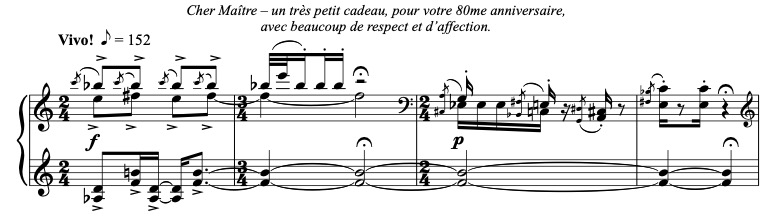
Tone Clock Piece V, subtitled ‘Vive Messiaen!’, is a brilliant and colourful tribute to McLeod’s ‘maître’, with numerous small nods toward the thumbprints of Messiaen’s langage musical—most notably the birdsong-like melodic patterns of the first subject.
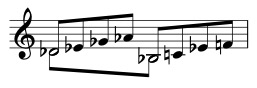
The form can be characterised as a quasi-rondo form (or, perhaps, a double ternary form): ABA-ABA. The A material is based on the opening IPF in the right hand, constructed from two tritones a major second apart. This forms tetrad VIIIm4, a subset of Messiaen’s Mode I (the whole-tone scale). Another transposition of VIIIm4 in the right-hand at b. 3 combines with the first to form a complete Mode II (the octatonic scale). Other intervallic constructs become important later on, particularly the IPF VIIm4 and the augmented triad (4-4), both seen emerging in b. 19.
The chromatic complement of the octatonic scale is the diminished seventh chord. McLeod uses the two VIIIm4 transpositions plus the diminished seventh in a typical anchor group form (A1), after which she proceeds to put the octatonic scale through the remaining two possible transpositions, varying Field A by transposing it down consecutive semitones:
Bars
Field
Field notation
1–6
A1 = [ ( VIIIm4⤫2 + X4 ) / IIIM ]
7–10
A2 = A1-1
11–14
A3 = A1-2
15–18
A1
In the B section starting at b. 19, a new field in the right hand—a 12-note tone-clock steering of VIIm4—is accompanied in the left hand by the field’s own ‘reverse steering’. The right-hand field does not completely unfold, however: the full field will not be heard until much later in b.79. After this B section, there follows a series of vacillations between the three A fields (with a short interruption from the B2 field). Due to space reasons, I am unable to go beyond the simple analysis below, which does not quite do justice to the various aggregations and revoicings that McLeod puts them through (such as the emergence of (4 / X4) in b. 38):
Bars
Field
Field notation
19–23
(RH) B1 = [ VIIm4 / XII ] (incomplete: A♭ & E tetrads only)
(LH) B2 = B1⇄ = XII / VIIm4
24–29
B2
30
A1
31
B2
32
A3
33–36
A2
36–38
A3
39–40
A2
At b. 41 we return to the opening material and the opening field, although the pcs McLeod chooses are in a different order than its first appearance at b. 1. This is followed by a reordering of A2 in which the tritonal relationships from the opening are brought out:
Bars
Field
Field notation
41–46
A1
47–52
A4 = A2 ! = [ ( 6 / X4 ) + ( 6 / 5 ) ]
53–62
A5 = [ ( VIIIm4⤫2 + Vm4 ) / IX ] ( = A4+5 )
63–78
A3
The B section returns with a fairly conventional re-establishment of the B fields, where we finally hear the complete tetradic 12-note tone-clock steering:
Bars
Field
Field notation
79–83
(RH) B2
(LH) B1 (complete 12-note tone-clock steering)
84–85
(RH) B1 (incomplete: C tetrad only)
(LH) B2 (incomplete: A and D triads only)
86–88
B2
The final refrain is followed by a coda featuring various reorderings of the original Field A to bring out new intervallic features, particularly major thirds and tritones. A6 and A7 are formed by exchanging the pc C♮ and E♮ in the first IPF with E♭ and G♮ in the second IPF:
Bars
Field
Field notation
89–99
A1
100–104
A6 = A1 ! = [ ( 4 / X4 ) + X4 ]
105
A4
106–107
A7 = A6 = A1 ! = [ IIIM4⤫2 + X4 ] / VIII
Tone Clock Piece VI
After the brilliance and vitality of Tone Clock Piece V, Tone Clock Piece VI returns to the more serene waters of earlier pieces. In this case, the anchor form is extremely clear: the left-hand chords in bb. 1 and 2 derive from a single hour-group, VIIM4, 31 while the right hand plays the symmetrical anchor IIIM4. From bb. 8–20, however, things become a little more complicated. According to McLeod’s analyses, the left hand uses an aggregate of two VIIM4 IPFs (transposed up a fifth), but reordered to create a new field. The open fifths, however, are voiced and grouped in such a way that we might be tempted to interpret this passage as simply a sequence of symmetrical, but otherwise unrelated tetrads, even though this does not conform to a typical tone-clock field construction.
Bars
Field
Field Notation
1–7
A1 = [ ( VIIM4⤫2 + IIIM4 ) / V ]
8–20
B1 = A1!+7 = [ 7 / IIm4 + IIIM4 ]
(alternative reading)
B1 = [ ( IVM4 + VIIm4 + IIIM4 ) / V ]
According to McLeod’s analysis, from bb. 21–24 the original transposition of the VIIM4 IPFs returns, albeit reordered. On the other hand, we might simply choose to interpret the reordering as a ‘revoicing’ of A, or a deliberate ‘playing’ with the effects of proximity. This is a good example of a passage in which it is unclear whether or not a new field has truly been introduced. From bb. 25–28, Field B1 returns, followed by a short passage featuring A1 (bb. 29–30). At b. 31, we seem to be getting a repeat of B1, as the same IIIm4 anchor group is heard (A♭, B, C, E♭). However, the shell has in fact been reordered. An IPF analysis quickly shows us that this is, in fact, just a transposition of Field A1. The last 4 bars of the piece are codetta-like, featuring the anchor group from B1 and A2 now becoming the shell of a new 13-note anchor form:
Bars
Field
Field Notation
21–24
B2 = A1! = [ 7 / IIm4 + IIIM4 ]
25–28
B1
29–30
A1
31–33
A2 = B1 ! = A1-5
34–37
C = { ( IIIM4 + 1441 ) / V }
No matter how you interpret the specific tone-clock configurations of this piece, the macrostructure is fairly clear:
ABB ́–BAA ́–C
Tone Clock Piece VII
Common-practice major and minor triads form the primary material in Tone Clock Piece VII. However, their treatment is very different from common-practice tonal procedures, controlled instead by tone-clock steering principles.
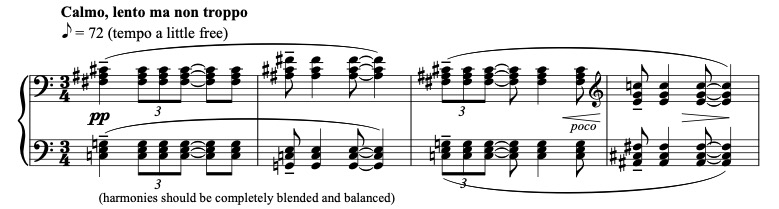
The first subject comprises a 12-note tone-clock steering formed from four triads—two major and two minor—presented in a homophonic, parallel ‘planing’, reminiscent of writing found in the preludes of both Debussy and Messiaen:
|
The major triad has the tessellation property that it can only be tone-clock steered through ‘TI-tessellation’: that is, the inversion, the minor triad, must be used. Therefore, in this case, we have the following series of triads:
C maj, F♯ maj, D min, A♭ min
McLeod combines pairs of triads a tritone apart to form a subset of the octatonic scale, IPF 1231232 . Both the use of IPF VIIIm4 and the overriding octatonic flavour relate back to material found in the opening of Tone Clock Piece V. In bb. 11–12, the same triads appear, although transposed by a fourth. Following this short passage, the subject area B appears, comprising two fields: Field B1 , the steering partner of A1 , and B2 , a transposition of B1. B1 shares the same construction as Field A5 in Tone Clock Piece V. The rhythmic material is developed from multiples of semiquavers, drawn from the Fibonacci series (1, 2, 3, 5, 8, 13):
Bars
Field
Field Notation
1–10
A1 = [ XI / VIIIm4 ]
11–12
A2 = A1+5
13–17
B1 = A1⇄ = [ ( VIIIm4⤫2 + V4 ) / XI ]
18–20
B2 = B1+5
21–23
✂ B1 = ( V4 + VIIIm4 ) / 3
At b. 24, we return to Subject A material, although the A1 and A2 fields are revoiced to bring out an underlying structure based on perfect fifths. Note that the aggregate of A3 is also a mode of limited transposition, the hexatonic scale.33
The final section, marked Tempo primo, recapitulates the two generative fields, A1 and B1, in a delicate oscillation:
Bars
Field
Field Notation
37–40
B1
41–44
A1
45–46
B1
47–48
✂ A1 = XI / 6
The ‘blending’ of A and B material at the end makes for a twist on a conventional ternary form: ABA’’-C, where C is formed from quick successions of A and B material.
Conclusion
These analyses only scratch the surface of this complex and beautiful music, and its complex and beautiful theory. Although I have chosen to focus primarily on the technical constructs, I acknowledge with some regret that there is not time or space enough to thoroughly delve into areas such as phraseology, rhythmic structure, texture, tension and release, voice-leading, and ‘deep structure’. These aspects will, I hope, be picked up by other authors. A contextual view of the impact of Jenny’s introduction of tone-clock theory to an Australasian audience would also be timely. Sadly, it seems unlikely the tone-clock theory will ever replace pc set theory in musicological journals as the analyst’s terminology of choice. Nevertheless, to those who choose to absorb even some of its basic lessons, tone-clock theory will leave permanent imprints on their harmonic organisation, most notably in its insistence on the economy of intervallic content and its exploration of the alluring effects of musical symmetry, while advocating a colourful exploration of multiple chromatic transpositional levels.
Bibliography
Boulez, Pierre. Penser la musique aujourd’hui. Gonthier. Geneva, 1963.
Croft, John. ‘Earth and Sky: The Music’, Music in New Zealand, Spring 1993. pp. 20–24
Forte, Allen. The structure of atonal music. Yale University Press, 1973
McLeod, Jenny. Tone-Clock Theory Expanded: Chromatic Maps I & II. Unpublished (available as a free download from https://sounz.org.nz/resources/448)
—. 24 Tone Clock Pieces. Score. Wai-te-ata Music Press.
Schat, Peter. (trans. McLeod). The tone clock (Contemporary Music Studies, Vol. 7). Harwood Academic Publishers, 1993.
Xenakis, Iannis. Formalized Music: Thought and Mathematics in Composition. Bloomington and London: Indiana University Press, 1971.
Footnotes
This essay should be read in conjunction with the score and CD published by Wai-te-ata Music Press. Many thanks to Jenny McLeod for sharing her analyses and other sketches with me. ↩︎
The question of whether or not it constitutes a genuine ‘theory of music’ is interesting, though beyond the scope of this article. Schat was uncomfortable with the term, and although McLeod introduced the term ‘tone-clock theory’, she acknowledges that “my thinking became less and less of a ‘theory’, as something ‘different from’ or ‘opposed to’ other theories.” [McLeod, unpub.], p. xiii ↩︎
See [Schat, 1993] and [McLeod, unpub.]. Schat, a pupil of Boulez, and McLeod, a pupil of Messiaen, met at a festival in Louisville, 1987, and became close friends. It has been pointed out, however, that McLeod was subconsciously using tone-clock principles as early as 1968, prior to her even meeting Peter Schat [Croft, 1993] ↩︎
Given that McLeod was a pupil of Messiaen’s, it is not surprising that certain of Messiaen’s harmonic, rhythmic and colouristic ideas should have found their way into her musical language. ↩︎
McLeod’s own performance directions bear out this interpretation: in Tone Clock Piece III she provides the performance direction ‘living crystal’. ↩︎
See [Forte, 1973], pp. 11–13. Although Forte does not actually use the term ‘set class’ in this early text, the method of identification is the same. ↩︎
‘Moveable-doh notation’. McLeod dislikes this notation with some passion, arguing that it seems faintly ludicrous to be alluding to solfège in an atonal context. ↩︎
See [Schat, 1993] for the initial, somewhat overwrought promulgation of his ideas. Also see my article ‘Tessellations and Enumerations’ for a thorough explanation of the maths and geometry behind this concept. ↩︎
Namely, Messiaen’s modes of limited transposition [Messiaen, 1956], Boulez’s frequency multiplication [Boulez, 1963] and Xenakis’s sieve theory [Xenakis, 1963]. ↩︎
McLeod does not refer to the ‘set class’ in her writings. ↩︎
Actually, Forte’s ‘interval vector’ gives probably the most useful guide to harmonic ‘flavour’. It has the distinct disadvantage, however, of being rather labour-intensive to calculate and less easy to interpret at a glance. ↩︎
As I point out in my article ‘Tessellations and Enumerations’, because 12÷3=4, the triads have the most tessellation possibilities in the chromatic scale, making them the most interesting to Schat and McLeod. ↩︎
This can be a useful developmental procedure, however. ↩︎
Although, not always. As we will see, comparison between my analyses and those of McLeod raised several interesting discrepancies in segmentation and interpretation of pc sets. ↩︎
Webern’s Concerto Op. 24, for example, is based on a tone row comprising a cell of a semitone plus minor third transposed four times. This row therefore conforms to the principle of a 12-note tone-clock steering, even though it was not conceived of in these terms. The treatment of the row, however, follows correct serial ordering principles, which a true tone-clock piece would not. ↩︎
Hence Webern’s attempt to create rows that have a highly limited set of intervals. This has the side-effect that many of his rows conform to tone-clock principles. ↩︎
A full list is given in the article ‘Tessellations and Enumerations’ ↩︎
With one exception: the diminished triad (X), the only triad not to possess this property. Rather than leave an unsightly gap on his diagram, Schat ‘cheats’ by replacing the triad with its related tetrad, X4 (a diminished 7th chord), which does possess this property. Drawing based on diagram by Peter Schat in [McLeod, unpub.] and www.peterschat.nl↩︎
In some cases, the reverse steering will be a complete 12-note tone-clock steering—this will only occur if transposition alone was used in the original steering. If inversion is used as well, then the reverse steering will be an anchor form. See my article ‘Tessellations and Enumerations’ for more information. ↩︎
In one of the analyses below, I argue that the steering groups can in fact become quite audible through voice-leadings. ↩︎
If too many rapidly superimposed transpositions and inversions are used, then a sense of ‘field’ might not be audible. ↩︎
[McLeod, unpub.] p. 124. The set of IPFs to the left of the anchor are called the ’lower shell’, the set to the right called the ‘upper shell’. ↩︎
The initial published version of this article only used IPF notation, and did not adopt the Roman numeral (hour) notation of the IPFs. In this revision, however, I have adopted them, as I find their simplicity and abbreviations helpful. ↩︎
Or, as McLeod calls it, a ‘second-hour Gemini’. A discussion of so-called Gemini sets can be found in [McLeod, unpub.], p. 12. ↩︎
A good example is of this practice is ‘Des pas sur la neige’ from Preludes, Book I. ↩︎
The derivation is not literal: repetitions of a chord within a section are ignored, and, as can be seen from the last column in the analysis, the chords are also occasionally out of sequence. ↩︎
Even the major seconds of Field A1 are reordered on the last page to feature major thirds instead ↩︎
In McLeod’s analysis, she refers to this as XI4 (343), which is a multiple-nature hour group, and is in fact the same as VIIM4 (one could argue that VIIM4 is technically the more ‘compact’ form). ↩︎
Incidentally, the only asymmetrical mode of limited transposition. See McLeod, unpub., p. 48 ↩︎
One of the few so-called ‘EDO cluster-scales’. See following article. ↩︎