This chapter was originally published in Searches for Tradition: Essays on New Zealand Music, Past and Present, Te Herenga Waka Press.
Like many composers of the mid-twentieth century, Douglas Lilburn had a complex and constantly evolving harmonic practice. From the lush modalities of his Symphony No. 1 (1949), to the folk vernacular of Sings Harry (1953), to the taut serial procedures of Symphony No. 3 (1961), to the voltage-controlled electronic dronescapes of Soundscape with Lake and River (1976), Lilburn constantly reassessed his approach to pitch organisation.
Throughout these seismic shifts in musical language, however, Lilburn maintained several harmonic constants. Firstly, even when his musical surfaces became increasingly chromatic, even serial, he imbued his lines and rows with triadic and scalar elements. Secondly, he continued to be fascinated by the sonic frisson of dissonances generated by the juxtaposition of ostensibly consonant elements. This juxtaposition often took the form of harmonic stratification, a technique of delimiting musical activity into registrally distinct layers that, while possessing unambiguous internal tonal identities, create a certain tension and ambiguity when superimposed due to their conflicting harmonic logics.
While biographer Philip Norman divides Lilburn’s output into three periods of distinctly different musical styles—namely, the ’nationalist period’ (1936-55), the ‘international period’ (1956-65) and the ’electroacoustic period’ (1965-80)1—harmonic stratification provides a common thread of sonic and expressive preferences across these stylistic divisions, even though the specifics of language, material and sound generation vary dramatically. It is particularly useful in accounting for the radically different musical vocabulary of his late works, with their resonant, spacious chromaticism, wide registral separation and unresolved ‘drones’; from the perspective of harmonic stratification, these works can be understood as more of a logical evolution rather than as a profound break with his earlier style.
Harmonic Stratification in the Early Twentieth Century
The seeds of Lilburn’s stratified approach can be found in the music of prominent British composers of the 1920s-40s, especially Ralph Vaughan Williams, Gustav Holst and Benjamin Britten, to whom he was clearly indebted in his early compositions. Along with his other primary influences, Jean Sibelius and Aaron Copland, these composers shared a harmonic conception that, while predominantly scalar and triadic in nature, was strongly informed by the post-tonal developments of the Franco-Russian school in the late nineteenth and early twentieth centuries.2 These developments included: a) the expansion of scalar resources beyond the standard major and minor scales, particularly focusing on modes of the diatonic collection,3 as well as occasional use of more exotic collections such as the whole-tone, octatonic, hexatonic and acoustic scales;4 b) the deployment of triadic harmonies in parallel motion, often occurring over static and/or tonally conflicting pedal points;5 c) a disjunct relationship between the tonal implications of the bass register and that of the upper structures, often deriving expressive, local-level dissonances from a deliberate conflict between the two.
These latter two developments are typical of much of Lilburn’s harmonic practice, where internally consonant material in one voice is superimposed over internally consonant material in another voice, but forming an aggregate dissonance. Norman refers to this practice in Lilburn’s early works as ‘root substitution’,6 in which a triad or third in the upper voices is placed over a dissonant bass tone, usually forming an aggregate seventh or ninth chord. Unlike standard common-practice part-writing, in which voices work together to reinforce the overall tonal logic, stratified part-writing results from the friction produced by each stratum’s perceptual autonomy.
In order to characterise the development of Lilburn’s harmonic stratification throughout his career, it is useful to analyse both the way in which strata are juxtaposed as well as the materials from which they are formed. The way these two parameters interact can be summarised in four categories of stratification: 1) modal-conjunct stratification, in which strata are drawn from a single scale (typically a mode of the diatonic collection), but form regular dissonances against each other and emphasise different tonics; 2) modal-disjunct stratification, in which strata derive from different scalar collections (bitonality would be considered an example of this); 3) chromatic-conjunct stratification, in which strata derive from a single chromatic (non-scalar) collection; 4) chromatic-disjunct stratification, in which strata derive from highly contrasted, or even mutually exclusive chromatic collections. While we can devise more detailed and specific categories beyond these four to deal with much more chromatic and complex music of the twentieth century, these categories will suffice to clarify the main developments of Lilburn’s harmonic practice.
Within each of these basic categories, we can further identify a continuum of complexity, depending on the number of interacting layers and the degree to which they reinforce or conflict with one another’s collections. For instance, the simplest and most prevalent form of stratification is a basic two-part texture, in which the bass line displays a tonal logic at odds with the upper structures. At the other end of the spectrum, however, multiple strata might interact in tonally complex ways, as in the works of Lutosławski such as Mi-Parti, Jeux Venitiens and Chain 3, where twelve-tone, fixed-register aggregates are formed from multiple timbrally contrasting strata.
In addition to the quantitative nature of the textural complexity, we can also differentiate between qualitative assessments of the degree of conflict and tension produced by stratification: we might, for instance, talk about ‘weak’ stratification, in which collections are the same or relatively close in pitch-class content, vs. ‘strong’ stratification, in which disjunct collections are highly contrasted in pitch-class content. Other musical characteristics such as the degree of registral separation, timbral contrast and rhythmic conflict further contribute to the perceived ‘strength’ of the stratification.7 Throughout this article, I will allude to this ‘strength’, which can be taken to mean a subjective assessment of the autonomy and contrast inherent in the strata.
In order to understand how Lilburn deployed these different approaches to harmonic stratification, it is useful first to examine a potentially influential piece written by Lilburn’s teacher. Ralph Vaughan Williams’ Symphony No. 5 provides a clear example of harmonic stratification in action; and given it was composed from 1938-43, during which time Lilburn was studying with Vaughan Williams in London, it may even have had a decisive impact on the young student.
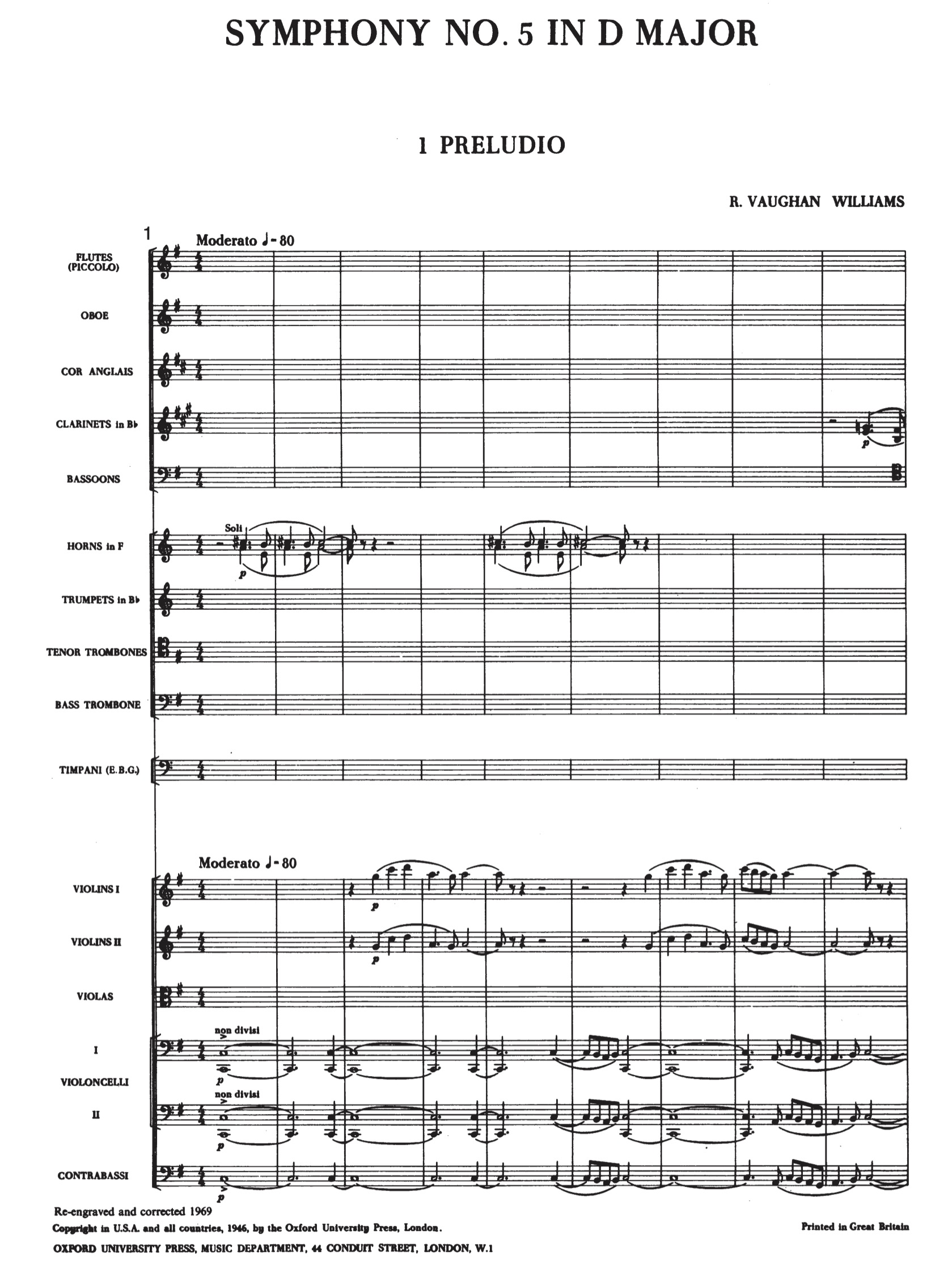
Ex. 1 depicts the unsettled tonal environment of the opening: the horns, which through a ‘Lebewohl’ motif outline a clear D major tonality, are placed in gentle opposition to the competing tonal logic of the bass line, which gravitates instead around the note C and, occasionally, its submediant A. This instability is heightened by the fact that an F♯ is placed in the first horn, forming a tritone relationship with the low strings. When the violins enter in b. 3, their line seems to provide further reinforcement of the A Dorian suggestions of the bass line, although the presence of a D at the melodic highpoint of the first phrase also provides a whiff of D minor, which, as it turns out, will become the tonic key by b. 12. Even though the opening is an example of relatively weak stratification, in that the stratification is modal-conjunct—the aggregate collection being G Diatonic, from which the D Mixolydian and A Dorian modes are drawn—these multiple centres of tonal gravity pull our parsing of this passage in different directions, creating a sense of floating instability.
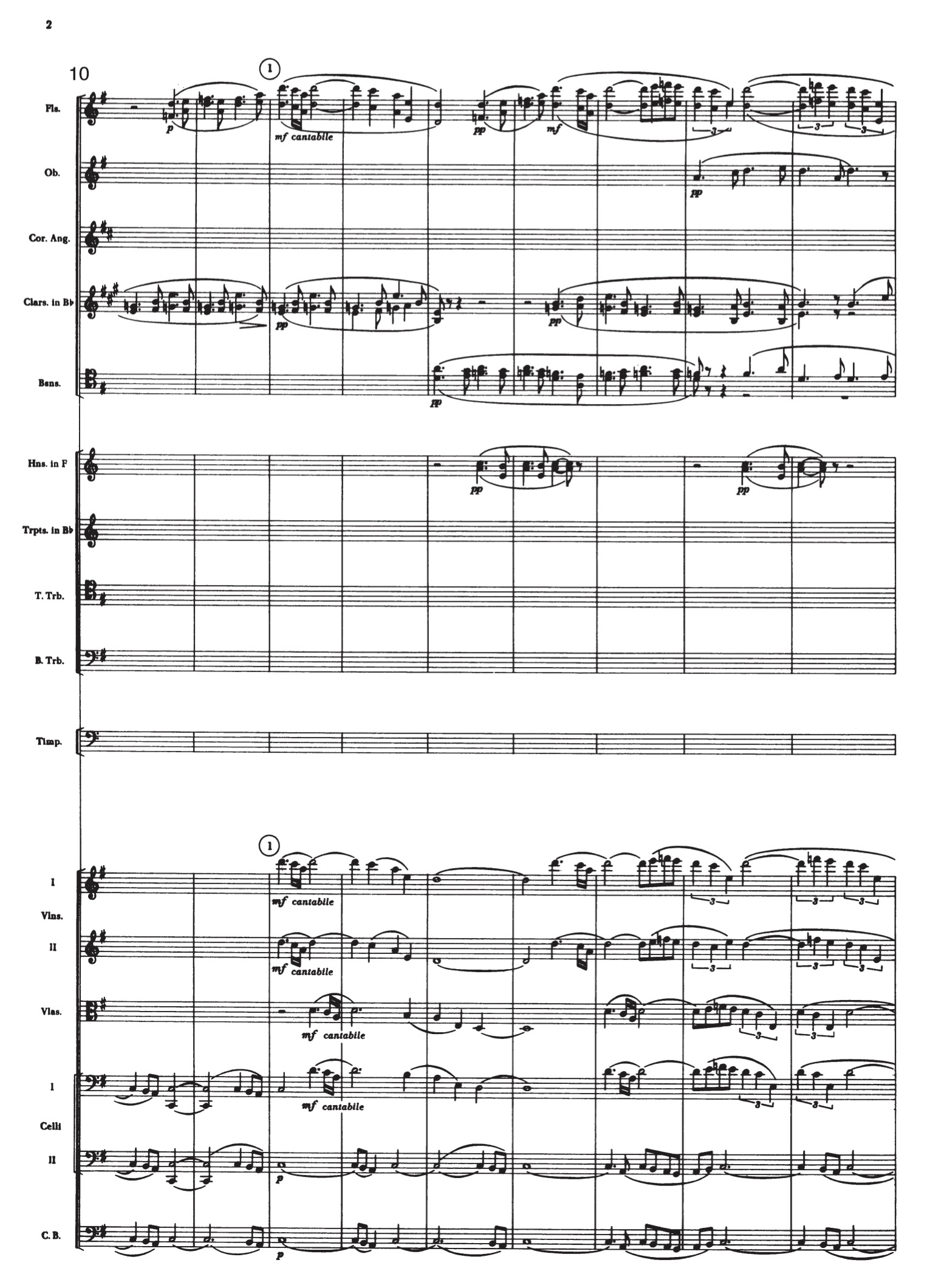
When the main subject enters at rehearsal mark 1, it does so in a clear D Dorian mode (see Ex. 2). Once again, however, the bass line continues to gravitate around the notes C and A, although the shift to the Dorian mode softens the inherent tension of the stratification, due either to the lack of tritone relationship between bass and treble, or to the fact that Aeolian and Dorian-mode English folk songs are considerably more common than those in the Mixolydian mode.8
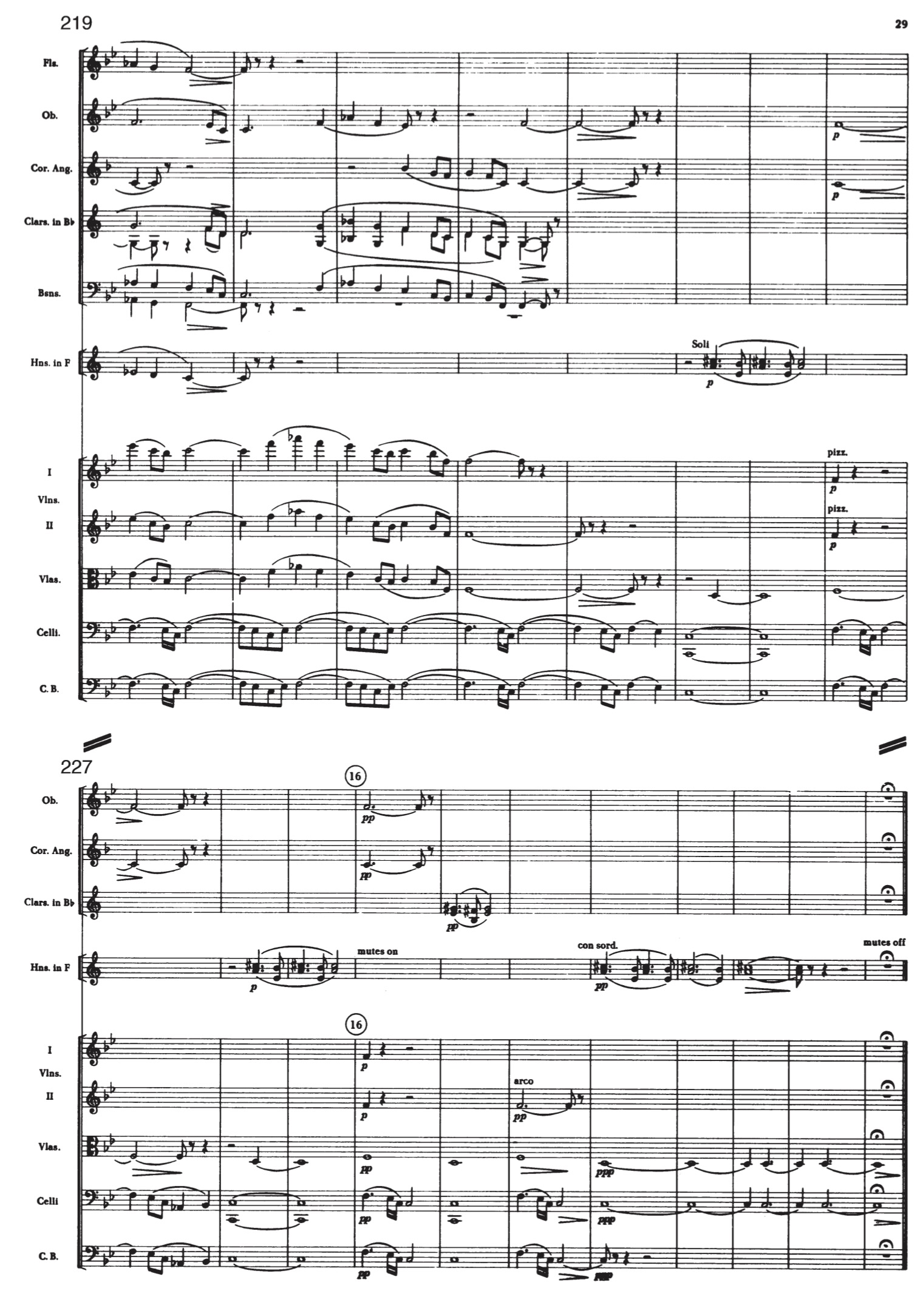
At the end of this movement, Vaughan Williams returns to the opening material, but intensifies the tonal conflict by moving from modal-conjunct to modal-disjunct stratification. Ex. 3 depicts how the D major ‘horn call’ motif of the opening returns, this time superimposed above a bass stratum that outlines C Aeolian, which differs from D major by five pitch-classes. The ‘home’ collections of these two modes are D Diatonic and E♭ Diatonic respectively, which are as harmonically distant as any two heptatonic scales can be.
Similar harmonic predilections in the music of the first half of the twentieth century have been extensively examined by music theorists such as Donald Zent (on the role of harmonic stratification in the music of Karol Szymanowski), Pieter Van den Toorn (on registral layering and modal-disjunct stratification within The Rite of Spring), Elliot Antokoletz (on the use of boundary intervals to control chromatic textures and inversional symmetries in the music of Béla Bartók) and Philip Rupprecht (on the role of harmonic stratification and ambiguity in the music of Benjamin Britten).9 Bartók and Stravinsky are particularly notable for their numerous innovations in the increasing autonomy and chromaticisation of textural strata, which led to the sonoristic layering techniques of composers such as Lutosławski, Ligeti and Penderecki in the 1960s.10 As I will examine later, Lilburn’s own musical developments in the 1950s reflect some of these musical innovations, most notably in the move away from Vaughan Williams’ use of modes of the diatonic collection and modal-conjunct stratification, towards the more symmetrical, intervallically conceived modal-disjunct and chromatic-disjunct techniques associated with Bartók’s and Stravinsky’s harmonic vocabularies.
Modal-Conjunct Stratification in Lilburn’s Early Period
In his early period, Lilburn generally adopted Vaughan Williams’ macroharmonic modality, showing a particular preference for the major, Dorian, Lydian and Aeolian scales, with occasional appearances from other scales such as the melodic minor and whole-tone scales.11 While melodic lines often appear harmonised in parallel thirds or triads in the upper voices, a typical Lilburnian technique is to superimpose these chords above either a static pedal point or a bass line that descends through a tetrachord, passing through different degrees of consonance and dissonance against the upper structures along the way. Norman describes the practice thus: ‘A particular characteristic of Lilburn’s harmonisation is the clear distinction made between his bass lines and his upper harmony. His bass lines move freely underneath, and often in contrary motion to, his upper lines, which frequently show evidence of parallelism. It gives rise to a most characteristic facet of Lilburn’s harmony: that of the triad stated above a bass note not part of that triad.’12
A canonic example of this occurs at the very opening of Overture: Aotearoa (1940). As seen in Ex. 4, the piece opens unambiguously in B♭ major, moving from chord I to an implied chord IV on the third beat of b. 3. But on beat 4, Lilburn introduces a sustained F in the bass, dissonant to the implied E♭ chord above it.
Notice that the bass note enters after the E♭ chord has already been sounded. This is another common move of Lilburn’s: a non-harmonic bass note will either enter after the upper structure has already been established or will slide by step underneath a sustained upper structure to form a dissonance. Furthermore, by using conventional signifiers of harmonic function in the lines, such as stepwise motion between scale degrees 1, 3 and 5, each stratum attempts to reinforce the centrality of its own harmonic identity. These deliberate conflicts create expressive tension from the uncertainty in the listener’s perceptual parsing of harmonic expectation.
In b. 4, the music proceeds by way of another Lilburn trope: the bass line descends through a tetrachord, the second and third note of which are dissonant to the upper structures above it. The final note lands on a C, which, together with the E♭ and G above it, finally forms a root-position chord (C minor). But this appearance of a root-position chord does not last long; in bb. 6 and 7, the upper structures begin to gravitate towards a G minor interpretation. When overlaid above the C, this forms a ninth chord with the third absent, a typical Lilburnian sonority.
Modal-Disjunct Stratification in Symphony No. 2
While in the early works, both bass line and upper structures tend to derive from the same collection, by the early 1950s Lilburn had developed a more disjunct conception of harmonic stratification, moving away from the softer dissonances of the modes of the diatonic collection, into more strident semitonal conflicts and greater collectional ambiguity.
The third movement of the Symphony No. 2, for instance, is a masterclass in semitonal tension, which Lilburn establishes between otherwise consonant and internally coherent strata. The greater degree of dissonance arises primarily from the fact that the upper and lower strata derive not from the diatonic collection, but from the hexatonic collection,13 which contains a high number of semitones. As can be seen in Ex. 5, the movement opens with a D pedal, above which a B minor triad gradually emerges. In b. 3, the B minor chord shifts to Eb major, a disjunct chromatic mediant; the aggregate of these two chords, {B, D, Eb, F♯, G, B♭} is the HEX(2,3) collection.14 The subsequent triadic move, still over the D pedal, is between G♭ major and D minor, and again, the aggregate of {D♭, D, F, G♭, A, B♭} forms a hexatonic scale, this time HEX(1,2).15
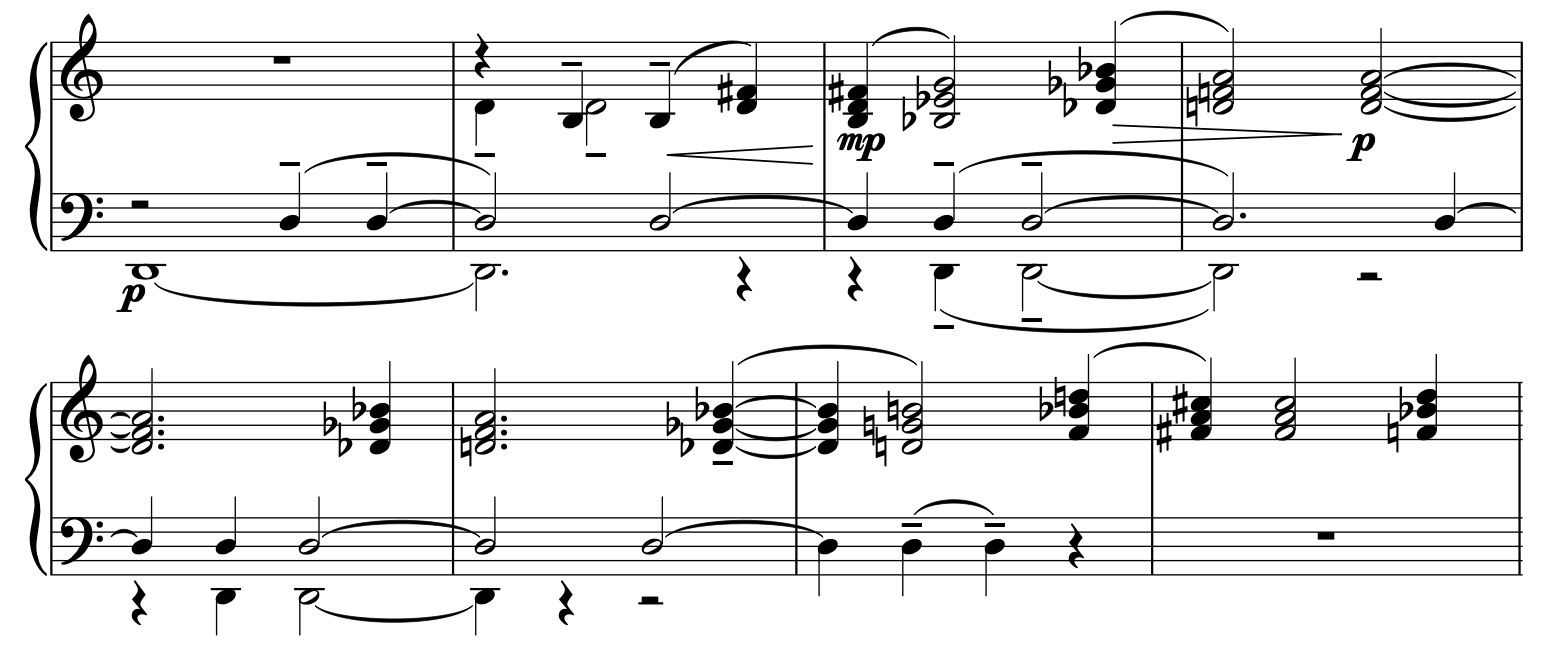
While the pedal tone and upper structures here both derive from the same hexatonic collection, there are examples later in the movement in which there is clear modal-disjunct conflict between the strata, resulting in potent expressive tensions. The final bb.of the third movement provide an evocative example (see Mus. Example 5.6). In b. 72, a clear cadence in B minor seems to establish the final key area, but two bb.later the second violins slip softly onto a D♯ while the basses stay resolutely on their D§, generating a pungent major-minor frisson. The basses then slip down to a C, a tone foreign to both B minor or B major, briefly eliciting another sharp dissonance of B major over a C bass. The C then steps down again to B, which finally would seem to reinforce the B major tonic. But Lilburn is not done with this passage yet: the bass line continues to descend, now to an A. Finally, the basses come to an uneasy rest on G, above which the upper strings’ B major chord continues to float, untethered and brimming with agitation. This produces an inherent perceptual disagreement between the lower stratum’s semantically loaded cadential trope of a descending 5-1 scale in G major, pitted against the intransigent B major triad in the upper stratum. The expressive impact of this passage derives precisely from these harmonic contradictions, and sets up the fourth movement with an imperative for resolution.
Symmetry and Stratification in Symphony No. 3
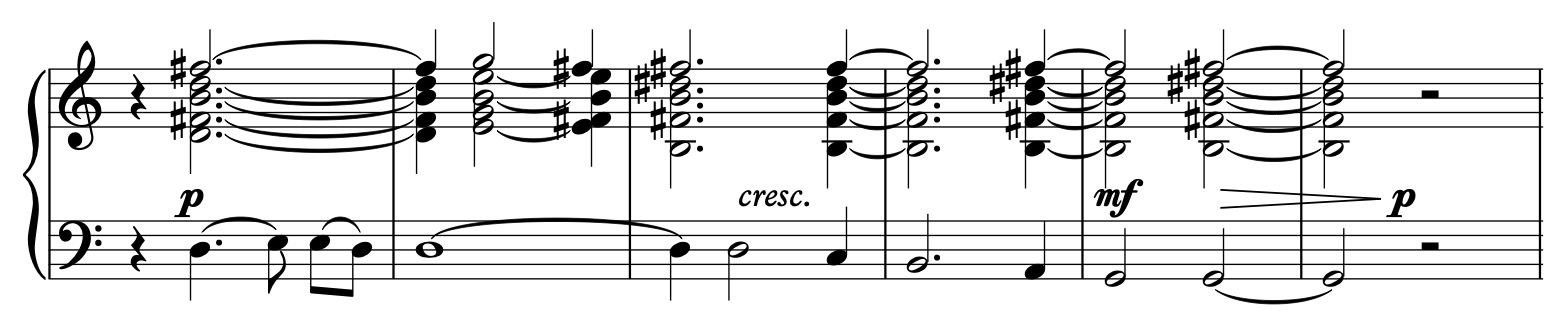
Composed in 1961, Symphony No. 3 represents a substantial shift away from both modal and triadic harmonic materials. Showing a clear indebtedness to the intervallic and fugal constructions in Béla Bartók’s Concerto for Orchestra (1943), it provides some of the most contrapuntal and linear writing in Lilburn’s oeuvre. While the symphony has been shown to have an ostensibly quasi-serial organisation,16 Lilburn ‘stacks the deck’ by imbuing the row with four trichords that clearly reference triadic and scalar materials.17 The pitch series {D, E, G, A♭, B♭, D♭, A, F, C, E♭, F♯, B} can be read as two trichords that hint at G major/pentatonic and D♭ major/pentatonic respectively,18 followed by an F major triad and a B major triad. It is also notable that the two constituent hexachords form an octatonic subset. Therefore, despite the serial nature of the harmonic organisation, the Symphony nevertheless retains vestiges of triadic and scalar materials, albeit in a rapidly shifting, unstable chromatic context.
Although in this work Lilburn largely avoids sustained chords that might provide evidence of a clear stratified approach, there are enough brief passages in which vertical aggregates are built up and sustained, that we can glimpse how Lilburn’s musical materials were moving away from the modal-conjunct writing of Vaughan Williams and Sibelius, into the world of symmetrical-scale disjunct construction, as seen in the music of Bartók, Stravinsky and Messiaen.19
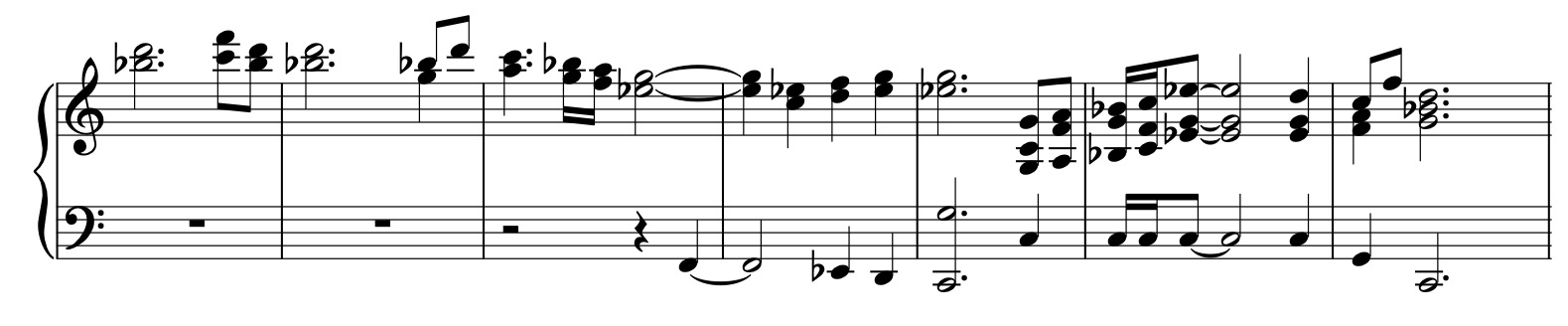
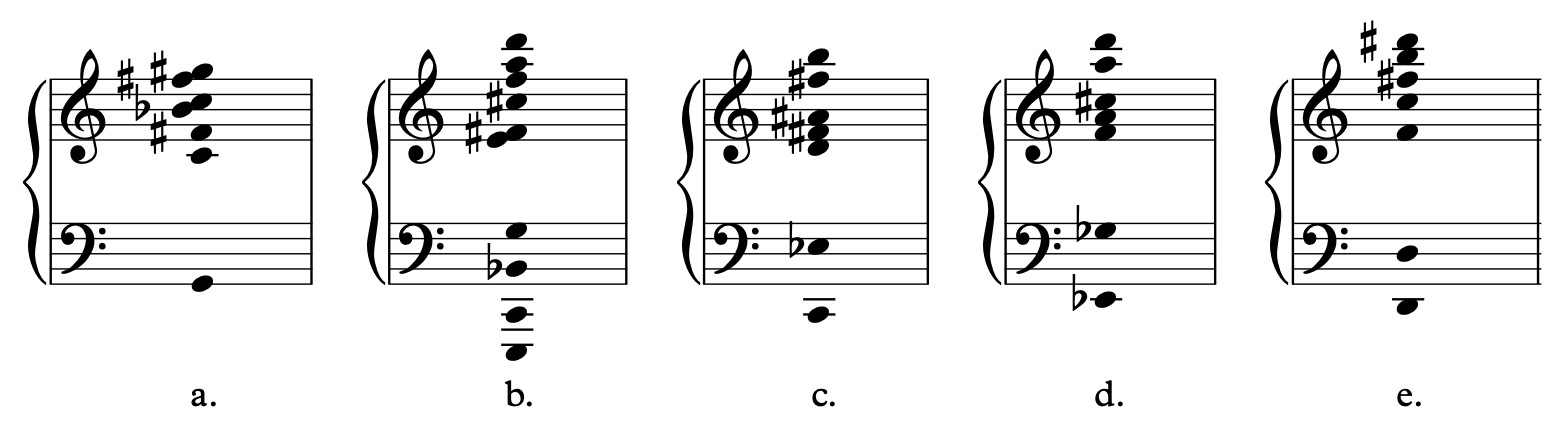
Ex. 7 shows a reduction of five key moments in Symphony No. 3 in which a chord is sustained in the orchestra. In each of these cases, Lilburn forms stratified aggregates from either a series of superimposed triads, or from a symmetrical scale subset superimposed above a dissonant note in the bass. Chord ‘a’ features an upper pentachord drawn from WT020 against a G in the bass; chord ‘b’ shows a three-part stratification comprising a C7 chord in the bass, an F♯7 chord in the middle voices, and a superimposed D minor chord on top; chord ‘c’ has a HEX(2,3) upper structure against a C in the bass, while chord ’d’ has a HEX(1,2) upper structure against an Eb in the bass. Chord ’e’ derives wholly from the OCT(0,2) scale, but again can be heard as a three-part triadic stratification: B major in the treble, F major in the tenor, and the note D in the bass.
Harmonic and Spatial Stratification in Nine Short Pieces
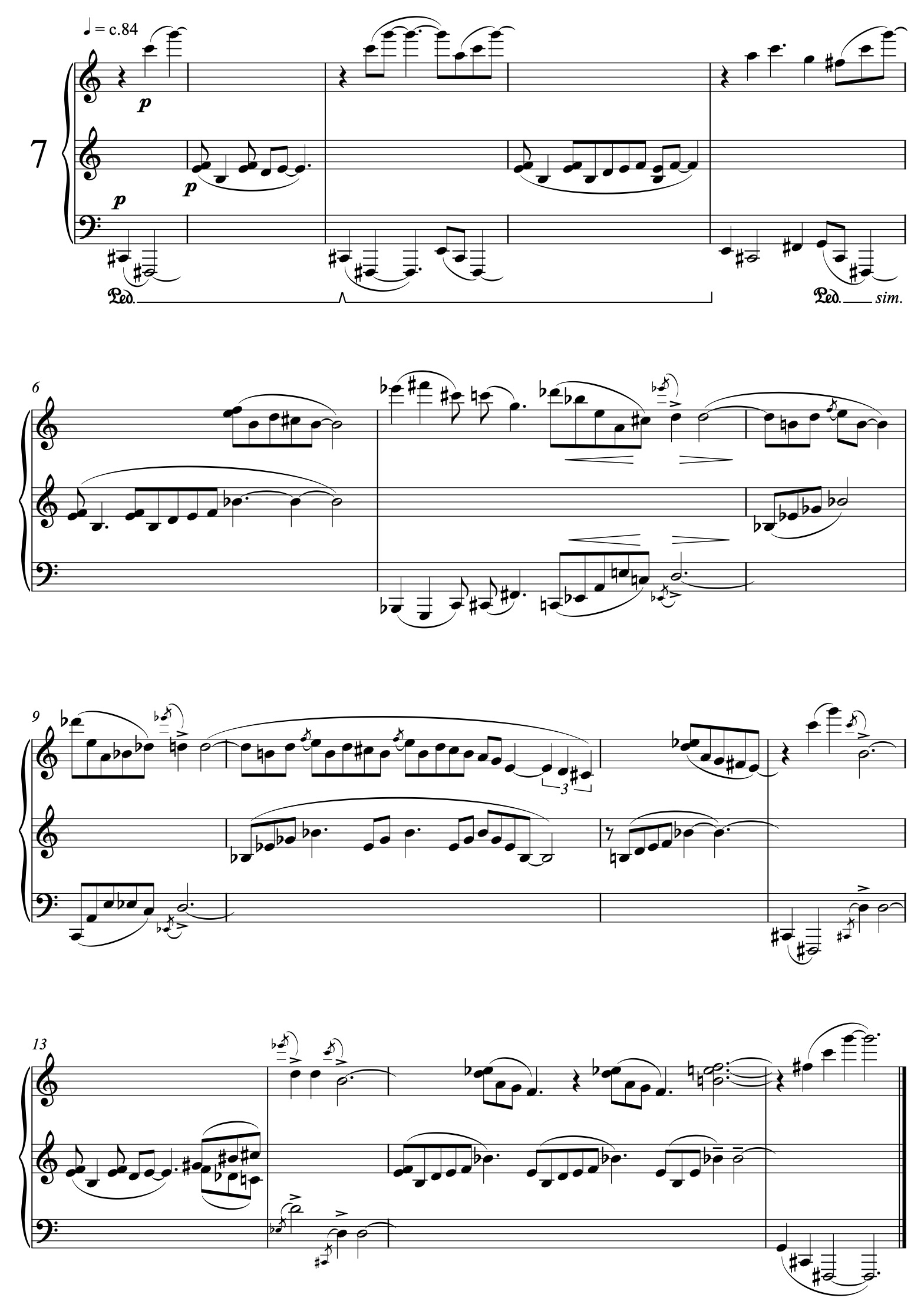
This kind of chromatic, symmetrical stratification reached its peak in the Nine Short Pieces (1966) for piano. Like Symphony No. 3, these miniatures draw on symmetrical hexatonic and octatonic scales, but with extensive use of the piano’s resonance and wide registral capabilities. As shown in Ex. 8, the seventh piece is perhaps Lilburn’s most stratified work. Here he divides the piano up into three distinct, widely spaced autonomous strata, each notated on a separate staff, and each deriving its pitch content from disjunct octatonic scales. The upper and lower strata are exact pitch inversions of each other, mirrored around a double-inversion axis of C4/C♯4, recalling Bartók’s fascination with inversional symmetry.21 These strata derive predominantly from the OCT(0,1) collection, with occasional passages in OCT(1,2). The middle stratum, on the other hand, is a limited-note melody in OCT(1,2), reminiscent of some of the melodic writing in The Rite of Spring. From time to time, the strata switch collections—the outer strata to OCT(1,2), and the inner stratum to OCT(0,1)—but they always maintain their dissonant relationship.
The Nine Short Pieces demonstrate that while Lilburn was interested in developing symmetrical, spatially stratified, sonorously resonant compositions, he never felt entirely comfortable in developing long-term forms out of these technical resources—indeed, the longest of the Nine Short Pieces weighs in at only three minutes. Instead, Lilburn abandoned his considerable reputation as an instrumental composer of great skill, and underwent an abrupt apprenticeship into the world of electroacoustic composition.
Tonal Vestiges in Three Inscapes and Soundscape with Lake and River Lilburn’s studio-based period, which lasted from 1961 until 1979, resulted in a substantial body of electroacoustic works that has been profoundly influential on subsequent generations of New Zealand composers. Thanks to the dynamic use of voltage-controlled synthesis, stereo panning, artificial reverberation, timbral transformation and multitrack capabilities, these compositions carry a strong emphasis on ‘spaciousness’, spatial design, a broad spectral distribution and a stratified approach to the superposition of distinct timbral layers.
Although Lilburn clearly foregrounds the structural roles of space, register and timbre in these works, there remains a strong concern with pitch, which provides the clearest point of connection to his instrumental works.22 Norman provides detailed evidence of this, noting specific features in the electronic works that bring to mind the stylistic thumbprints of early Lilburn. These include such examples as the opening motif of the second of the Three Inscapes (1972), which ‘recalls the “dramatic themes” of Lilburn’s first period’,23 or the oscillation of a minor third, which can also be found in ‘a number of his second-period works, particularly Wind Quintet and Symphony No. 3’.24 Elsewhere, he notes the ‘striking use of reiterated notes’ and an ‘intervallic shape [that] recalls that of the opening . . . of Sings Harry’.25
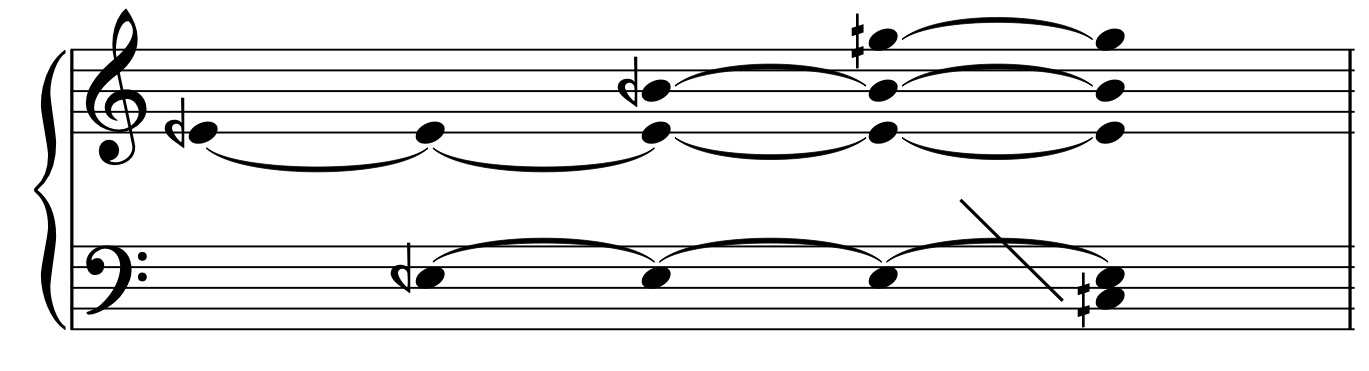
Most appositely to this current study, however, Norman argues that ’the most interesting relationship with the instrumental works . . . lies in the element of harmony. Both the outer inscapes produce what are essentially concordant harmonic textures . . . the introduction of the bass note C in [the third] inscape is reminiscent of Lilburn’s characteristic ‘root-substitution’ technique’.26 Ex. 9 shows a transcription of the key frequencies in this movement. The gradual introduction of long, sustained pitches gradually opens up a triad, based around the first five overtones of an E quarter-flat harmonic series, with the fourth harmonic being absent. At about 2'00", however, an oscillator glissando drops down into the bass registers, settling on a C quarter-sharp, which reframes the previous two minutes of E quarter-flat major as now its relative minor, C quarter-sharp. In fact, this move—in which an E♭ tonality is established in upper voices before the introduction of a C in the bass register—is similar to the opening of the Overture: Aotearoa.27
In Soundscape with Lake and River (1979), the formal design is likewise based around a dronescape that evolves almost imperceptibly over eleven minutes. The drones are virtually uninterrupted, save for two caesurae in which environmental recordings of water—first from a lake, and then a river—come to the foreground. While these abrupt emergences of concrete sounds from an otherwise abstract electronic atmosphere provide macrostructural landmarks, they do not in and of themselves provide a sense of progression or teleological goal-orientation. Rather, Lilburn uses the internal tensions of the analogue tones to provide a sense of underlying unresolvedness, ambiguity and spaciousness, the slow evolution of the harmonies providing an almost geological timescale.
Although the oscillators are not tuned to a strict twelve-tone equal temperament, we can still make an approximate transcription of the pitches (see Ex. 10). For the sake of illuminating the underlying pitch tensions in the drones, this reduction removes the timbral detailing—especially the subtle buzzes and accompanying motivic birdsong gestures that punctuate the soundscape, not to mention the microtonal inflections. What the transcription does show, however, is a certain predilection for triadic verticalities,28 with the additional tensional elements of non-chordal tones providing elisions between areas of relatively stable harmonic content. These non-harmonic tones are often introduced a semitone away from one of the notes of the preceding triad—see, for instance, 0'38", 1'35", 5'37", 6'27"—a sonority that clearly Lilburn favoured, as it appears throughout his oeuvre.29 It is worth pointing out here, however, that the pitch registers are not as clearly stratified as in Lilburn’s instrumental music: only at 6'27" do we get a clear case of registral separation, where the bass-register C# contradicts the upper G major triad.
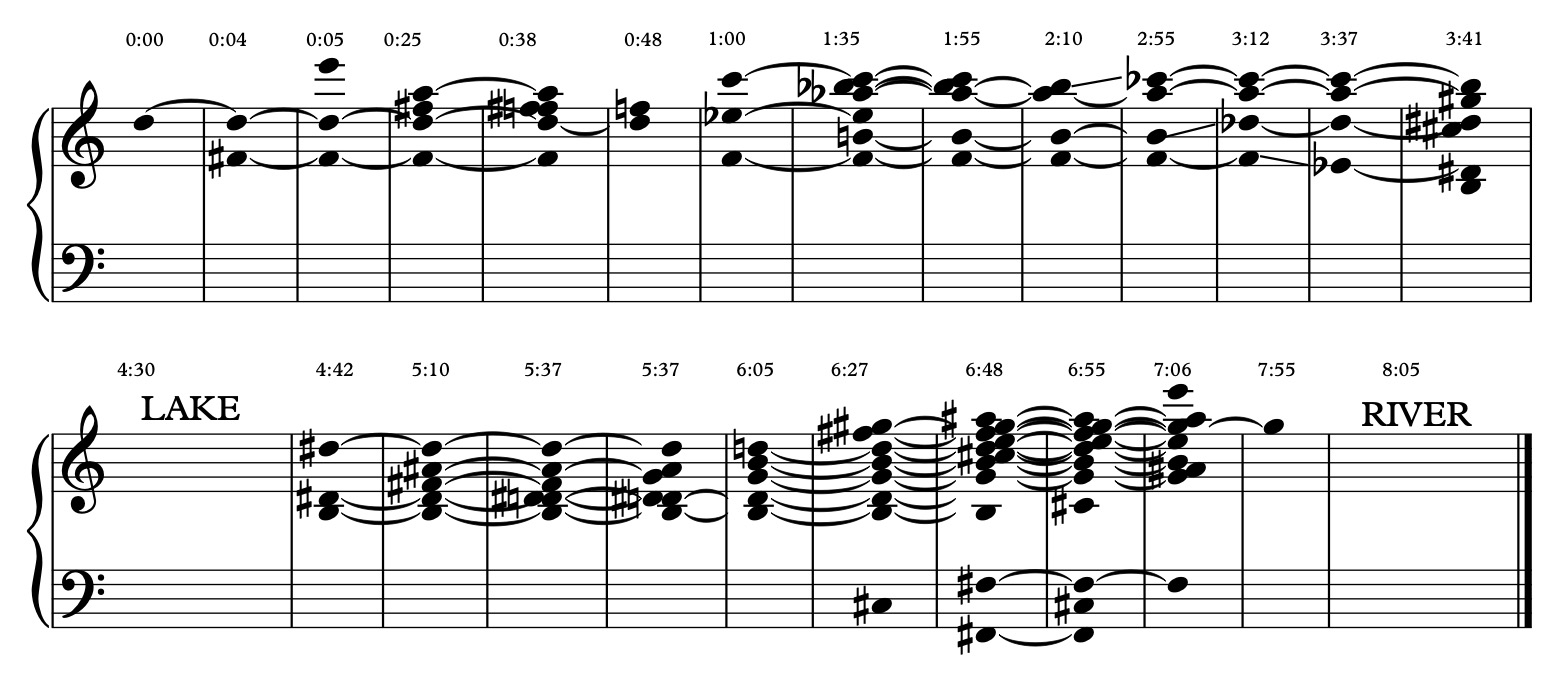
The piece opens with a drone on the note D5 which, over the first half a minute expands out to a D major triad. At 0'38", a new drone enters on an F5, creating semitonal conflict with the existing F♯5. At 1'00", this instability resolves as the F continues to underpin a new harmonic centre, with tones above it that seem to suggest an F minor construction. The introduction of a B4 drone destabilises the harmony at this point, however.
As Lilburn slowly shifts the oscillator frequencies throughout the third minute of the piece, one hears an almost traditional form of late-Romantic semitonal voice-leading: for instance, in the transformation of the F minor chord to a D♭ dominant seventh chord between 2'55"-3'12", or the transformation through to 3'41" into a complex aggregate that has a B major quality to it. Throughout the fifth and sixth minute, the drone contains competing tonal centres, including B major and G major, until clearly cadencing onto an F♯ chord with a strong dominant quality at 6'48".
There are two provisos to this analysis. Firstly, we do not hear the dominant quality of the seventh chords as in any way predicating a long-term harmonic direction. Due to the sustained duration of the drones, their timbral detailing and the microtonal inflections, we attend only to their immediate internal, intervallic tensions rather than any implicative long-term function—in other words, their dominant quality merely gives them a sense of gentle instability and ‘ungroundedness’. Secondly, this analysis should not be taken as evidence that Lilburn had clearly mapped out a precompositional tonal scheme for his electroacoustic work, or even that he had consciously referenced his earlier harmonic practices. The appearance of tensional non-harmonic tones and a vestigial kind of harmonic stratification resulted from intuitive preferences, resulting from repeated listenings as he tuned the voltage controllers in a presumably improvisational manner.
At the end of the work, as the recording of the river enters, the birdsong mingles with the previous electronic motifs, as if asking us to re-evaluate the preceding material as essentially two sides of the same, unified soundscape: Lilburn’s ultimate expression of environmental and musical unity. These two late electroacoustic works, then, provide evidence that Lilburn sought to draw attention to the relationship between his abstracted spectromorphological discourse and the concrete recordings of the New Zealand landscape. When electronic vestiges of his earlier harmonic practices are presented in a non-teleological, spacious recontextualisation, surrounded by water and birdsong recordings, Lilburn seems to be asking us to appreciate with renewed awareness the mimetic, evocative qualities of his earlier instrumental works. It is as if these abstract, stratified harmonies are the core signifier in Lilburn’s pursuit of capturing, sonically, the ‘patterns of our landscape and seacoasts, the changing of our seasons, and the flow of light and colour about us’.30 And if that is the case, then the deliberate collision of consonance and dissonance through harmonic stratification invokes the sublimity—the dark and the light, the majesty and the disquietude—of New Zealand’s wild spaces.
Notes
-
Philip Norman, Douglas Lilburn: His Life and Music (Christchurch: Canterbury University Press, 2006). ↩︎
-
Most notably Debussy, Stravinsky, Ravel, Rimsky-Korsakov, Satie and Dukas. ↩︎
-
Namely, the Dorian, Phrygian, Lydian, Mixolydian, Aeolian and Locrian modes. ↩︎
-
For a thorough account of the development of new scale systems at the beginning of the twentieth century, see Dmitri Tymoczko, ‘Scale Networks and Debussy’, Journal of Music Theory 48/2 (2004), 219-94. ↩︎
-
Canonic examples include b. 38 of Vaughan Williams’ Symphony No. 2, virtually the entire ‘Mars’ movement from Holst’s The Planets, and the opening of Sibelius’ Symphony No. 2, which Lilburn clearly invokes in the opening of his second Symphony. Philip Norman provides numerous examples of this practice in Lilburn’s work, see Douglas Lilburn, 382-5. ↩︎
-
Norman, Douglas Lilburn, 384. ↩︎
-
Wallace Berry provides similar qualitative and quantitative measures of texture and harmony in Structural Functions in Music (Englewood Cliffs, NJ: Prentice-Hall, 1976). ↩︎
-
For instance, in Cecil J. Sharp, One Hundred English Folksongs: For Medium Voice (New York: Dover, 1975 [1916]), twenty-seven of the songs are in Aeolian mode, twenty are in Dorian mode, but only nine are in the Mixolydian. ↩︎
-
Donald Zent, ‘The Harmonic Language of Karol Szymanowski’s Metopes, op. 29, and Masques, op. 34’, DMA diss. (University of Cincinnati, 1988); Pieter C. Van den Toorn, Stravinsky and the Rite of Spring: The Beginnings of a Musical Language (Berkeley, CA: University of California Press, 1987); Elliott Antokoletz, The Music of Béla Bartók: A Study of Tonality and Progression in Twentieth-Century Music (Berkeley, CA: University of California Press, 1984); and Philip Rupprecht, ‘Tonal Stratification and Uncertainty in Britten’s Music’, Journal of Music Theory 40/2 (1996), 311. ↩︎
-
See, for instance, Michael Klein, ‘Texture, Register and Their Formal Roles in the Music of Witold Lutosławski’, Indiana Theory Review 20/1 (1999), 37-70; Miguel A. Roig-Francolí, ‘Harmonic and Formal Processes in Ligeti’s Net-Structure Compositions’, Music Theory Spectrum 17/2 (1995), 242-67; and Danuta Mirka, ‘Texture in Penderecki’s Sonoristic Style’, Music Theory Online 6/1 (2000), www.mtosmt.org, accessed 22 July 2017. ↩︎
-
I have adopted the period 1936–55, which Philip Norman identifies as Lilburn’s ’nationalist’ period (see Douglas Lilburn, 375ff), as the composer’s ’early period’. ↩︎
-
Norman, Douglas Lilburn, 384. ↩︎
-
A scale of alternating semitones and minor thirds. ↩︎
-
I have adopted the HEX (hexatonic), OCT (octatonic) and WT (whole-tone) labelling nomenclature from Joseph N. Straus, Introduction to Post-Tonal Theory, 4th edition (New York: Norton, 2016). So HEX(2,3) is the hexatonic scale that includes pitch-classes 2 and 3, namely {D, E♭, F♯, G, A♯, B}. ↩︎
-
The roots of these four triads—B, D, E♭ and G♭—lie on what Richard Cohn terms ‘hexatonic poles’, which he argues replaced common-practice fifths-relations in many nineteenth-and early twentieth-century works. See Richard Cohn, ‘Maximally Smooth Cycles, Hexatonic Systems and the Analysis of Late-Romantic Triadic Progressions’, Music Analysis 15/1 (1996), 9-40. ↩︎
-
Ross Harris, ‘Douglas Lilburn’s Symphony No. 3’, Canzona 2/5 (1980), 3-7. ↩︎
-
Devising tone-rows that contain clear tonal references has a precedent in the serial practices of several mid-twentieth-century British composers, especially Britten, Benjamin Frankel, Elisabeth Lutyens and Humphrey Searle, all of whom were influenced by the ’tonal serialism’ of Berg’s Violin Concerto. See Arnold Whittall, Serialism (Cambridge: Cambridge University Press, 2008), 152. ↩︎
-
Especially given they are the ‘Sings Harry’ motif of a tone followed by a minor third. ↩︎
-
The type of symmetry I am referring to here is ’transpositional symmetry’, in which a pc-set maps onto itself under non-zero transposition. Scales that possess transpositional symmetry were referred to by Messiaen as ‘modes of limited transposition’, which included the whole-tone, octatonic and hexatonic scale. The other kind of symmetry is ‘inversional symmetry’, in which pitch-classes in a set map onto themselves under inversion. ↩︎
-
The whole-tone scale on C. ↩︎
-
For example, in Bartók’s Mikrokosmos Nos. 12 and 141, and Bagatelle Nos. 2 and 4. ↩︎
-
Several commentators have remarked on the prima facie resemblance, such as pianist Margaret Nielsen who suggested that the Nine Short Pieces ‘reflect an extension of [Lilburn’s] sound world, possibly inspired by the experiments and discoveries taking place in the newly-established electronic studio under the old Hunter Building’ (in ‘The Piano Music of Douglas Lilburn: Reflections on My On-Going Appreciation of a Unique Treasury of Music’, Music in New Zealand 31 (1995-6), 24-6). ↩︎
-
Norman, Douglas Lilburn, 405. ↩︎
-
Norman, Douglas Lilburn, 405. ↩︎
-
Norman, Douglas Lilburn, 405. ↩︎
-
Norman, Douglas Lilburn, 406. ↩︎
-
Albeit a quarter-sharp higher. ↩︎
-
At various points in the piece the chords of D major, F7, D♭7, G♯ minor, B major, G major and F♯7 are clearly audible. ↩︎
-
The ’triad plus semitone’ sonority is particularly emphasised throughout Symphony No. 2, A Song of Islands, and in the first of the Nine Short Pieces. ↩︎
-
Douglas Lilburn, A Search for Tradition & A Search for a Language (Wellington: Lilburn Residence Trust in association with Victoria University Press, 2011), 44. ↩︎