This paper was presented at the New Zealand Musicological Society Conference 2017
Abstract
This paper reconsiders the late instrumental works of Douglas Lilburn, situating them not as the marginalia of his “electroacoustic period” (1965–1980), but as a concentrated site of aesthetic tension and technical synthesis. Focusing on the Nine Short Pieces for piano, it argues that these works begin to articulate an unresolved dialectic between competing compositional imperatives: the inherited modal–triadic language of Lilburn’s earlier music and the chromatic, post-tonal procedures associated with mid-twentieth-century European modernism.
While not resulting in a fully-fledged new instrumental aesthetic, Lilburn demonstrates in these works a willingness to develop a synthesis of (i) quasi-serial, cellular pitch organisation, (ii) transpositional and inversional symmetry (notably through octatonic and hexatonic collections), (iii) triad-derived chromatic generative procedures, and (iv) a stratified conception of texture characterised by registral separation, temporal discontinuity, and resonance-based sonority.
Through close analytical readings, the paper demonstrates how recurrent “Triad + 1” formations, symmetrical scalar resources and mirror structures generate a harmonic language that resists teleology, instead projecting stasis and atemporality. At the same time, these procedures can be understood as a recontextualisation of earlier modal techniques, particularly Lilburn’s “root substitution” within a chromatically saturated framework.
While these works potentially embody a compelling late synthesis of Lilburn’s influences, they are ultimately unrealised in anything other than miniature form, revealing Lilburn’s ambivalence toward fully realising their aesthetic implications through a large-scale form. The Nine Short Pieces, therefore, stand as a poignant coda to his instrumental output, offering us merely a glimpse of a path not fully taken, a path in which his serial, symmetrical, stratified and sonic-spatial thinking could have truly converged.
Introduction
Lilburn’s late period, spanning the years 1965 until his retirement in 1980, is referred to in the Philip Norman biography as his ’electroacoustic period’, for Lilburn underwent the radical self-transformation of abandoning the instrumental medium and focusing almost solely on electronic sound. But in fact his manuscript paper and pen were not entirely abandoned. Rather, there was an interesting ’tailing-off’ of instrumental activity during this period, and it is this I want to examine today, for in these late instrumental works we can most clearly see Lilburn’s internal and ultimately unsuccessful struggle with the very significance of composition as a communicative act. They confront head-on the strongly dialectical nature of music’s semiotic realm, a dialectic situated between, to use the Peircean tripartition, the co-option of the iconic and indexical power of music, on the one hand, and the symbolic dimension of music as a signifier of social status on the other. So Lilburn abandoned the symphony orchestra after his Third Symphony, for despite the mimetic and metaphorical processes through which the orchestra can evoke the icons and indexes of a largely unpeopled rural New Zealand, it brought with it a strong symbolic whiff of Viennese coffeehouses, Parisian salons and Cologne opera theatres. Despite the broad sonic vistas of the orchestra, its semiotic baggage of European high culture became anathema to the son of a sheep farmer from the backblocks of Whanganui. The more neutral medium of tape and loudspeaker allowed Lilburn to evoke a specific geographical location and its inhabitants through the strongly iconic activity of sound recording, much more so than the mediated and compromised domain of instrumental composition. Furthermore, music notation had formed the battleground on which the intergenerational struggle between competing compositional memes had been waged by the post-war avant-garde.
Darmstadt and the avant-garde
During the 1950s and 1960s, Lilburn found himself increasingly amidst more progressive colleagues. His star pupil Jenny McLeod was firmly ensconced in the midst of the European high modernism, while his colleague Fred Page’s tours of Donaueschingen and Darmstadt surely further stoked Lilburn’s anxiety of anachronism. Lilburn wrote of this period ‘…unless I somehow kept up with all the new developments I might be condemned to a musical inconsequence or sterility. Of course, in human or musical terms this would be intolerable — to spend one’s life keeping up with the Darmstadt Joneses.’
At this crucial watershed, Lilburn was aesthetically torn between the gentle modality of Vaughan Williams, Sibelius and Copland which had underpinned his canonic works of the 1940s, and the more confrontational demands of Boulez, Stockhausen and Nono that represented, at least at that point in time, the future direction of musical technique. His late instrumental music, then, is neatly symptomatic of an artistic crossroads that can, as Eve succinctly put it yesterday, be characterised as an almost paralysing impulse not so much from facing the abyss of freedom, but facing the competing pressures of the nostalgic love for Sibelius’s symphonic sweep and the spatially, timbrally and harmonically energized textures of, say, Stockhausen’s Gesang der Jünglinge.
Late works and their stylistic features
The complete list of instrumental works written between 1965–1980 are:
- Crotchety at 51 for piano (1965)
- Nine Short Pieces for piano (1965–66)
- Three Bars for M.N. (1968)
- Seven Short Pieces for piano (1965–66)
- Seventeen Pieces for Guitar (1962–70)
- Sea Change for piano (1972)
- Untitled for solo viola (1972)
- Still Music for W.N.R (1973)
- Andante Commodo (1973)
- Piece (1981)
All solo works, and mostly written for piano, they feature a formal brevity of the kind championed by the Second Viennese School. The chromatic language shows a continuing attempt to reconcile these competing pressures that were found in Lilburn’s dalliance with serial technique in Symphony No. 3 and A Birthday Offering, and it is the first of these works, the Nine Short Pieces, arguably the last substantial instrumental work written, that I will examine today. These nine short pieces show different technical approaches to the synthesis of four post-tonal approaches:
a) a kind of ‘cellular post-Schoenbergian quasi-serialism’ often suffused with tonal allusions, as seen in composers such as Berg, Britten, Maxwell Davies, Dallapiccola, Carter, Berio and, in NZ, the 1960s works by Jenny McLeod and Jack Body; thematic elements are fragmented and cellular in nature often suffused with a relatively economic intervallic language;
b) symmetry, especially the transpositionally symmetrical scale resources such as the octatonic and hexatonic collections, common in the music of Stravinsky, Messiaen and Bartók, and use of strict inversional symmetry between upper and lower registers, seen in Bartók’s piano works such as the last three books of Mikrokosmos; Lilburn’s symmetrical organisation of pitch diminishes the ability of music to create teleological trajectories of tension and release, instead emphasising the music’s general air of stasis and atemporality;
c) generation of diverse local-level verticalities from procedures of chromatic embellishments of simple triadic structures, something I will relate to both Lilburn’s own modal practice and the pre-serial atonal works of Schoenberg and Berg;
d) deployment of temporally and registrally separated sound objects or sound strata, emphasised by the replacement of the strict metrical articulation and lyrical impulse of the early works with a phraseology that is freed from, or at least much more ambiguous in relation to, an underlying pulse framework. There is abundant use of caesuras, additive rhythms to disguise the metrical articulation, pedalled resonances, unresolved chromatic ambiguities, nonteleological harmonic organisation and wide registral delineation.
Nine Short Pieces
The synthesis of serial, symmetrical and sonic-spatial approaches is evident from the outset of the first of the Nine Short Pieces. It is paradigmatic of his increasing concern with gesturality, spatial and registral expansion and separation, and the sonic frisson of a chromatically saturated pitch organisation.
Ex. 1 shows the opening of the piece, an arpeggiated hexachord that outlines a triad of E♭ minor, with the additional pitch-classes of B♮, G♮ and A♮. The final note is rearticulated as a bell-like (or perhaps, more aptly, kokako-like) resonance that emerges from the opening wash.
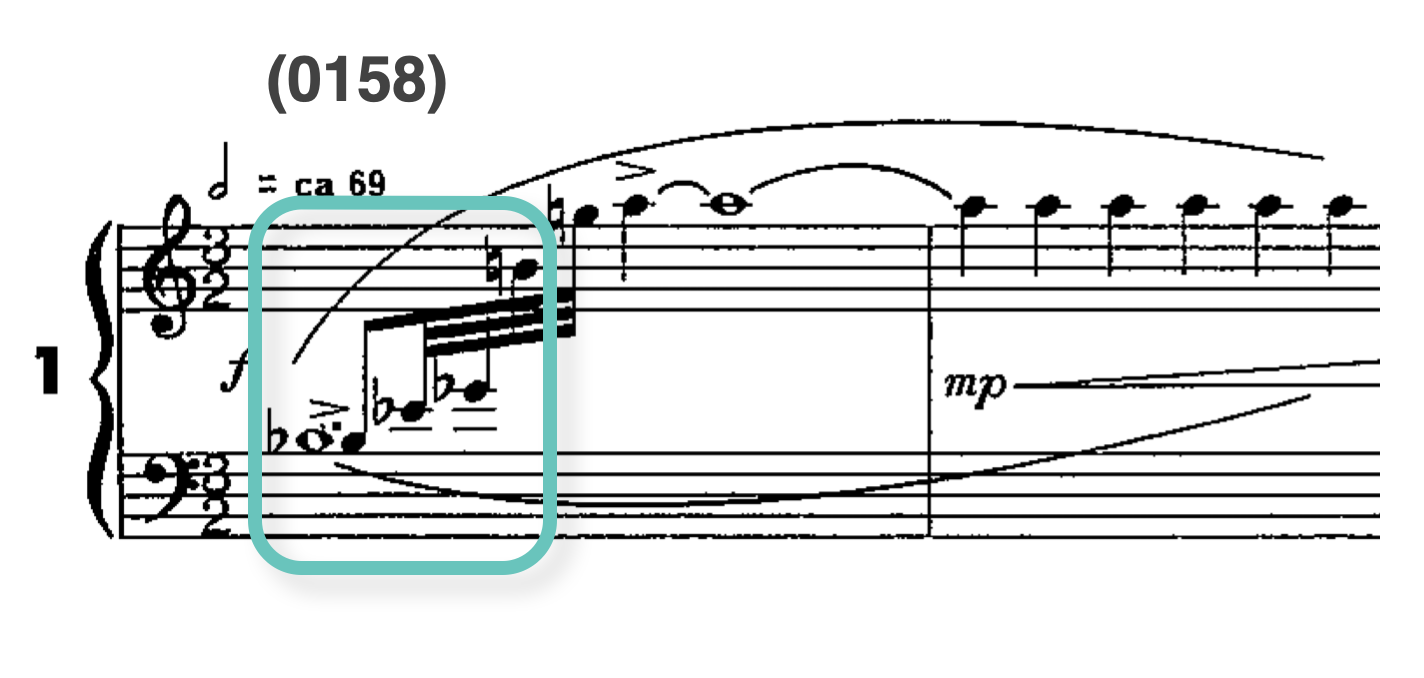
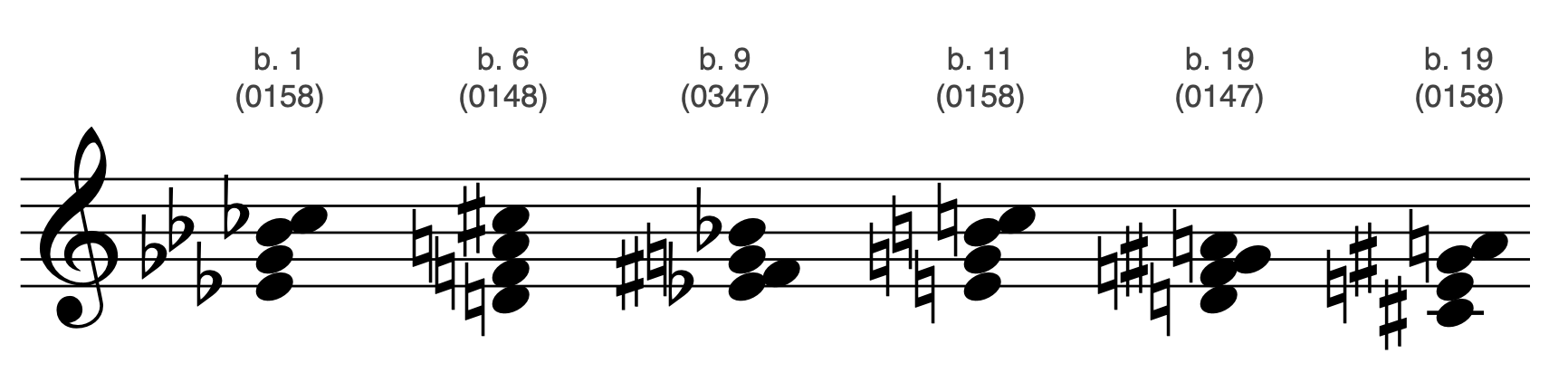
The primary sonority of the piece is encapsulated in the first four pitch-classes of the work: that is, an E♭ minor triad plus B♮, together comprising set-class 4-20 to use Forte’s terminology. This aggregate of minor triad plus a note a semitone away from one of the chord tones recurs throughout the piece. As shown in Ex. 2, b. 6 contains a D minor chord plus a C♯; b. 9, an E♭ minor chord with a G♮; b. 11, an E minor chord with a C♮; and b. 19 contains a D minor chord with a G♯ added followed by a C♯ minor chord with an A added.
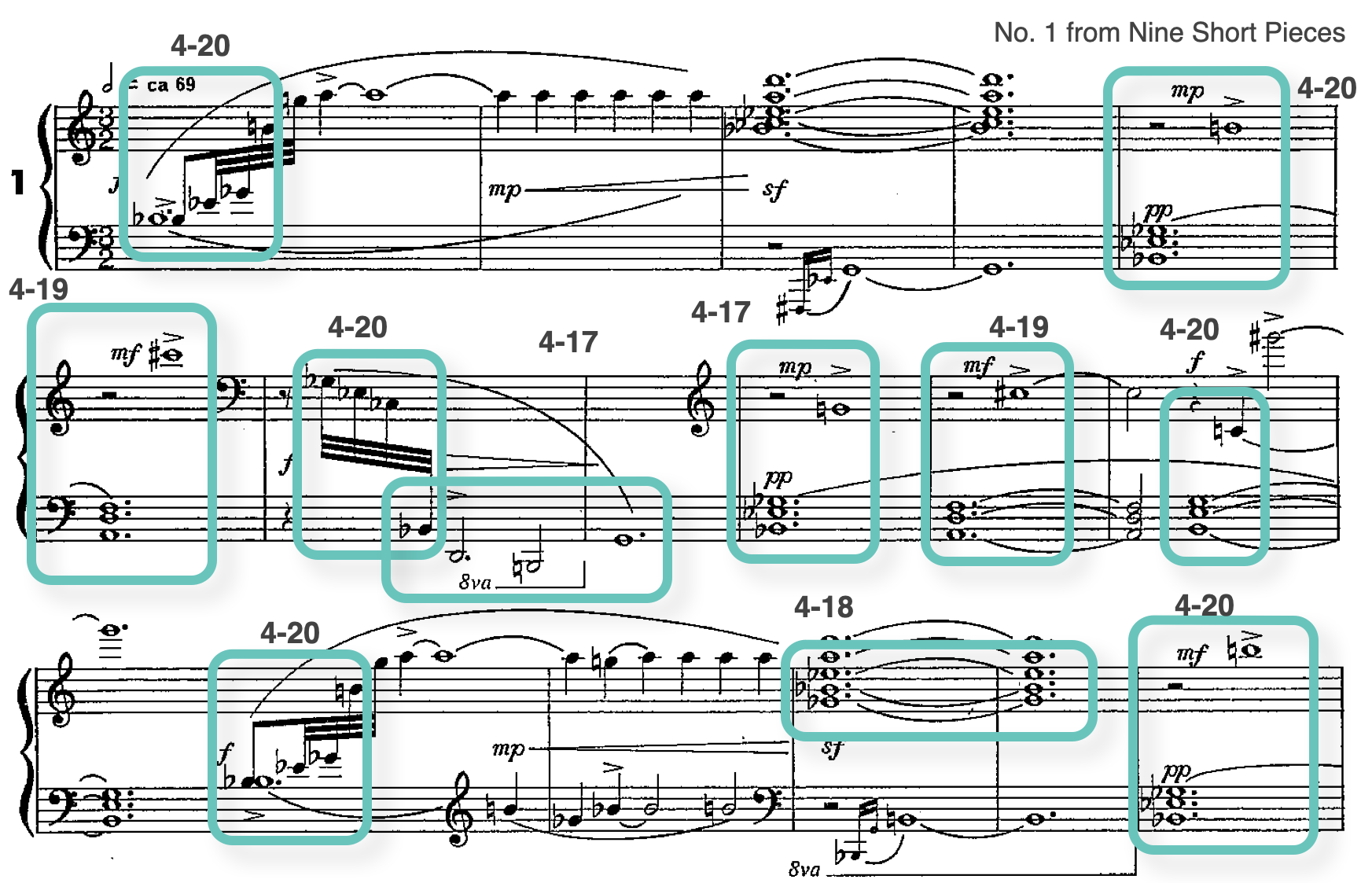
Despite the diversity of set-classes (4-17, 4-18, 4-19 and 4-20), the common generational procedure ties them together, giving them a unified sound construction, and a similar aural provenance. Ex. 4 shows how the ‘triad + 1’ generative procedure (herein referred to as T+1) is not new: Schoenberg’s Op. 19, No. 2 shows the composer using this procedure to generate a variety of tetrachordal pc-sets that bridge the triadic and the chromatic.
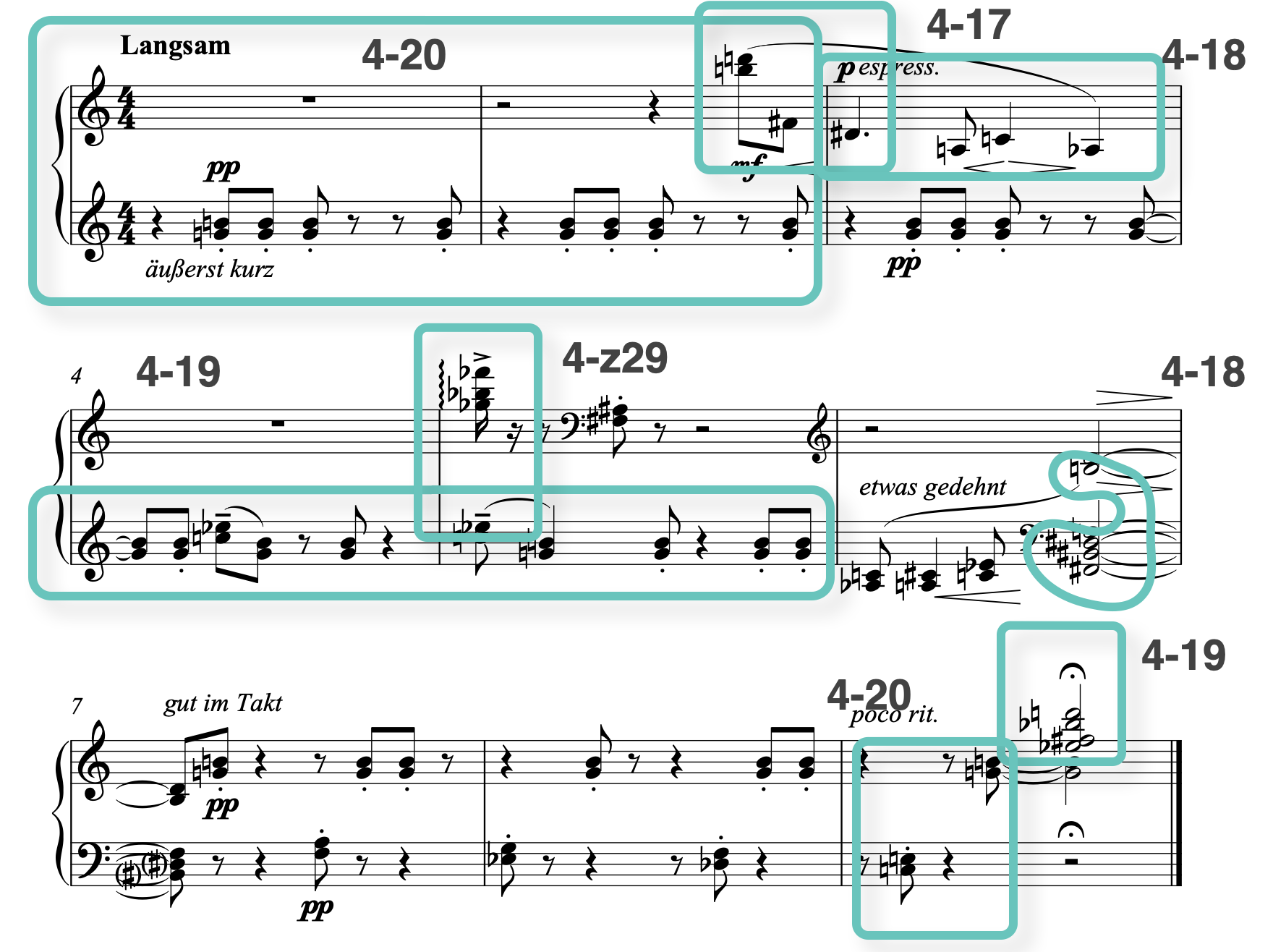
T+1 tetrachords and their shared hexatonic superset
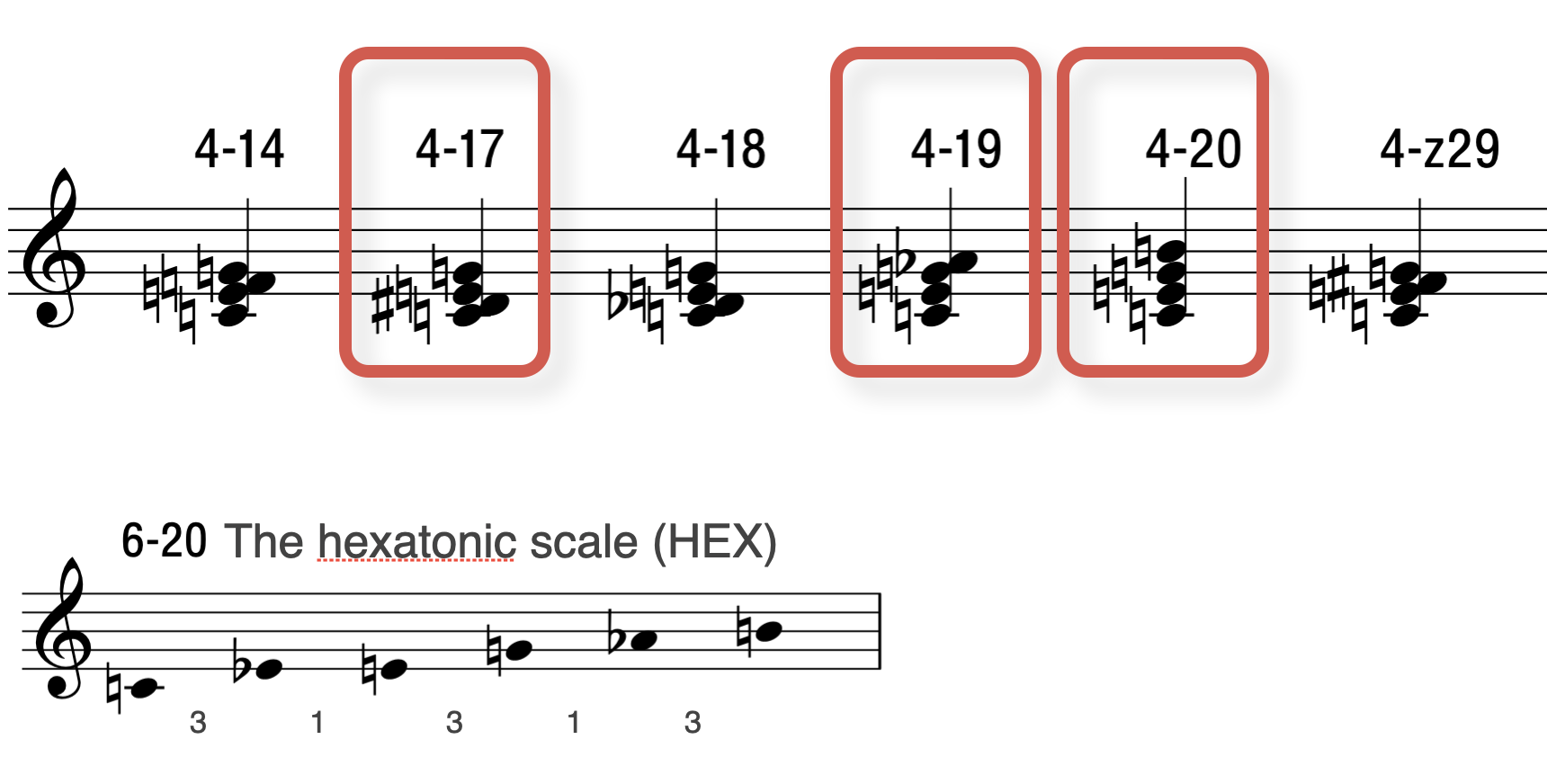
Ex. 5 shows the six possible tetrachords formed by the T+1 procedure: 4-14, 4-17, 4-18, 4-19, 4-20 and 4-z29. The first three T+1 tetrachords that appear in this piece — 4-20, 4-19 and 4-17 — share another strong point of relationship: they are the only three of the six T+1 tetrachords that are also subsets of the so-called hexatonic scale, a symmetrical mode generated from alternating minor thirds and semitones.
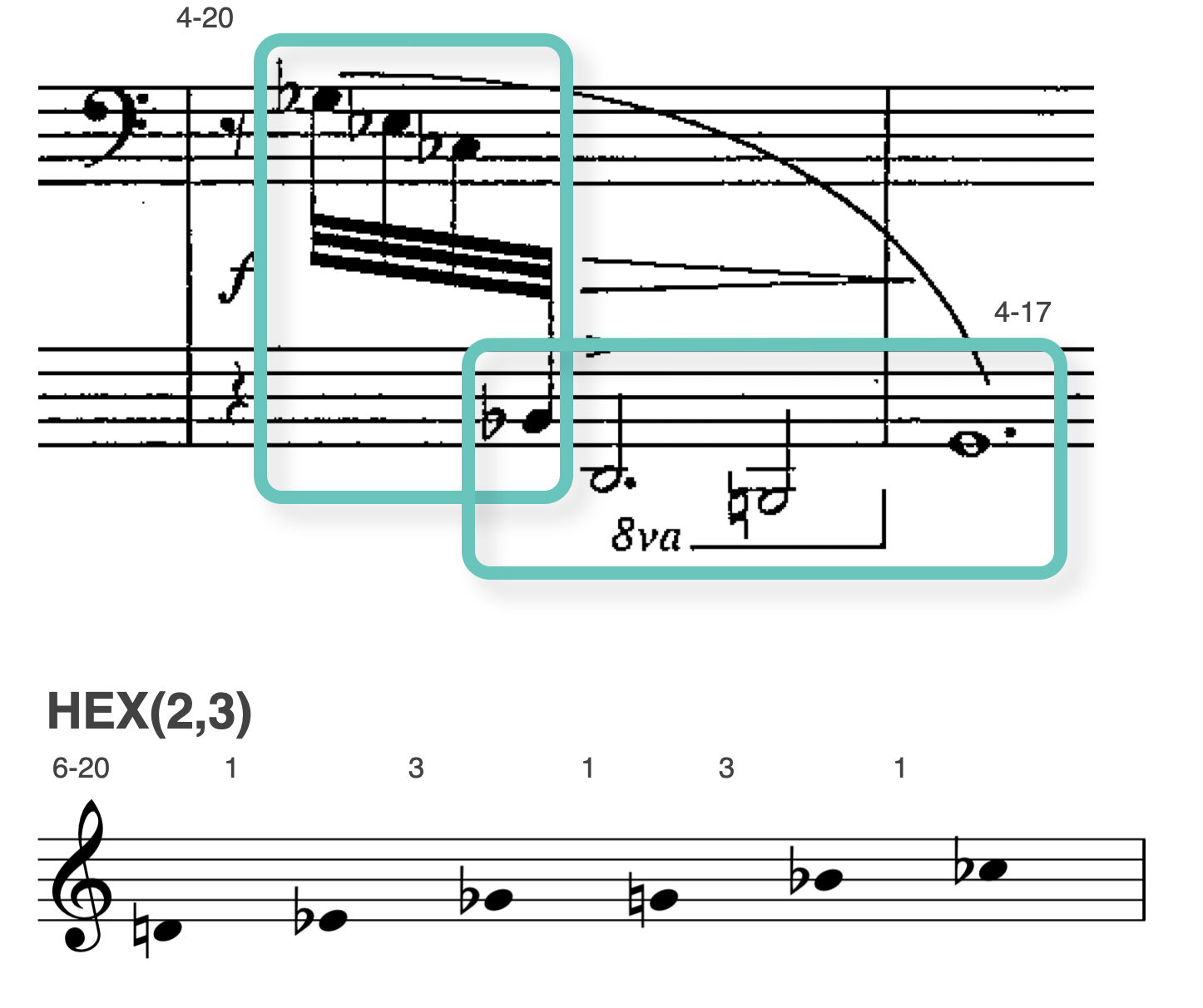
Underlying the importance of the HEX collection, all six pc of HEX(2,3) are used at bb. 7-8.
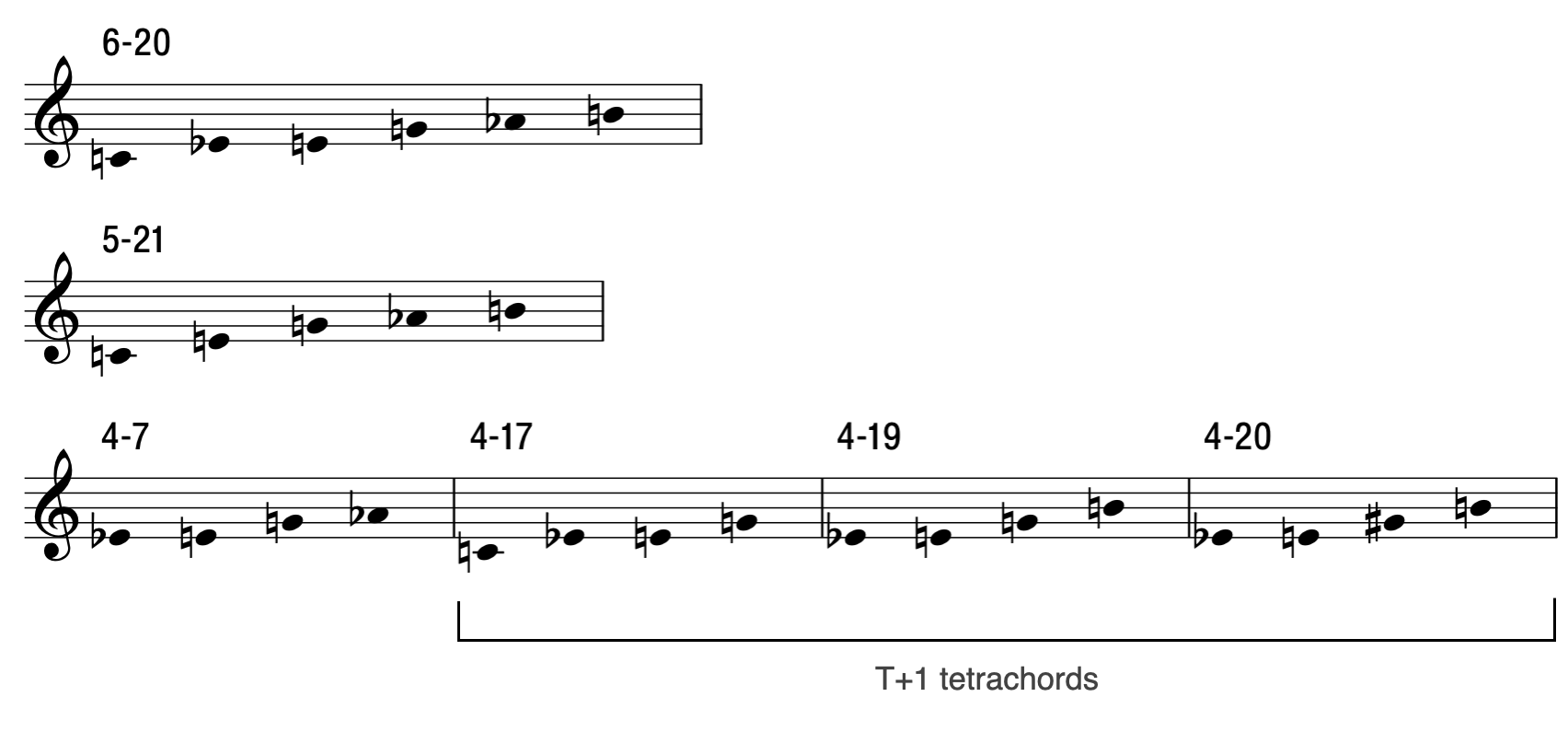
Ex. 7 shows other subsets of the HEX collection: the one possible pentachordal subset of HEX (5-21) appears in a number of places in the first of the Nine Short Pieces. HEX has four possible tetrachordal subsets (4-7, 4-17, 4-19 and 4-20), of which 4-7 is the only one that is not a T+1 tetrachord. And finally, HEX only has one heptachordal superset: 7-21. The HEX collection plus its tetrachordal and pentachordal subsets and septachordal superset forms much of the harmonic organisation in this piece.
Relationship to Lilburn’s earlier modal practice
The saturation of the harmonic discourse with an underlying symmetrical generative set evidences a shift away from the inherent asymmetry of the diatonic collection and its seven modes that had hitherto formed the basic scalar groups of Lilburn’s earlier periods. But these sonorities are not entirely without precedent in his earlier works: one of the particularly idiosyncratic modal techniques that Lilburn championed in his works from the 1940s and 1950s is the superposition of an ostensibly straightforward triad over a non-harmonic pedal tone. In many cases, the non-harmonic tone was a semitone away from one of the notes of the triad. (This is referred to by Philip Norman as the ‘root substitution’ technique.)
Ex. 8 shows a good example of this sonority in the opening of his orchestral work A Song of Islands (1946).
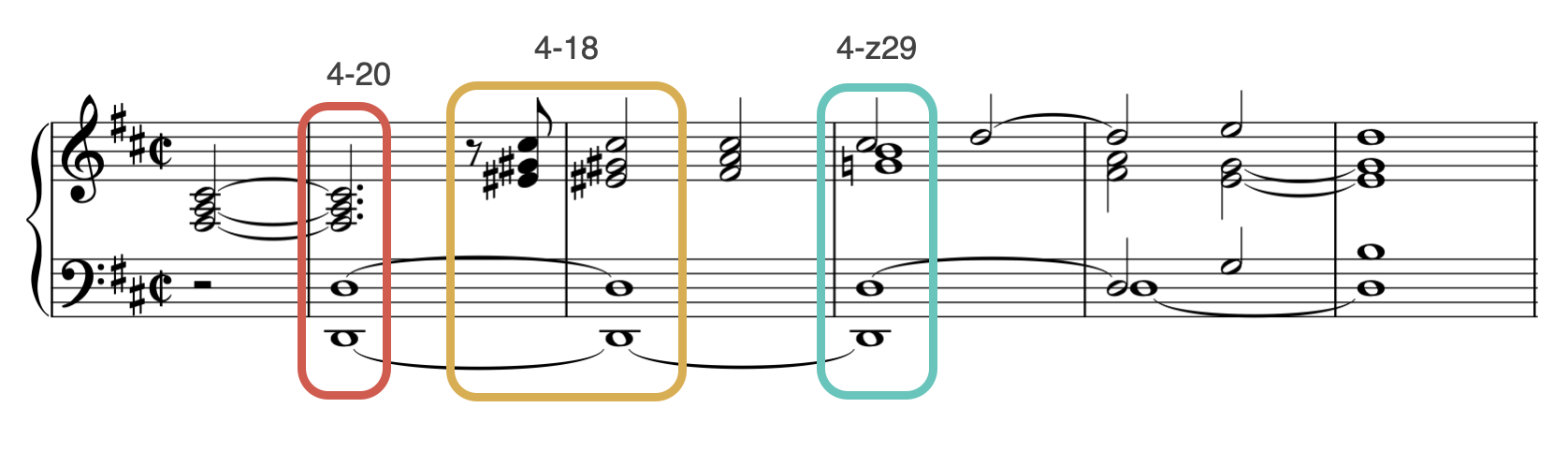
Here we see the opening F♯ minor triad becomes superimposed over a pedal D in cellos and basses, followed by a C♯ minor triad over the same D pedal, followed by the F♯ minor triad again, then a G major triad with a C♯ in the melody line. These preferred vertical structures, featuring the gentle frisson of a semitone dissonance within a triadic underpinning, became recontextualised in his later works in a more thoroughly chromatic, symmetrical language. This suggests that Lilburn was attempting to reconcile — as did many composers in the post-serial era — the underlying dialectic between conservative and progressive elements, and between the mimetic and the symbolic realms.
Nine Short Pieces, No. 2
The second of the Nine Short Pieces continues in this harmonic vein. Ex. 9 shows the piece opening with a T+1 tetrachord — set-class 4-14 — constructed from an E♭ minor chord plus one semitone. The subsequent note C creates set-class 5-29, which conforms to a similar generative procedure: DOM7+1 (i.e. a dominant seventh chord, plus one note a semitone away).
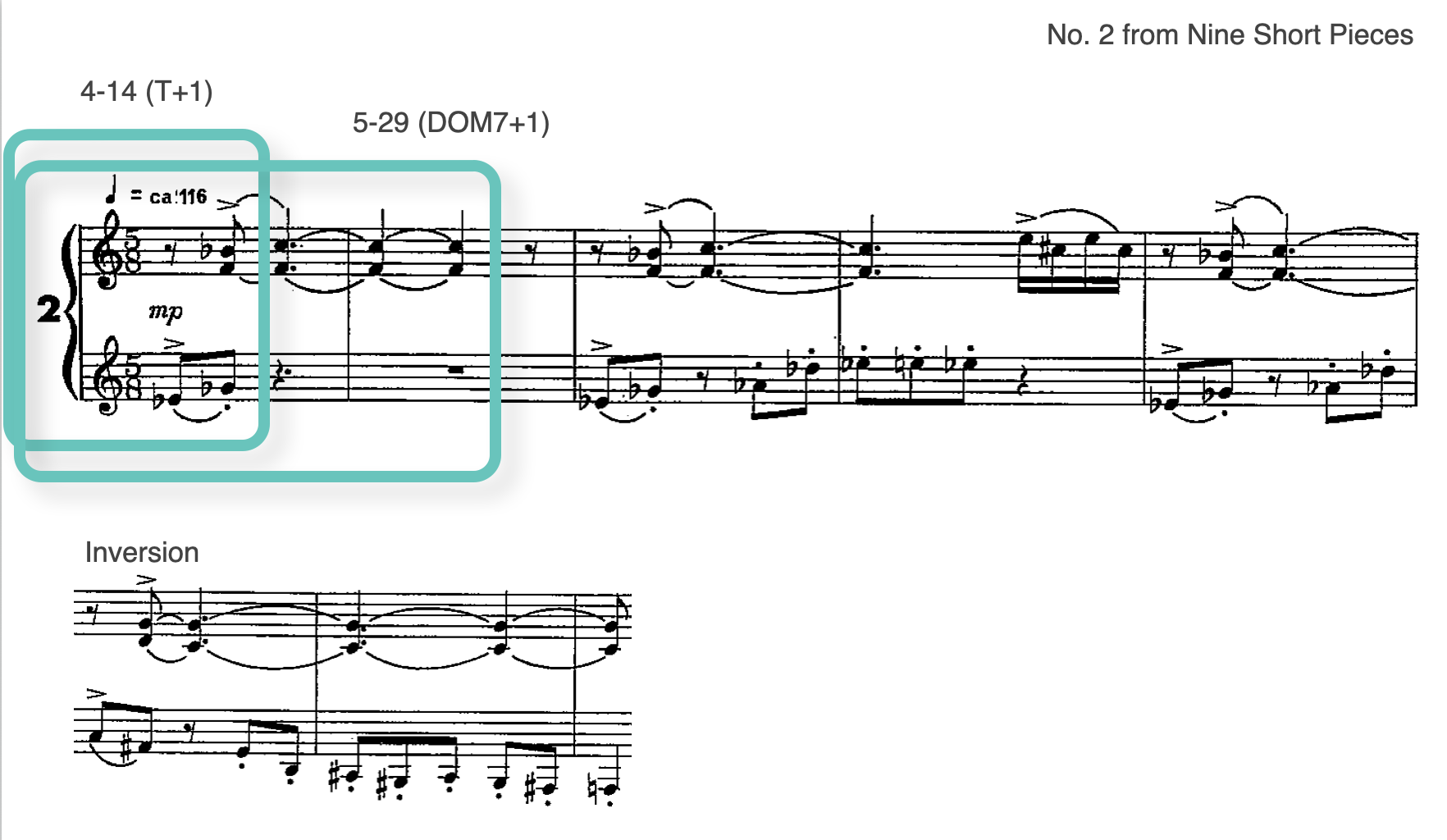
The consequent introduces a phrasal response, once again set-class 4-14, but now transposed onto D♭. This is responded to by an exact chromatic inversion of the opening material starting on an A, a tritone away from the E♭. This use of exact chromatic inversion foreshadows the appearance of strict inversional symmetry in some of the later pieces in this collection.
Nine Short Pieces, No. 3
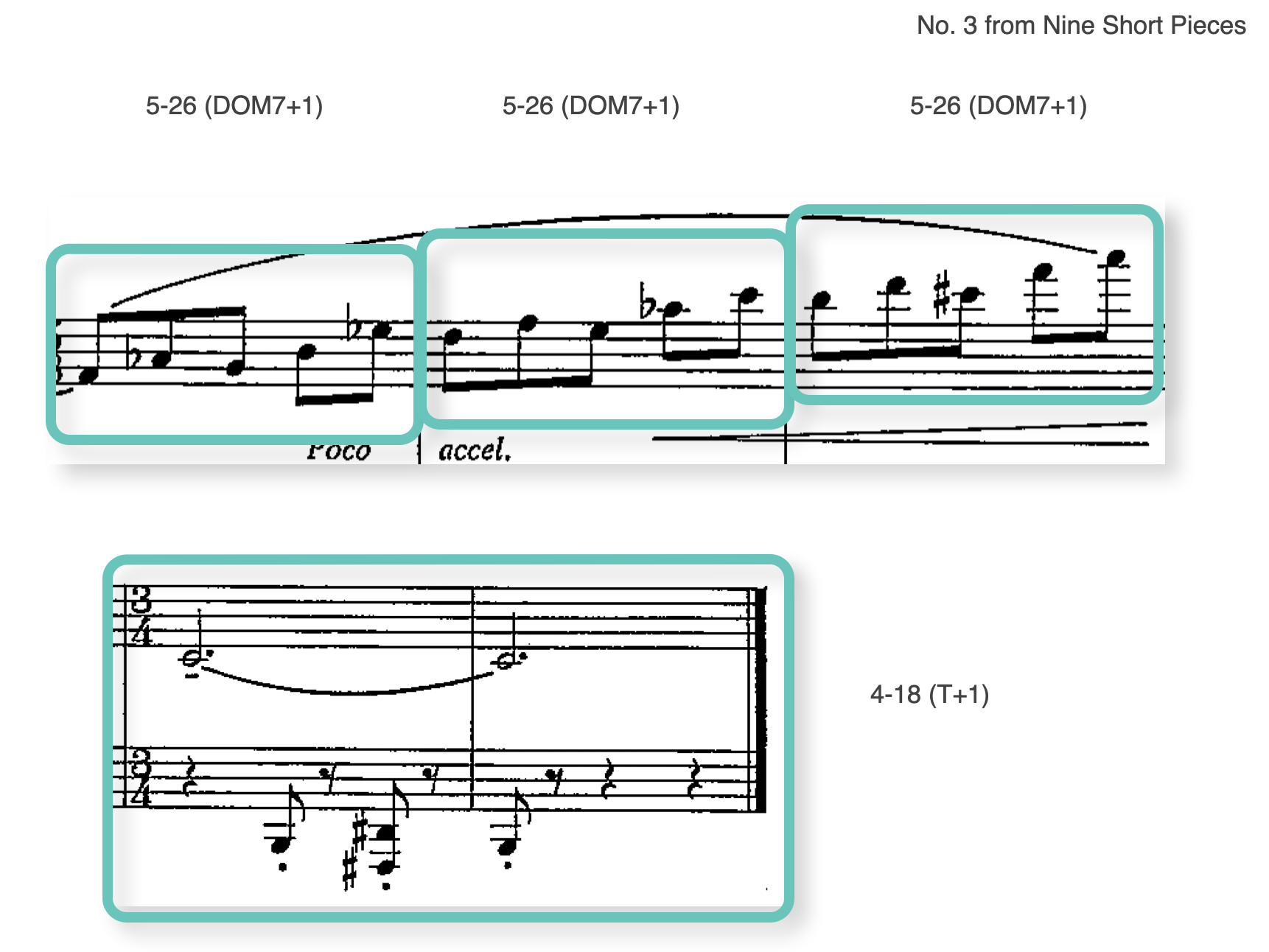
The third of the Nine Short Pieces, for instance, features a sequential passage of DOM7+1 pentachords (set-class 5-26), as shown in Ex. 10. The last bar of the piece cadences on a clear T+1 tetrachord.
Nine Short Pieces, No. 4
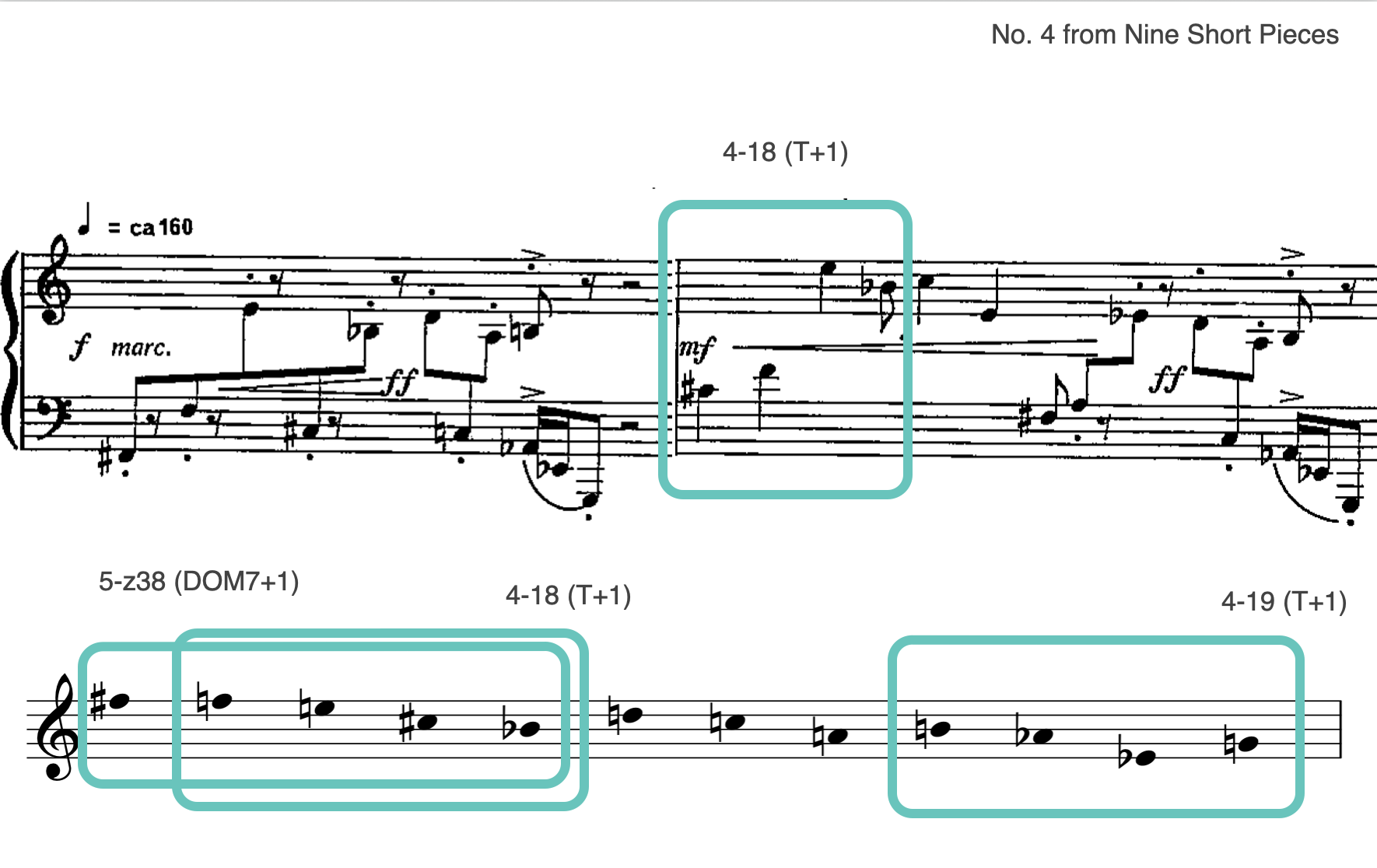
While the fourth of the Nine Short Pieces opens with a twelve-tone row, the construction of this row derives from set-classes that conform to the T+1 and DOM7+1 generative principles: the first five notes of the tone row are set-class 5-z38, one of the DOM7+1 pentachords (you can see the embedded F♯7 chord plus an F♮), and notes 2 to 5 make up set-class 4-18, one of the T+1 tetrachords. The last four notes are also another T+1 tetrachord.
Ex. 11 shows how notes 2 to 5 appear, reordered, in the second bar, where Lilburn drops the opening F♯, instead using the 4-18 tetrachord.
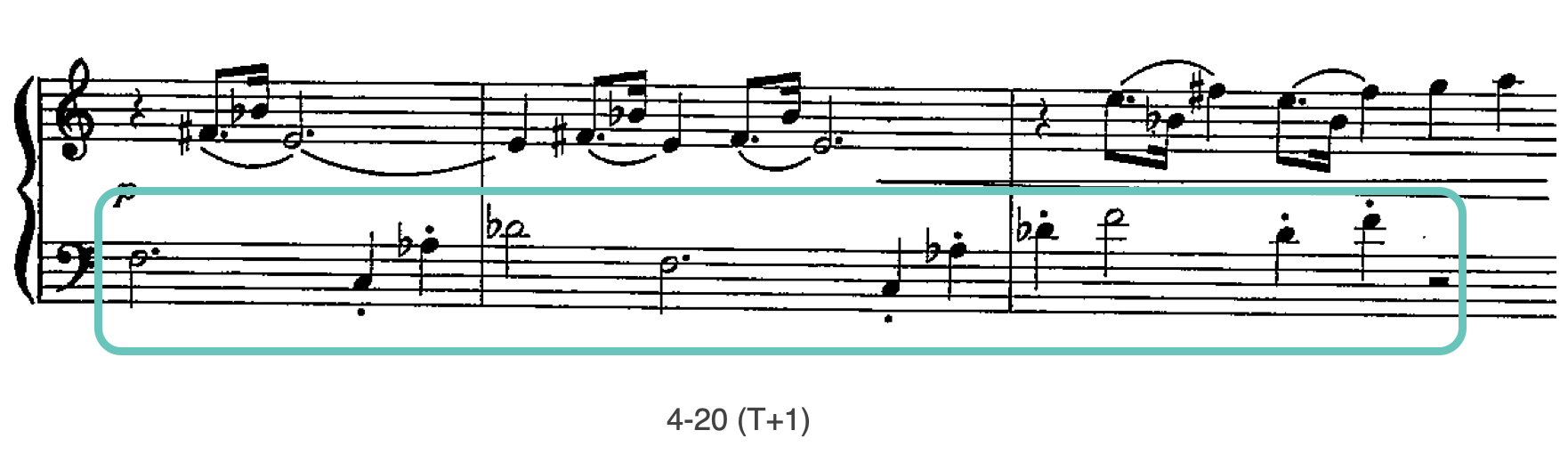
In the second system a curious, almost bitonal passage occurs (see Ex. 12). In the left hand are the pcs F, C, A♭ and D♭, which together form set-class 4-20, again one of the T+1 tetrachords. In the right-hand are the pitch-classes F♯, B♭ and E, the odd numbered pc from the opening tone-row. These pc, together with the G, A and D♭ that complete the phrase, derive from the octatonic scale centred on C, or OCT (0,1).
Octatonicism in Nine Short Pieces
The OCT collection, together with the HEX collection form the primary scalar resources of the Nine Short Pieces. The last of the Nine Short Pieces, for instance, features a melodic line strongly centred around OCT(0,1) (see Ex. 13).
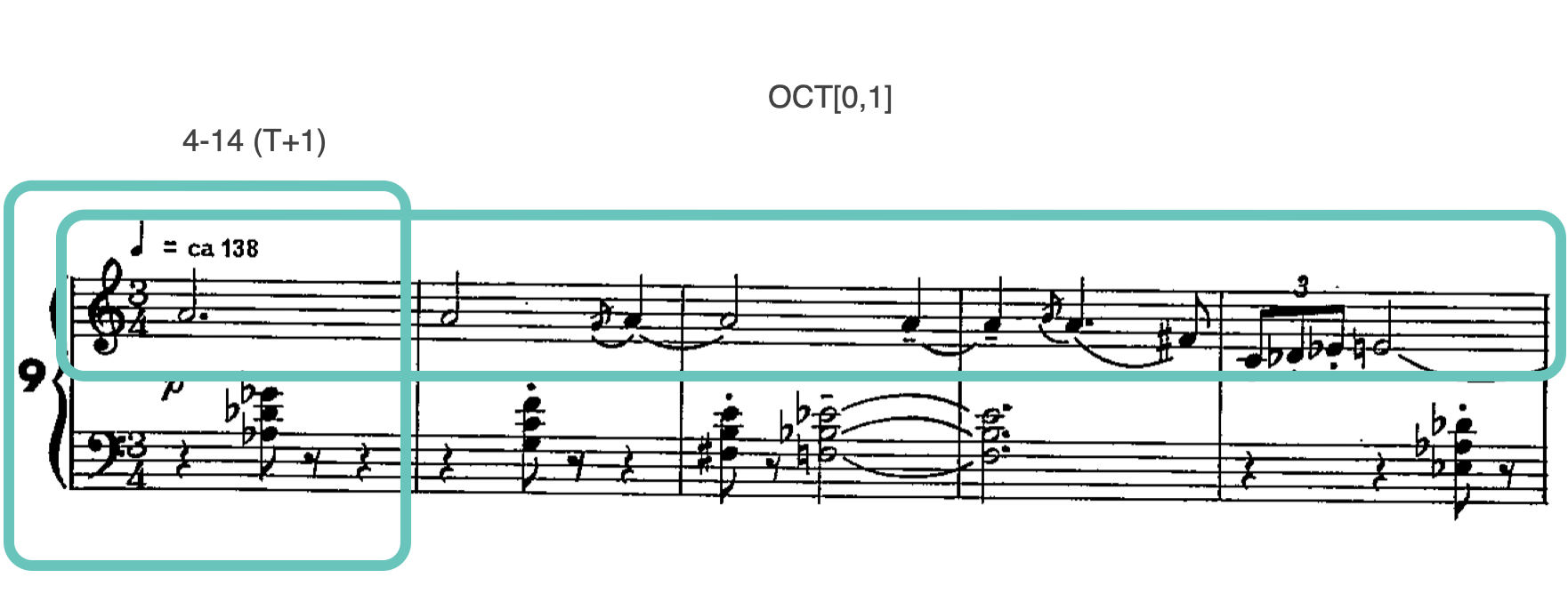
Throughout the piece, the right-hand material shifts between the three possible transpositions of the octatonic collection, while the accompaniment emphasises quartal harmonies which move around in parallel motion. The left-hand chord of stacked fourths in the opening bar combines with the sustained A♮ in the right hand to form set-class 4-14, another of the T+1 tetrachords, because the four-note chord could be revoiced as F♯ minor with an added G♯. This shows how Lilburn’s sonic preferences underlie even seemingly atypical harmonic choices.
Inversional symmetry in Nine Short Pieces
Two of the Nine Short Pieces display the axiomatic use of inversional symmetry, surely indebted to Bartók’s use of such mirror-image techniques in his 14 Bagatelles, op. 6 and in the last three books of Mikrokosmos. As opposed to the transpositional symmetries of the OCT, HEX and WT collections, the use of inversional symmetry creates a contrapuntal line that operates in strict contrary motion to the primary melodic line. Examples of this feature heavily in the seventh and eighth pieces.
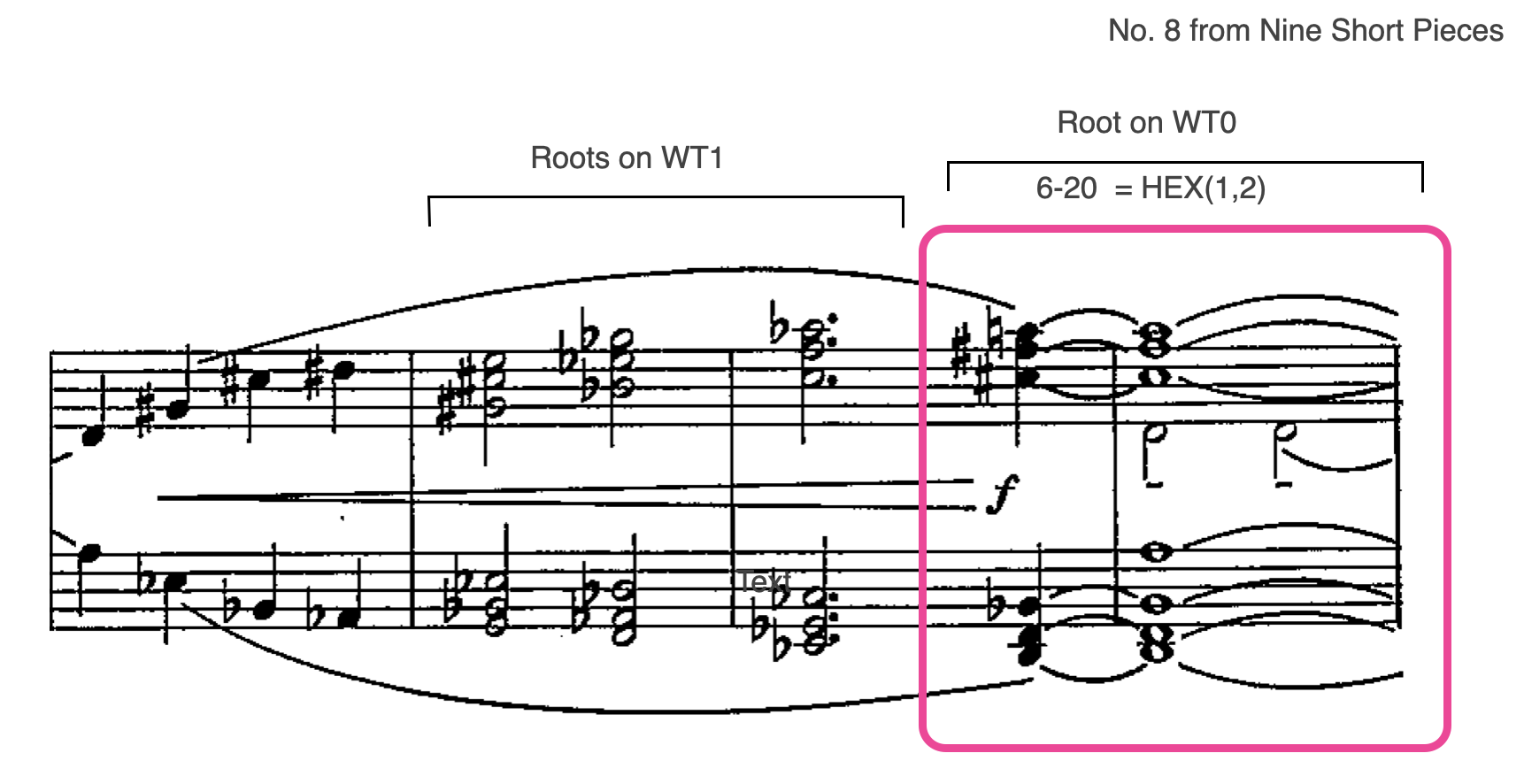
In No. 8, for instance, the entire work, including the triadic harmonies, are mirrored between left and right hands via a double inversional axis on B and C (see Ex. 14), sometimes simultaneously, and sometimes in an approximate mirror canon.
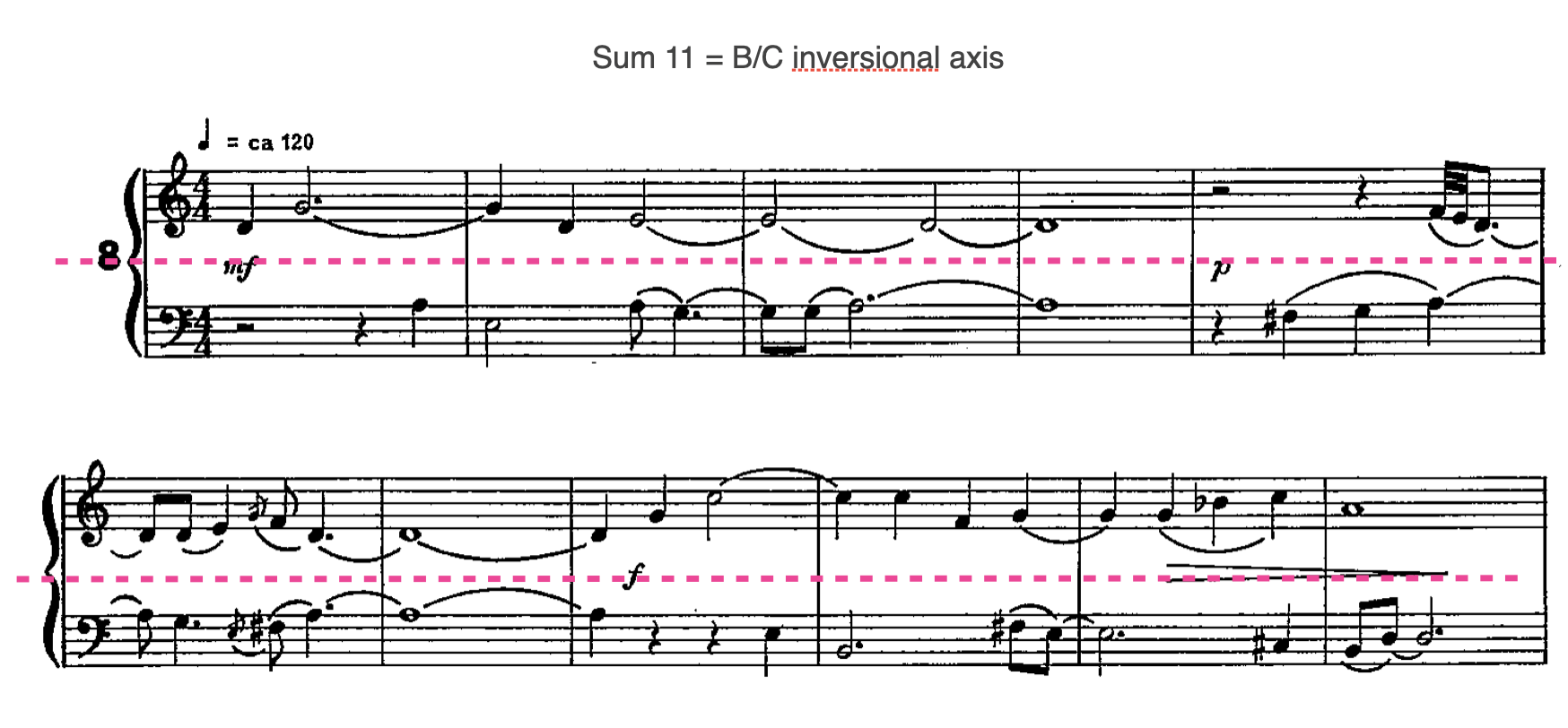
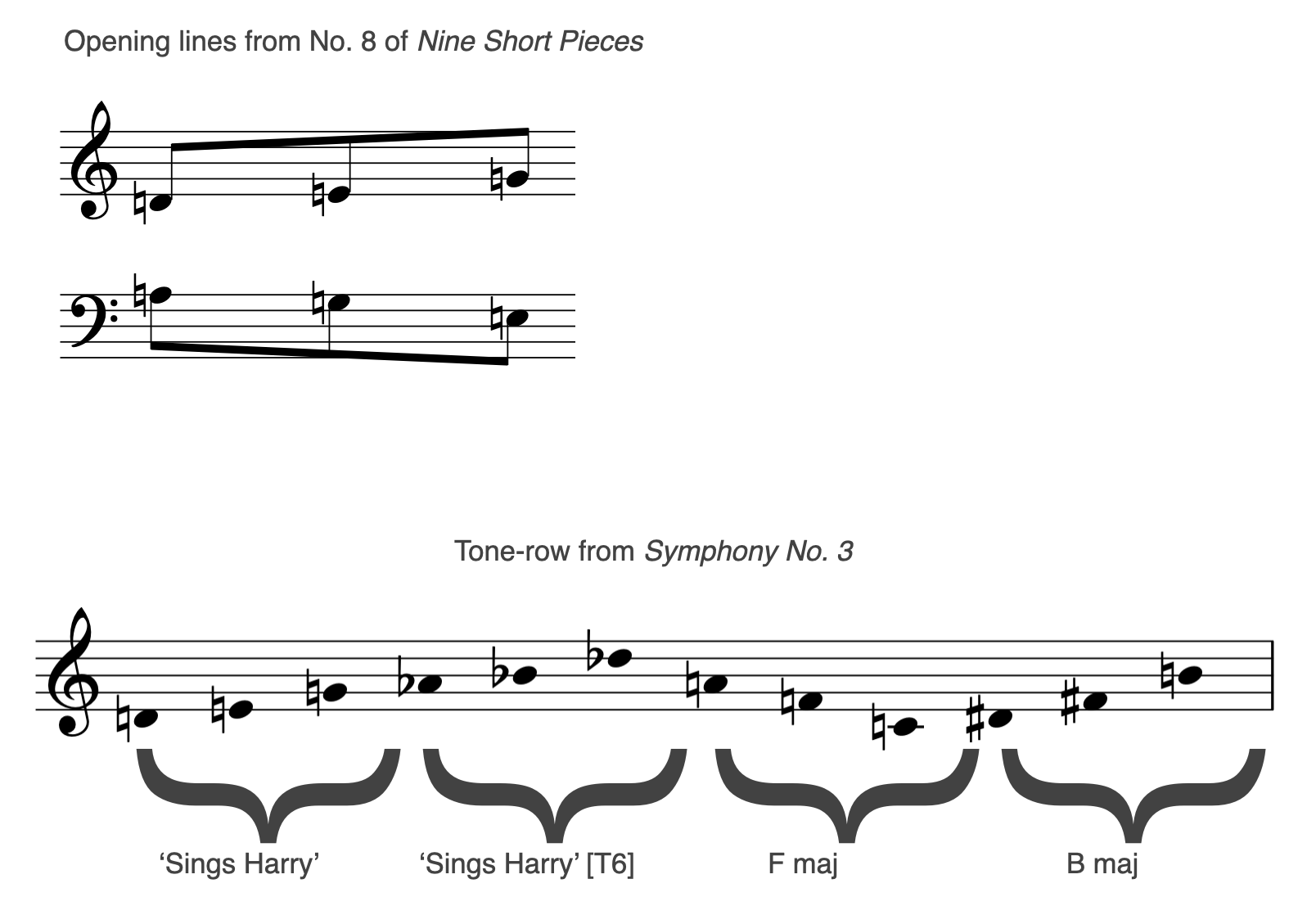
When inverting an octatonic scale around a double inversional axis, only the specific OCT transposition that includes those two pc will invert onto itself, while the remaining two transpositions reflect onto the other. In the case of the axis B/C, this means that only OCT(0,2) will reflect onto itself. But the opening 7 bars are written in the OCT(1,2) collection in the right hand, meaning that the left hand is written in OCT(0,1). This creates a tantalizingly non-modal accompaniment to a simple octatonic melodic line, a line that features a pentatonic subset redolent of the 2-3 Sings Harry motif (D-E-G, the pc that also open Lilburn’s Third Symphony) —– see Ex. 15.
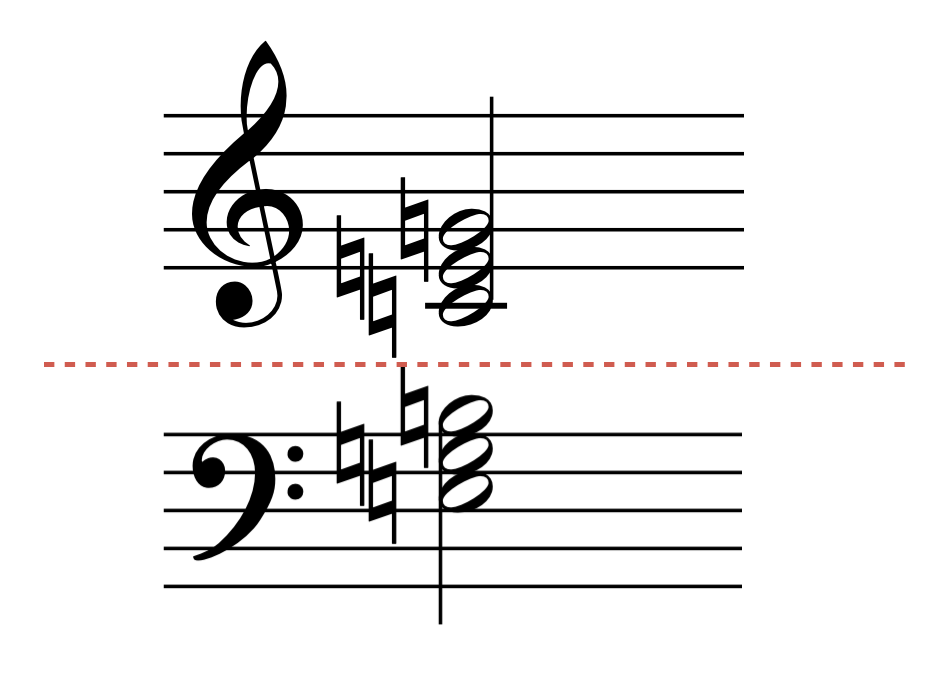
Later, the two-part texture gives way to full triadic harmony, and we can see that when inversional symmetry is applied to these triads, some interesting aggregates result. A major triad above the axis of symmetry will be reflected to a minor triad below, and the fifth degree of the upper triad will flip over the axis to become the root of the triad below.
In addition, if you superimpose any major or minor triad with another major or minor triad whose root is a multiple of 4 semitones away, you will end up with an aggregate that is some subset of the hexatonic collection, and in some cases, not just a subset but the entire hexatonic collection can be formed. These two facts combine in this work in the following way: any triad whose root lies on the Whole Tone Scale on C will be reflected to a triad whose root will be a multiple of 4 semitones away, and will thus combine to form a subset of the hexatonic collection, or potentially it will even form the entire scale.
Ex. 17 shows a good example of this process, that occurs in b.22: Lilburn deliberately places his triads on poles of the WT1 collection (C♯, E♭, F) until the very climactic point of the expanding wedge, when through semitonal voice-leading an F♯ minor chord is reached in the right hand. F♯, being part of a WT0 collection, is reflected onto a B♭ major chord, and the two triads form the aggregate of a full HEX(1,2) collection.
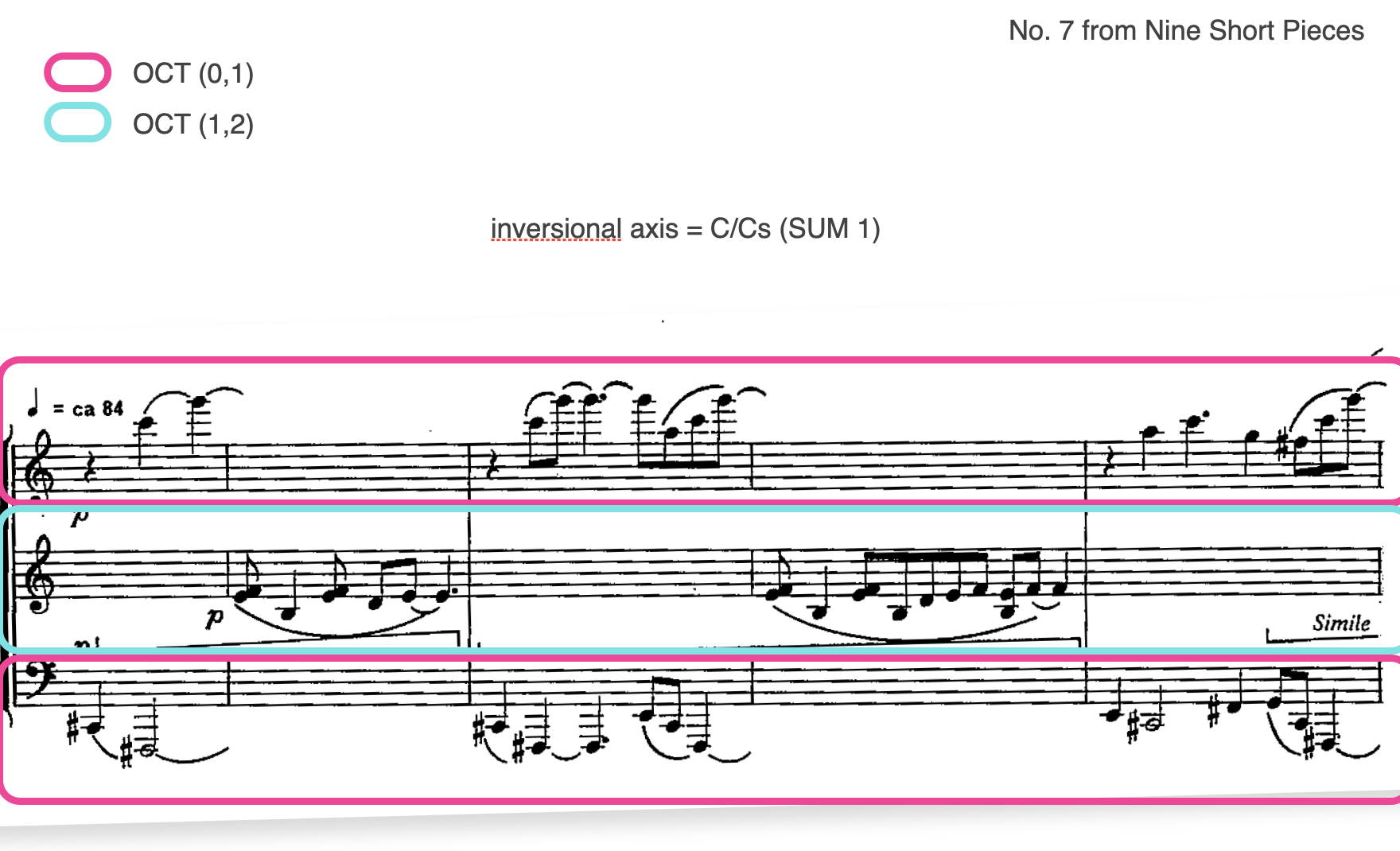
In the seventh short piece, however, Lilburn chooses a double inversional axis between C and C♯. The OCT(0,1) collection in the top staff now includes the pc of the inversional axis, and thus its inversion in the left-hand remains in the same transposition. Lilburn partitions these two strata with a middle-register line in OCT(1,2). The widely spaced registral spread of this piece, allied with the free rhythm and multiple laisser vibrer markings (which presumably implies that the piece is awash with pedal), creates a spacious distribution of distinct sonic strata.
Summary
These analyses of the harmonic organisation of these late piano works show that Lilburn was clearly influenced by early-to-mid-twentieth-century post-tonal developments from abroad. Despite the typically chromatic language, however, symbolic of a progressive impulse, Lilburn imbues them with his own triadically derived preferences, a strategy potentially stemming from the root substitution sonorities of his modal works of the 1940s. We might speculate that, given the brevity and relative simplicity of the material, Lilburn felt ambivalent about the musical worth of these late instrumental works.
This may stem either from the problem of building long-term functional structure with symmetrical pitch resources, or from Lilburn himself sensing that the dialectical synthesis was essentially an artistic compromise, rather than a compelling musical direction. It’s also worth noting that Jenny McLeod was poised to embark on the most fertile project of her compositional career, the Tone Clock Pieces, based on a rigorous expansion of pitch-class set theory bringing in symmetrical concepts that far outweighed Lilburn’s own dabblings here in terms of intellectual and theoretical scope.
In any case, the fact that these works are the last real development of Lilburn’s instrumental language is a shame. Despite the orchestrational virtuosity displayed in late works such as A Birthday Offering, Lilburn could never quite bring himself to adopt the kind of spatial, textural and timbral focus that post-war European composers, such as Penderecki, Nono, Ligeti, Harvey, Grisey, Murail, Sciarrino or Saariaho had adopted during the 1970s and 1980s. One wonders what he might have made of the rough-hewn sonic nuances of Helmut Lachenmann’s musique concrète instrumentale, for instance — an acoustic attempt to capture the timbral continua of electroacoustic music. I suspect he would have dismissed it, despite the fact that he was doing precisely that with his analogue synthesizers in the studio, for the use of extended instrumental technique seems to have been a bridge too far for Lilburn. One can speculate that this may have stemmed both from the lack of experience in New Zealand performers in the 1960s in extended techniques, which surely must have been pretty non-existent, as well as to his own personal lack of conviction at the merits of timbral manipulation as a valid musical pursuit in the instrumental domain. But one can’t help but privately imagine what the composer the glistening, crystalline spaces of his electronic study Soundscape with Lake and River might have created had he sought to bring them into the instrumental domain: the Nine Short Pieces provide us with only the tiniest glimpse into that future that was never to be.