This article was originally published in Canzona 2006. It was revised in 2026; revisions were made to make some of the technical terms a little more intuitive, as well as clarifying some of the wording and language.
This article explains the mathematical foundations of Allen Forte’s pitch-class set theory and Jenny McLeod’s tone-clock theory, focusing on two central ideas: the classification of pitch-class sets by prime form (called ‘Intervallic Prime Forms’ or IPFs by McLeod) and the phenomenon of “12-note tone-clock steering”, in which a single IPF, when transposed and/or inverted multiple times, can generate the complete chromatic aggregate without pitch repetition. The article explains how to enumerate the number of IPFs in any equal tempered system using Pólya’s enumeration theory and Fripertinger’s formulation for the dihedral group, and secondly, the systematic generation of pitch-class tessellations: partitions of chromatic space produced by repeated transposition alone (T-tessellations) or by combined transposition and inversion (TI-tessellations). Finally, the paper demonstrates how these group-theoretic tools can be generalised beyond twelve-tone equal temperament, outlining practical computational approaches and exemplifying tessellations in other EDOs, such as 24-TET, thereby laying groundwork for extending tone-clock principles into broader microtonal pitch spaces.
Introduction
Allen Forte’s pitch-class set theory (hereafter abbreviated PCST) and Jenny McLeod’s development of Peter Schat’s tone-clock theory (TCT) make many interesting and useful observations about the nature of the chromatic scale and its subsets.1 The theories provide composers with some robust technical armoury, especially through the notion of “set classes”, which relates sets of pitch-classes through their “prime form”. In TCT, the “prime form” is called the “Intervallic Prime Forms” or “IPF” for short (McLeod does not use the term “set class”).
Set classes, prime forms and IPFs are useful in a post-tonal context because they can be used to relate different musical ideas that share a common intervallic construction. There is a sense, that is borne out by Schat’s and McLeod’s music, that musical motifs, gestures and chords that saturate a work with a common small set of intervals, give that work a strong sense of harmonic cohesion and unity.
Both Schat and McLeod were particularly fascinated by the way in which you can use transposition and inversion on a set of pitches to generate all twelve pitch-classes of the chromatic scale without repeats—a technique called “tone-clock steering”.2
Many of the concepts and observations in both Forte’s and McLeod’s texts are, unfortunately, presented without a rigorous mathematical foundation. As such, it is difficult to generalise these concepts beyond the chromatic scale. If, for example, we wanted to follow the principles of TCT in microtonality, this would currently be difficult.3 Moreover, there is not much in the literature that attempts to fill in the mathematical foundations of either theory. This is particularly surprising given the fact that both PCST and TCT are couched in quasi-mathematical language. Two important texts that examine PCST are [Lewin, 1987] and [Soderbergh, 1995]; however, there are no texts to my knowledge that examine TCT from a specifically mathematical point-of-view.
This article therefore provides some of the mathematical and algorithmic groundwork for the compositional ideas presented by TCT, as a starting point for future work.
Justification
There are undoubtedly those to whom the idea of applying mathematical principles to music is, at best, misguided and, at worst, abhorrent and unmusical. I concede that there are numerous pieces of music that, while displaying some interesting mathematical principle, fail to actually become an interesting piece of music in its own right. It could be argued that history has consigned Boulez’s Structures 1a to something of an exhibit in the history of “intellectual music”. However, its bold experimentation with total parametric control opened up a certain sonic space that was promptly inhabited by an entire generation of composers including Xenakis, Ligeti and Penderecki. Even if this space was not one that was entirely intended by the compositional technique, we still feel the resonance of this immediate post-war period today.4
In relation to the current article, it might be argued that the maths and pitch symmetries presented here are musically irrelevant, obtuse or meaningless. Like any tool, however, it gains meaning and expressivity through an insightful composer’s intuition. I hope, therefore, that I can present my thoughts in a manner such that some other composer may, like Boulez, use these tools to open up new sonic spaces from which emerge meaningful works of art.
Mathematical definitions
In this article, I assume the standard mathematical definitions of chromatic pitch space: the chromatic scale comprises a series of pitch-classes (pcs), numbered using pitch class integer (pc int) notation (a whole number from 0=C up to 11=B). These numbers are always manipulated using “modulo” mathematics: if we add 1 to 11, we get 0, just as the next pitch-class after B is C.
The two most important musical operations of transposition and inversion have simple mathematical equivalents: transposition is addition of a constant (n+x, where x is the pc int and n is the interval of transposition) while inversion is subtraction from a constant (n-x).
In mathematical parlance, the chromatic scale is known as a “finite abelian group of order 12”—finite as it has a finite number of members, and abelian because the operations of addition hold.5
This article will examine how two particular notions of PCST and TCT—the “prime form” and “pitch-class tessellation”—can be generalised to finite abelian groups of any order (which, in musical terms, can be thought of as any equal-tempered divisions of the octave).
How many prime forms? Enumerating equal-tempered configurations
The notions of the “set class”, “prime form”, “intervallic prime form” are related concepts that form the basis of both chromatic theories. They represent a way of characterising, and therefore relating, different sets of pitch-classes through their fundamental intervallic construction. This is done through the principle of “invariance under transposition and inversion”—that is, if two chords can be transposed and/or inverted onto the same set of pitch-classes, then they share the same “set class” and are equivalent. A C-major triad, for instance (C, E, G) can be inverted to form an F minor triad (C, A♭, F); therefore, major and minor triads share the same set class.6
When it comes to listing the complete catalogue of set class, however, there are some discrepancies in the literature. In [Forte, 1973], 220 set classes are identified7, while in [McLeod, unpub.], there are 222 IPFs.8 It turns out that this discrepancy merely comes down to the sizes of sets we include in our catalogue.
In any case, neither author gives us a clear mathematical basis or algorithm for calculating the exact number of prime forms available, or much of an insight into how the exhaustive list is determined. There is no procedure in either text, for instance, for determining how many set classes there are in 24-division microtonality. It seems as if a “trial and error” method is the only means for working these out.
There has been a recent interest, however, in solving some of these questions. A number of authors have presented solutions to the problem of determining the number of prime forms and the composition of these forms. The solution to the first problem—the number of prime forms—uses a conjecture known as “Burnside’s lemma” (and its generalisation, “Pólya’s enumeration theorem”). These conjectures are traditionally used to solve problems with regards to chemical compounds: for instance, if we can create a molecule from 12 atoms, and each atom can be one of two elements, how many possible different molecules are there?
This conjecture is most frequently presented under the guise of the “binary necklace problem”. The question goes something like this: if we have a necklace of 12 beads, and each bead can either be red or blue, then how many different configurations of necklace are there? Now, we would normally expect that, if each bead has two colours, the answer would be $2^{12}$. However, the catch is that rotating the necklace and/or turning it upside-down does not change the configuration. So we cannot calculate the number of possible configurations through a simple exponential.
The chemical compound problem and the binary necklace problem are directly equivalent to the problem of enumerating prime forms. The analogy is given by considering each bead of the necklace as representing one of the twelve pitch-classes of the chromatic scale. A red bead symbolises a pitch-class that is included within the set, while a blue bead symbolises a pitch-class that is not included. Rotating the necklace, then, is equivalent to transposing a pitch-class set. “Turning it over” is equivalent to inverting the set. In both cases, the prime form is unchanged, just as the fundamental “configuration” of the necklace/molecule is unchanged (“invariant”) by these operations.
Specific equations for enumerating IPFs are given in a 1992 article by Austrian music theorist Harald Fripertinger, who uses Pólya’s enumeration theorem to determine a number enumeration problems in twelve-tone music.⁹ One of these problems is entitled the “number of patterns of k-chords in 12-tone-music with regard to the dihedral group”. Translating that into musical terminology, “k-chords” are just sets of pitch-classes of any size, and the dihedral group is simply the series of operations including rotation (transposition/addition) and reflection (inversion/subtraction)—precisely the operations that IPFs are invariant under.
Fripertinger gives us the following algorithm:9
$$\begin{cases} \frac{1}{2n}\left(\sum_{j|\gcd(n,k)} \varphi(j)\left(\begin{matrix}\frac{n}{j} \\\\ \frac{k}{j}\end{matrix}\right) + n\left(\begin{matrix}\frac{(n-1)}{2} \\\\ \left[\frac{k}{2}\right]\end{matrix}\right)\right) & \text{if } n \equiv 1 \bmod 2 \\\\ \frac{1}{2n}\left(\sum_{j|\gcd(n,k)} \varphi(j)\left(\begin{matrix}\frac{n}{j} \\\\ \frac{k}{j}\end{matrix}\right) + n\left(\begin{matrix}\frac{n}{2} \\\\ \frac{k}{2}\end{matrix}\right)\right) & \text{if } n \equiv 0 \bmod 2 \text{ and } k \equiv 0 \bmod 2 \\\\ \frac{1}{2n}\left(\sum_{j|\gcd(n,k)} \varphi(j)\left(\begin{matrix}\frac{n}{j} \\\\ \frac{k}{j}\end{matrix}\right) + n\left(\begin{matrix}\frac{n}{2}-1 \\\\ \left[\frac{k}{2}\right]\end{matrix}\right)\right) & \text{if } n \equiv 0 \bmod 2 \text{ and } k \equiv 1 \bmod 2. \end{cases}$$The number of k-chords in $\mathbb{Z}_n$ with respect to the dihedral group is:
Which gives us the following output for $\mathbb{Z}_{12}$.
| IPF cardinality | 1 | 2 | 3 | 4 | 5 | 6 | 7 | 8 | 9 | 10 | 11 | 12 |
|---|---|---|---|---|---|---|---|---|---|---|---|---|
| Count | 1 | 6 | 12 | 29 | 38 | 50 | 38 | 29 | 12 | 6 | 1 | 1 |
Summing these counts gives us 223 IPFs, though that includes the trivial ‘one-note’ group, as well as the full chromatic scale. This approach can be generalised to other divisions of the octave.10
Although this solution gives us the number of prime forms available in $\mathbb{Z}_n$, it does not tell us what those prime forms are. In [Roeder, 1982], however, a solution is presented: the list of ics in an IPF are given by an array of coordinates bounded by a set of (given) inequalities.
Roeder provides the example of generating all 12 possible triadic IPFs, by showing how the set of [x,y] pairs of intervals must satisfy the three inequalities $x\gt 0$, $y\ge x$, and $x+2y\le 12$. These are: [1,1], [1,2], [1,3], [1,4], [1,5], [2,2], [2,3], [2,4], [2,5], [3,3], [3,4], [4,4] — precisely the 12 triadic IPFs (even given in McLeod’s IPF notational format!). We can then generalise Roeder’s inequalities to other IPF sizes and other divisions of the octave by specifying the following two conditions for a set of interval classes in $\mathbb{Z}_n$:11
- an ic in the list must be greater than or equal to the previous one
- the sum of the ics, with one ic doubled, must be less than or equal to n
Tone-clock steering: tessellating chromatic space
A musically alluring observation made by Schat, that was absolutely pivotal to his conception of the tone clock, was that eleven out of the twelve triadic IPFs can be transposed and inverted to generate all twelve pitch-classes without repeats. The only exception to this is the diminished triad, although its four-note counterpart—the diminished seventh—does display this property.
This procedure of generating the chromatic aggregate using transposition and inversion of an IPF is known as “twelve-tone steering”, and has been used extensively by McLeod and Schat in their compositions. It is musically attractive because it generates and controls chromatic saturation (using all twelve notes of the chromatic scale) while retaining a high degree of intervallic coherence thanks to the invariance of the IPF under the operations of transposition and inversion.
Ex. 1 shows the IPF 4-4 (an augmented triad) being transposed (or, in geometrical terms, rotated) to complete every note of the chromatic scale without repeats:
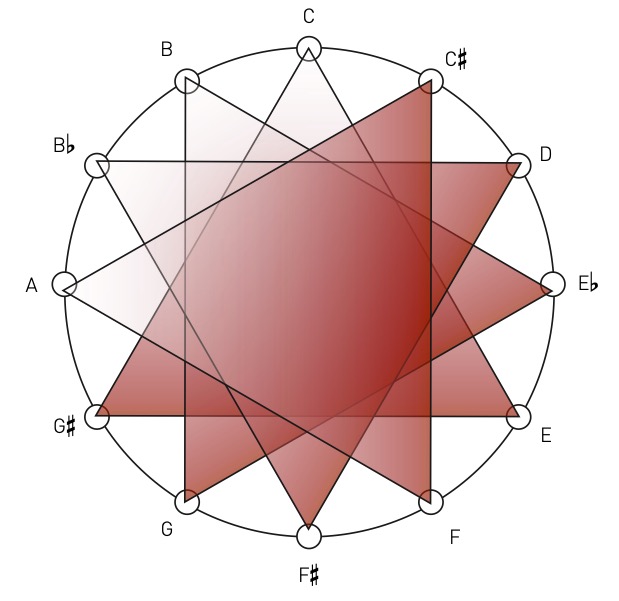
This ability to partition a finite cyclic group through operations on a single IPF is given a number of names in the literature, including “tone-clock steering”, “tiling the line”, and “chromatic partitioning”. In this paper I adopt the geometrical term “tessellation”, the filling of a space through the operations of rotation, translation and/or reflection performed on a single shape.¹³ To identify the fact that I am specifically interested in musical tessellations, I will use the term “pitch-class tessellation”, but on the understanding that this concept applies to other equal-tempered divisions of the octave than just the chromatic scale.
Pitch-class tessellation is not mentioned, as far as I can determine, in any of Forte’s writing, except, perhaps, in discussing the concept of hexachordal combinatoriality, which is a special case of pitch-class tessellation. We say that a twelve-tone row has hexachordal combinatoriality if there is an inversion or transposition of the row in which the first six notes are the complement of the first six notes of the original row (which means they are the same as the last six notes of the original row). This is the same as saying: if the first six pitch-classes of the row are an IPF, then this IPF tessellates the chromatic circle, as the last six notes of the row are exactly equivalent to some inversion and/or transposition of the first six (because they were found in the first six notes of another row form).
Josef Hauer appears to be the first composer to systematically explore hexachordal combinatoriality, with his system of “tropes” dating from 1921, though his interest is constrained to hexachords. Beyond hexachords, we have to look to the writings of Romanian composer Anatol Vieru, whose modal theory is based on so-called “partitioning modal classes” (IPFs) and their supplementary sets (steering groups).12 What is particularly interesting about Vieru’s work is that his methods were extensively analysed by Romanian mathematician Dan Tudor Vuza, and thus is, as far as I can tell, one of the first mathematicians to attack the question of twelve-tone steering from a rigorous group-theoretical background.13
There is a fundamental difference between Vieru’s modes and McLeod’s tone-clock steerings, however. Vieru’s modes rely only upon the transposition of a set to tessellate the chromatic space: he does not consider the possibility of inverting a set as well. McLeod and Schat, on the other hand, allow the possibility of inversion (given that an IPF is invariant under inversion, this makes mathematical sense). In this sense, McLeod’s work goes further, although Vuza does apply these theories to the rhythmic domain, create a series of “tessellating canons”, rhythmic patterns that can appear in counterpoint at some delay, with no two attack-points ever appearing together.
Research questions
This article developed from a cluster of questions that emerged during my readings and discussions of tone-clock theory. The questions particularly centred around the degree to which the theory was an expression of deeper mathematical truths about the chromatic scale. Here are examples of the kind of questions I found myself asking:
- Given an arbitrary IPF, is it possible to determine, without using trial and error or a pre-existing chart, whether the IPF can tessellate, and, if so, what its steering group is?
- Relatedly, what is it about the structure of the diminished triad, for instance, that prevents it from having this property, while all other 11 triads have it?
- Do other divisions of the octave (say, into 24) also possess chords that have this property? Are there limitations on the types of tessellations that occur in certain subdivisions of the octave?
It turns out that these questions are actually extremely interesting to mathematicians as well, and not all of these have been definitively answered, as far as I can determine. However, it was possible with some basic maths and a little common sense to set about tackling these by posing a specific research question which I felt I could answer:
Is there an algorithm, or set of algorithms, that will generate all possible pitch-class tessellations for any finite cyclic group $\mathbb{Z}_n$ and any arbitrary IPF size within that group?
Terminology
Before we begin looking at the maths of tessellation, we need to understand the basic mathematical terms:
- $\mathbb{Z}_n$: a ‘cyclic group’ of order n (e.g. 12 for chromatic scale). In musical terms, this would be any ’equal temperament’.
- M: any IPF of cardinality14 #M
- EDO: Equal Division of the Octave, such as the chromatic scale (12EDO). We are particularly interested in equal subdivisions of a ‘higher’ division: for instance, 12EDO can be subdivided into other equal subdivisions: 22222 (the whole-tone scale), 333 (the diminished seventh tetrad), 4-4 (the augmented triad) and 6 (the tritone). These equal subdivisions of an EDO are key to understanding tessellation.
- EDO cluster: a semitone cluster that ‘fills in’ an EDO. EDO clusters are important because they always create the aggregate when they are transposed by the EDO period. There are four EDO clusters in the chromatic scale:
- 1 (a semitone)
- 1-1 (a cluster of two semitones, or hour I in tone-clock terminology)
- 111 (a cluster of four semitones, or hour-group I4)
- 11111 (a cluster of six semitones, or hour-group I6)
- EDO cluster-scales: EDO cluster-scales are a special kind of IPF formed by taking a smaller EDO cluster (in the case of 12TET, either 1 or 1-1), and transposing it by a larger EDO that is a whole-number multiple of the smaller EDO period repeatedly until you complete the octave. This will create something that looks a bit like a scale, but with regular ‘gaps’ between the semitones/clusters that can be filled through its own transposition. An example would be taking the EDO cluster 1-1 (of size 3) and transposing it by period 6 (a tritone) to create the ‘scale’ IPF 11411(4). Note that in this instance, we can not create an EDO cluster-scale by transposing it by period 4, as 4 is not a multiple of 3. EDO cluster-scales are important because, like EDO clusters, they can also create tessellations through transposition alone. There are only three possible EDO cluster-scales in 12TET:
- 13131 — hexatonic scale (HEX), or III6
- 151 — Bartók’s Cell Z, or V4
- 11411 — Messiaen’s Mode 5
Conditions for tessellation
The first mathematical principle is to state the two fundamental conditions necessary for forming any tessellations at all within a finite cyclic group of arbitrary size:
- For any tessellations at all to occur in $\mathbb{Z}_n$, n must be non-prime;
- for example, 12TET and 24TET will contain tesselations, but 5TET will not
- For an IPF of size #M to have the potential of tessellating in $\mathbb{Z}_n$, #M must be a divisor of n, and 1 < #M < n, though this does not guarantee tessellation.
- for example, in 24TET, only IPFs of size 2, 3, 4, 6, 8 and 12 will have the potential of tessellating
Types of tessellation symmetry
Next, we identify five algorithms for generating tessellating pitch sets in $\mathbb{Z}_n$. These algorithms can be grouped into two main types of symmetry:
- T-tessellations (tessellations that occur through transposition alone)
- TI-tessellations (tessellations that require inversion, and potentially transposition as well)
The five algorithms are as follows:
- T-tessellations with EDO transpositions
- T-tessellations of EDO cluster-scales
- TI-tessellations with inversion along
- TI-tessellations with inversion and transposition
- TI-tessellations with EDO cluster symmetry
A note on steering partners
It seems that true “reverse tone-clock steerings”, in which the steering group can, in turn, be transposed by the notes of the original IPF to obtain saturation, are guaranteed to occur for T-tessellations only. For TI-tessellations, on the other hand, the inverse steering will be an “anchor form” (assuming the steering group is symmetrical, which is the case for any of the steerings produced by these algorithms), in which the IPF will only be able to be reverse steered a certain number of times, and the “remainder” will be a symmetrical “anchor group”.
The tessellation algorithms
The following section gives a brief explanation of how each algorithm works.
1. T-Tessellations (tessellations through transposition only)
1.1 T-Tessellates with EDO transposition
These tessellations occur through repeated transposition of an IPF at an EDO period equal to the cardinality of the IPF (#M). For example, in Ex. 2 below, the IPF is a triad (cardinality 3), and it is therefore transposed by a diminished seventh chord (333). (As with all tessellations, #M must be a divisor of n — see Conditions of Tessellation above.)
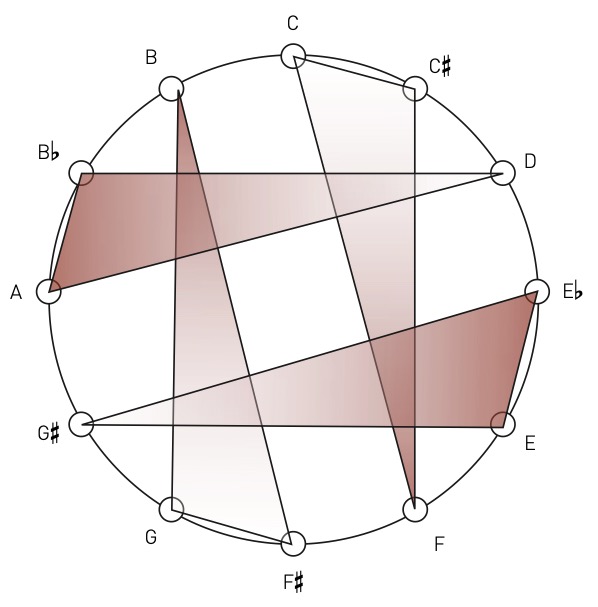
IPFs that can be tessellated in this manner
These tessellations are based on the underlying concept that an EDO cluster can always ‘fill in’ the aggregate when transposed. So, all EDO clusters can therefore be tessellated in this manner. There are other IPFs, however, that are not EDO clusters, but can be traced back to them.
We can create an exhaustive list of all IPFs of a particular cardinality that can be tessellated in this manner by drawing an EDO cluster of the required cardinality, starting on C on a chromatic circle, and then, for each pc in the cluster, transpose that pc by a multiple of the EDO period.
For instance, the example tessellation of a triad shown in Ex. 2 above was derived from an EDO cluster of cardinality 3 (C, C♯, D), was remapped through F through transposition by 3 semitones, forming the new IPF C, C♯, F. To create the tessellation, repeatedly transpose the IPF by #M.
If we follow this procedure for EDO cluster 1-1, the IPFs formed by this algorithm are as follows (all tessellatable by the diminished seventh triad, or X4 in tone-clock notation):
| Original cluster with 0 or 1 pc transposed by EDO period (3) | Cluster with 1 pc transposed by the EDO period (3) |
Resulting IPF (hour) | Notation (in ordered voicing) |
|---|---|---|---|
| C, C♯, D | C, C♯, F | 1-4 (IV) | 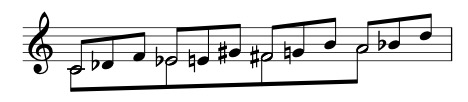
|
| C, C♯, D | C, C♯, G♯ | 1-4 (IV) | 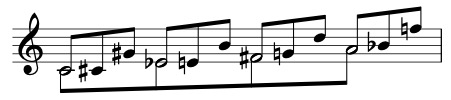
|
| C, C♯, D | C, C♯, B | 1-1 (I) | 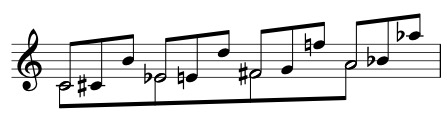
|
| C, E, D | C, E, D | 2-2 (VI) | 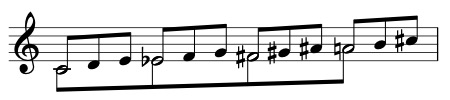
|
| C, E, D | C, E, F | 1-4 (IV) | 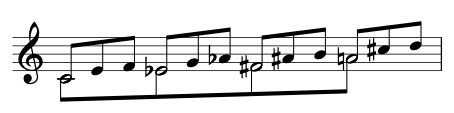
|
| C, E, D | C, E, A♭ | 4-4 (XII) | 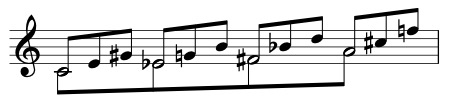
|
| C, E, F | C, E, B | 1-4 (IV) | 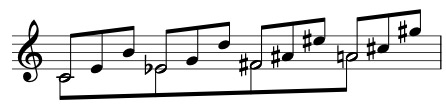
|
| C, G, A♭ | C, G, D | 2-5 (IX) | 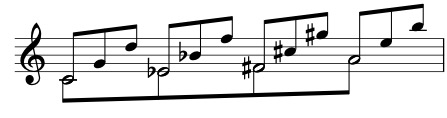
|
| C, G, A♭ | C, G, F | 2-5 (IX) | 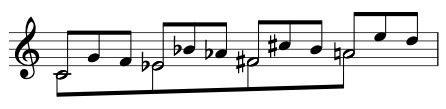
|
| C, G, A♭ | C, G, A♭ | 1-5 (V) | 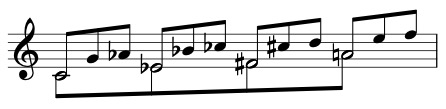
|
| C, G, A♭ | C, G, B | 1-4 (IV) |
|
Note: many transpositions and voicings of the basic sets above are possible.
This demonstrates that the following IPFs are the 5 possible T-tessellatable chromatic triads: all can be tessellated through transposition by 333 (X4):
| IPF | Hour | 12-note tone-clock steering | Notation |
|---|---|---|---|
| 1-1 | I | I / X4 | 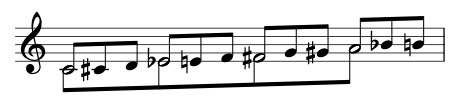
|
| 1-4 | IV | IV / X4 | 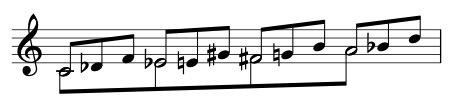
|
| 2-2 | VI | VI / X4 | 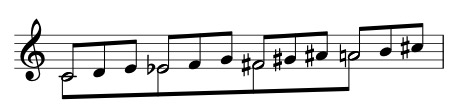
|
| 2-5 | IX | IX / X4 | 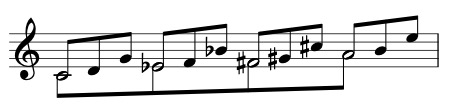
|
| 4-4 | XII | XII / X4 | 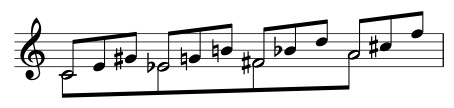
|
Tessellation test
To check whether any IPF tessellates using the method above:
If for each pc x in the IPF, x MOD #M is unique, then the IPF T-tessellates.
For instance, the pc set [057] MOD 3 gives [021]. Therefore [057] has a T-tessellation. On the other hand, pc set [047] MOD 3 gives [011]; because ‘1’ repeats, therefore [047] does not T-tessellate. (It may tessellate through some other algorithm, however.)
1.2 T-Tessellates of EDO cluster scales
These tessellations occur through repeated transposition of an IPF at an interval equal to the “period” of the EDO cluster.
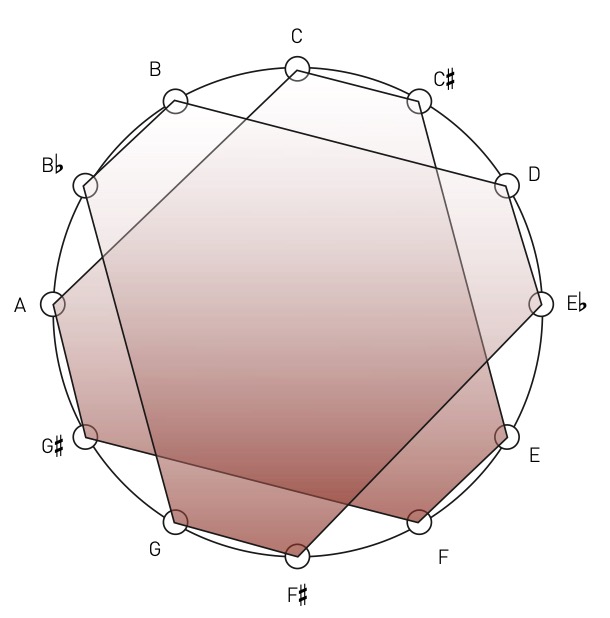
How to create these tessellations
All EDO cluster-scales will tessellate in this manner, transposed at the EDO period of the ‘subcluster’. For example, in the Ex. 3, IPF 131313 tessellates through transposition by 2 (2 being the period of the semitone subcluster).
This is a rare form of tessellation, as it requires an EDO cluster that is an equal subdivision of a larger EDO—the only possibilities of which are a group of 2 consecutive semitones in 4EDO, or 2 or 3 consecutive semitones in 6EDO. This means that there are only 3 possible IPFs in 12TET that are tessellatable in this manner:
| IPF | Hour-group | Common name | EDO cluster period | Steering-group | Notation |
|---|---|---|---|---|---|
| 151 | V4 | Bartók cell Z | 2 | 22 (VI) | 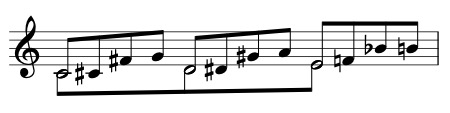
|
| 13131 | III6 | Hexatonic scale | 2 | 2 (major second) | 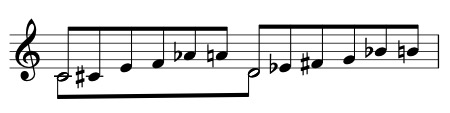
|
| 114-114 (=141-141) |
IVm4+IVm4 (Fourth-hour gemini) |
Messiaen Mode 5 | 3 | 3 (minor third) | 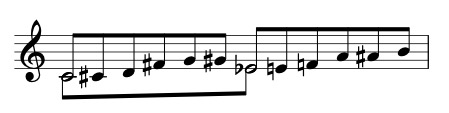
|
3 TI-Tessellations (transposition + inversion)
3.1. TI-Tessellates through inversion alone
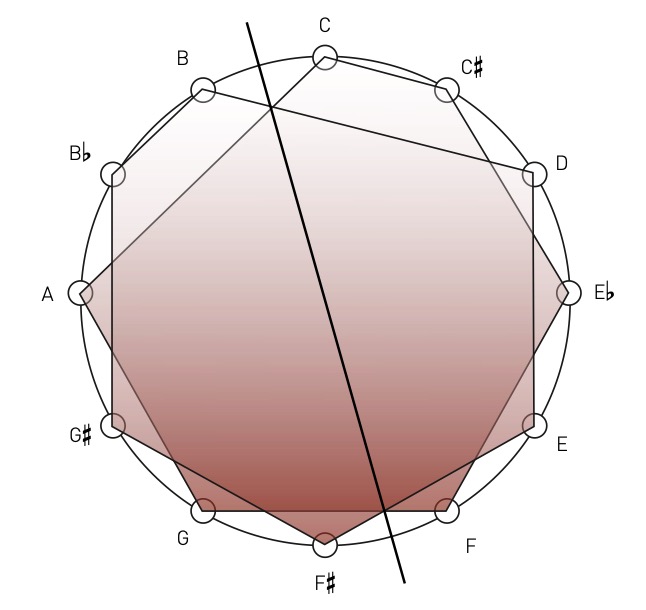
Tessellations using inversion (reflection) alone can only be generated where n/#M = 2 (in other words, in $\mathbb{Z}_{12}$, these are only possible for certain groups of size 6). If n/#M is a multiple of 2 greater than or equal than 4, then these tessellations will appear in the results of the RT-symmetrical algorithm below, and therefore do not need to be calculated separately.
Note that all of the IPFs that can be tessellated in this way possess hexachordal combinatoriality.
How to create these tessellations
On a chromatic circle, draw a vertical axis that divides the group into two equal portions (i.e. between B and C, and between F and F#). Draw an EDO cluster that fills the first half. Now for each pc in the cluster (except C), choose one of the following two remappings:
- keep as is
- reflect the pc in the vertical axis (i.e. 11-pc int) Tessellations occur firstly reflected around V, then, if further tessellations are needed, both the original and reflection can be transposed by 2#M semitones.
For example, we might take the EDO cluster (012345), and then choose pc 1, 2 and 5 to reflect. These become pc 10, 9 and 6, creating pc-set (03469T), which is IPF 12312.
IPF tessellation test algorithm
If #M = Z/2, then for each pc x in the IPF, either: 1) x<#M and x is unique; or 2) x>n/2 and n-1-x is unique, then the IPF TI-tessellates with R symmetry. For instance, with pcs [0,1,3,5,7,9], 0, 1, 3 and 5 are < 6, while 7 & 9 map to 11-7=4 & 11-9=2, which gives [0,1,3,5,4,2], all of which are unique. Therefore the IPF tessellates with R symmetry.
3.2 TI-Tessellates through transposition and inversion
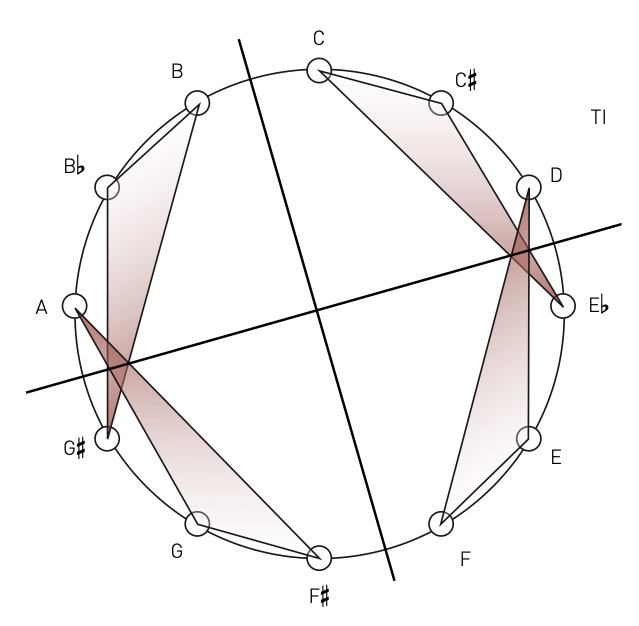
These tessellations can be generated if n/#M is a multiple of 2 greater than 2 (e.g. in $\mathbb{Z}_{12}$, these occur only for groups of size 3 or 2, which divide 12 4 times and 6 times respectively)
How to create these tessellations
On a chromatic circle, draw an EDO cluster of period #M. The EDO cluster period must divide the aggregate period by a multiple of 2 that is greater than 2 (e.g. 4, 8, etc). For 12TET, this means that the only value of #M can be 3.
Label the first cluster T, the next R, and so on, alternately, clockwise around the circle. For each pc in the EDO cluster (except C), choose one of the following three remappings (at least one of which must be a reflection):
- Keep as is
- Reflect the pc into an “R” segment (e.g. if #M is 3, then the 3rd pc would map into the 1st pc of an R segment)
- Transpose the pc into a “T” segment.
In the example above, for instance, the third pc of segment 0 (D) has been remapped by reflection into segment 1 (E♭).
Tessellations occur reflected around the vertical axis, then both the original and its reflection are repeatedly transposed by 2#M semitones until the tessellation is complete.
| Original cluster | Cluster with pc inverted/transposed | Resulting IPF (hour) | Notation |
|---|---|---|---|
| All IPFs can be steered by (C, D, F♯, G♯) = 242 = VIIIm4 |
|||
| C, C♯, D | C, C♯, E♭ | 1-2 (II) | 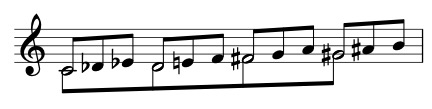
|
| C, C♯, D | C, C♯, G♯ | 1-5 (V) | 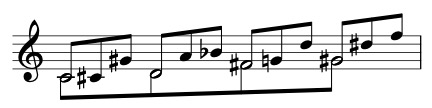
|
| C, C♯, D | C, C♯, A | 1-3 (III) | 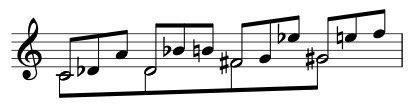
|
| All IPFs can be steered by (C, D♭, F♯, G) = 151 = V4 |
|||
| C, E, D | C, E, E♭ | 1-3 (III) | 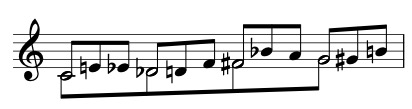
|
| C, E, D | C, E, G♯ | 4-4 (XII) | 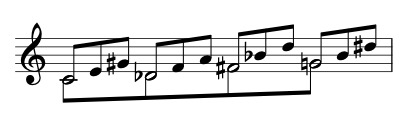
|
| C, E, D | C, E, A | 3-4 (XI) | 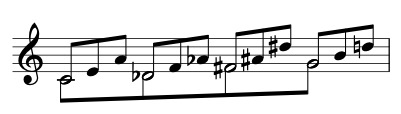
|
| All IPFs can be steered by (C, F, F♯, B) = 151 = V4 |
|||
| C, G, D | C, G, E♭ | 3-4 (XI) | 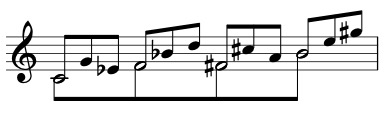
|
| C, G, D | C, G, A♭ | 1-5 (V) | 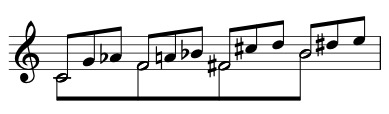
|
| C, G, D | C, G, A | 2-3 (VII) | 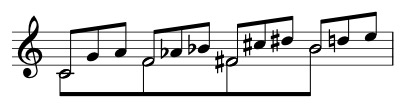
|
| All IPFs can be steered by (C, F, F♯, B) = 151 = V4 |
|||
| C, B♭, D | C, B♭, E♭ | 2-3 (VII) | 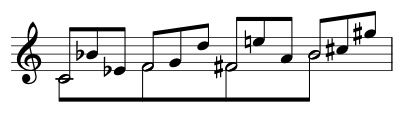
|
| C, B♭, D | C, B♭, A♭ | 2-2 (VI) | 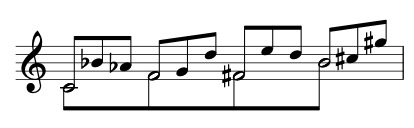
|
| C, B♭, D | C, B♭, A | 1-2 (II) | 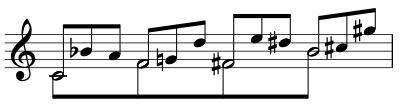
|
IPF tessellation test algorithm
For all pc x of an IPF, if x DIV #M is even, then m = x MOD #M, else if odd, then m = #M - (x MOD #M). Collate all m. If each m is unique, then the IPF has TI-tessellation through transposition and inversion. For example: for [025], 0 remains at 0, (2 DIV 3) = 0, so 2 is mapped to (2 MOD 3) = 2, and (5 DIV 3) = 1, therefore 5 is mapped to 3 - (5 MOD 3) = 3-2 = 1, which gives [012]. Each new number is unique, therefore TI-tessellation through transposition and inversion occurs.
3.3. TI-Tessellates with EDO cluster scale symmetry
These tessellations use the symmetrical properties of EDO cluster scales, by dividing an EDO cluster scale into half, and then using inversion to map one half of the cluster scale pc to the other half, this will give you another method of forming the aggregate. These tessellations can be generated if n/#M is a multiple of 2 greater than 2 (e.g. in $\mathbb{Z}_{12}$, these occur only for groups of size 3 or 2)
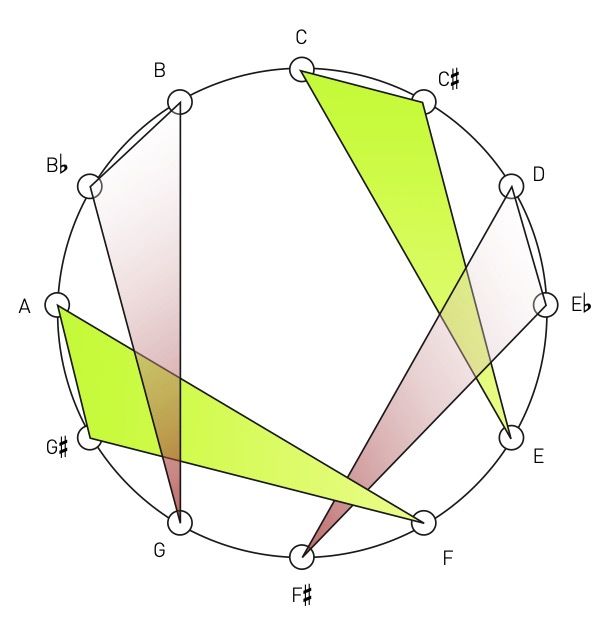
How to create these tessellations
Choose an EDO cluster of size 2#M. Draw an axis of reflection between the first and second #M members of the cluster. For each member of the first #M pc of the EDO cluster (except C), choose one of the following two remappings:
- Remains in place
- Use the pc reflected in the axis of reflection In the example above, the first three pc of EDO cluster scale 13131 have been used.
Tessellations occur reflected around the axis of symmetry, then both the original and the reflection are repeatedly transposed by the EDO segment size until the tessellation is complete.
| Original cluster | Cluster with 0–1 pc inverted | Resulting IPF (hour) | Steering group | Notation |
|---|---|---|---|---|
| Using EDO cluster scale 131313 (hexatonic scale) = (C, C♯, E, F, A♭, A) |
Note triads 1+2 & 3+4 = hexatonic scale | |||
| C, C♯, E | C, C♯, E | 1-3 (III) | VII4 | 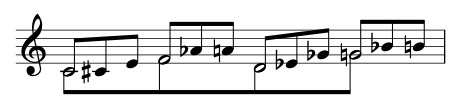
|
| C, C♯, E | C, C♯, F | 1-4 (IV) | VI4 | 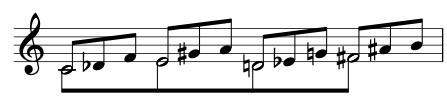
|
| C, G♯, E | C, G♯, E | 4-4 (XII) | VII4 | 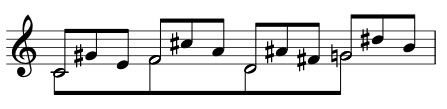
|
| C, G♯, E | C, G♯, F | 3-4 (XI) | VI4 | 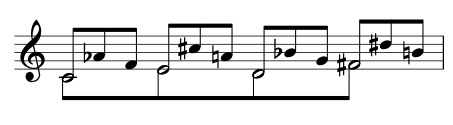
|
| Using EDO cluster scale 114-114 (Messiaen Mode 5) = (C, C♯, D, F♯, G, A♭) |
Note triads 1+2 & 3+4 = Messiaen Mode 5 | |||
| C, C♯, D | C, C♯, D | 1-1 (I) | X4 | 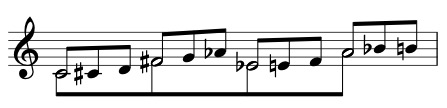
|
| C, C♯, D | C, C♯, F♯ | 1-5 (V) | IIM4 | 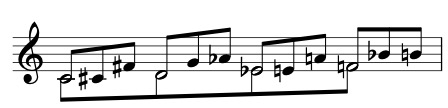
|
| C, G, D | C, G, D | 2-5 (IX) | X4 | 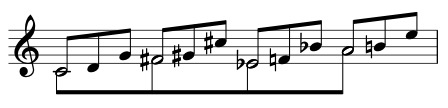
|
| C, G, D | C, G, F♯ | 1-5 (V) | IIm4 | 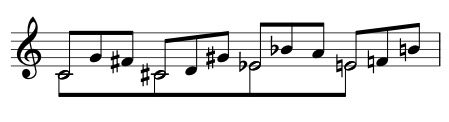
|
IPF tessellation test algorithm
If there exists an EDO cluster scale that is twice the size of the IPF and contains the IPF, and the remaining pc are also the same IPF, then the IPF tessellates in this manner.
Algorithm comparison to IPF charts
In order to test the validity of these algorithms, I compared the outputs of them with McLeod’s own IPF charts. In the chart below, the first column is the IPF name. The next two columns show which kind of 12-note tone-clock steering can be deduced from McLeod’s IPF tables. The following columns relate to the algorithms given here. A * is recorded if the IPF is able to be tessellated using a given algorithm. It also demonstrates the fact that these algorithms can give more detail about the types of steerings available:
Application to microtonality
Using these algorithms, we can easily generate tessellations in standard 24-division microtonality—a sample tessellation is given here:
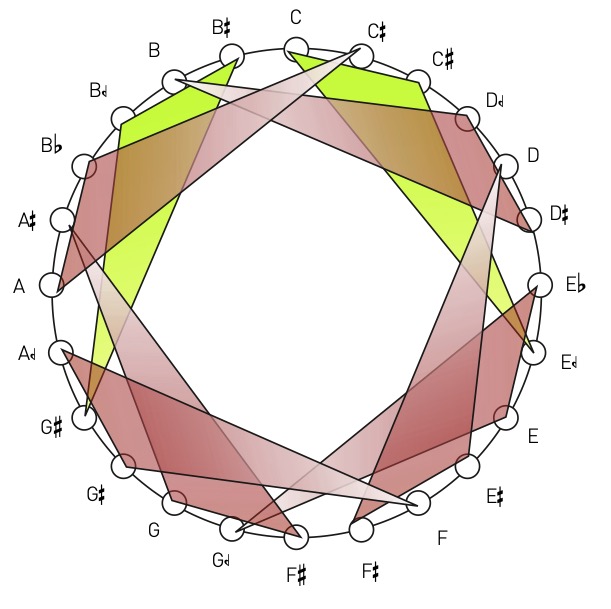
These can be generated most effectively by using a computer. Below, I have printed the URLs for two online algorithms for generating tessellating IPFs.
Bibliography
- FORTE, Allen. The structure of atonal music. Yale University Press, 1973.
- FRIPERTINGER, Harald. Enumeration in music theory. Beiträge zur Elektronischen Musik 1, 1992
- LEWIN, David. Generalized Musical Intervals and Transformations Yale University Press: New Haven, CT, 1987
- McLEOD, Jenny. Tone-Clock Theory Expanded: Chromatic Maps I & II. Unpublished (available as a free download from http://sounz.org.nz/catalog/BO1095DS.pdf)
- ROEDER, John. A Geometric Representation of Pitch-Class Series. Perspectives of New Music, Vol. 25, No. 1/2 (Winter–Summer 1987), pp. 362–409
- SODERBERGH, Stephen. “Z-Related Sets as Dual Inversions”, Journal of Music Theory, Vol. 39, No. 1, (Spring, 1995). pp. 77–100
- VUZA, Dan Tudor. “Supplementary Sets and Regular Complementary Unending Canons (Part One)”, Perspectives of New Music, Vol. 29, No. 2, (Summer, 1991), pp. 22–49
- VIERU, Anatol. Cartea modurilor I (Le livre des modes I). Muzicala, 1980
- VUZA, Dan. Classes modales partitionnantes. Muzica, Vol 5: 1983, 45–47
Online algorithms
Javascript versions of some of these algorithm are available, and can be run in any web browser:
ENUMERATION OF IPFs IN $\mathbb{Z}_n$: http://www.michaelnorris.info/enumerations.html
CALCULATION OF PITCH TESSELLATIONS FOR ANY IPF SIZE IN $\mathbb{Z}_n$: http://www.michaelnorris.info/tessellations.html
-
See [Forte, 1973] and [McLeod, unpub.] ↩︎
-
See the previous article “Crystalline aphorisms: commentary and analysis of Jenny McLeod’s Tone Clock Pieces I–VII” for a full description of 12-note tone-clock steering. ↩︎
-
In fact, one of the main premises of this article is to devise a systematic application of the essential principles of tone clock theory to standard 24-division microtonality. ↩︎
-
Even though many of them rejected total serialism, the raised awareness of a new “statisical” mode of listening and composing was prompted by such works as Boulez’s Structures 1a, Messiaen’s Mode de valeurs et d’intensités, and Stockhausen’s Klavierstücke ↩︎
-
An abelian group consists of a set of elements and a binary operation that satisfy the axiom of commutivity (a * b = b * a) ↩︎
-
Set class 3-11, prime form (037), IPF 3-4. See my discussion of this unusual aspect of the prime form in the previous article ↩︎
-
[Forte, 1973], p. 5 ↩︎
-
[McLeod, unpub.], p. 3 ↩︎
-
Diagram reproduced from [Fripertinger, 1992] ↩︎
-
See the following section “Online Algorithms” for a computer programme that does this. ↩︎
-
There are some additional conditions involving the resolution of duplicate “boundary cases”. See [Roeder, 1982], endnote 9. ↩︎
-
[Vieru, 1980] ↩︎
-
[Vuza, 1983] ↩︎
-
The number of pc in the IPF ↩︎