This article was originally published in Naxos Musicology Online, 2022
Abstract
Rerenga is a ten-minute composition for taonga puoro, live electronics and orchestra, composed by the author and premiered by the New Zealand Symphony Orchestra, with soloist Alistair Fraser, in 2019. It was conceived as a tightly integrated structure in which the orchestra and electronics act as a sonic ‘resonating chamber’ for the taonga puoro, deploying techniques of sustain, overlayering and sound mass construction seen in the orchestral works of György Ligeti, amongst others. Due to this tight integration and the fact that taonga puoro have no standard tuning system, it is likely that the soloist’s part is only able to be performed on the set of instruments belonging to Fraser, requiring a substantial rewrite should other soloists wish to perform it. This ‘unreproduceability’ is reframed as a positive ‘uplifting of the mana’ of his instruments, honouring their uniqueness, craft, materiality and whakapapa. In addition, the compositional processes deployed in the creation of the work are framed as a shift away from the conventional ‘combative’ discourse of Western concerti, towards a spirit of respect and symbiosis. Other topics covered in the article include the relationships between the Māori concept of ‘irirangi’ and late twentieth-century Western concerns with timbral liminality, the use of music notation for taonga puoro, and the way in which competing ‘anxious and celebratory narratives’ underpinned the author’s own feelings in the creation of this work.
Note
This article uses extensive vocabulary from te reo Māori: a glossary of translations is provided at the end, and any words or phrases in the text that appear in the glossary have been italicised, with the exception of very common vocabulary.
Positionality
I am a Pākehā composer and researcher working in Aotearoa. While I have attended numerous taonga puoro workshops, wānanga and noho marae over several decades, I acknowledge that I am engaging with mātauranga and tikanga Māori of which I have no whakapapa. While Rerenga grew out of a personal connection and collaborative process with taonga puoro musician Alistair Fraser, any cultural biases or blindspots that emerge in the piece or in this article are entirely my own.
Introduction
As a teenager, I was completely immersed in the traditional repertoire of the Western classical and jazz canons. I pored over Bartók’s string quartets, absorbing their harmonic complexities, seeking to capture their technical brilliance and contrapuntal inventiveness in my own work. I followed his model in my own schoolboy compositions, fashioning threads of four-part imitative counterpoint interwoven in the Bartókian manner, punctuated with crunchy chromatic chords.
It was not until I was 17 that I first heard taonga puoro, the indigenous instruments of Aotearoa. The workshop presenter, the late Richard Nunns, had laid out his collection of instruments on a large trestle table for us to view, before proceeding to demonstrate the ‘voice’ of each instrument.1 I immediately recognised that they were strikingly beautiful, yet at the same time they felt a long way from my own musical preoccupations. As a child of English parents living in a very Pākehā suburb of a very Pākehā city, in a time when even te reo Māori was not widely taught in schools and opportunities for meaningful encounters with Māori communities were few and far between (indeed, I think I attended more haggis ceremonies than pōwhiri), I was acutely aware of my own lack of understanding about the tikanga and mātauranga of these instruments.2
Nunns warned the workshop attendees, who were themselves almost exclusively Pākehā, about the need to ‘do our homework’ should we wish to use these instruments in our own compositions. I, for one, felt keenly that the Māori space of taonga puoro was not accessible to me without significant mahi on my part. Compounding this feeling was the seeming incompatibility of taonga puoro with my own compositional concerns: I could not see how their diffuse timbres, fluid, microtonal pitching and relative softness might engage productively with my own elaborate, dramatic chromaticisms at that time.
In recent years, however, my practice has shifted away from this ‘note-heavy’ discourse to one that is more concerned with the interrogation of sonic phenomena and slowly developing timbral-textural aggregates. At the same time, I have also been developing a live electronics practice based on spectral decomposition/reconstitution, granular fragmentation and texturisation techniques. As my interests shifted from the ‘notey’ to the ‘sonic’, it seemed to me that the textures and transformations with which I was working provided a more convincing conduit for engaging with taonga puoro on their own terms. By deploying compositional strategies that amplify, proliferate and reflect back their melodies and timbres, I could finally conceive of a process and form that emanated from the taonga puoro themselves, rather than coercing them into an incompatible and irreconcilable relationship with Western harmonic concepts, resulting in their ‘othering’.
As an adult, I have slowly improved my knowledge of the tikanga and mātauranga of taonga puoro, through attendance at multiple wānanga, noho marae and performances, while also immersing myself in broader cultural training through te reo Māori and tikanga courses. It was my friendship with one of New Zealand’s leading exponents of taonga puoro, Alistair Fraser, however, that was a turning point in my feeling willing to engage in composing for taonga puoro. One of a new generation of taonga puoro musicians, Fraser incorporates taonga puoro in a variety of genres and media, ranging from electronic to classical music to free improvisation. In addition to being one of Aotearoa’s leading exponents of these instruments, he is also a carver/instrument-maker and researcher, being particularly interested in the way the whenua influences the forms, materials and sounds of particular instruments.3
Audible materiality: te reo o ngā taonga puoro
The first step in the composition of this new work was to listen anew to the voices (te reo) of Alistair’s instruments. We met in a recording studio with a selection of his instruments packed into in a large flight case.4 As Alistair introduced me to each of his instruments, I was struck by how he always referred to the instruments’ material provenance: the particular tree, animal or stone from which the instrument was constructed, and even, in some cases, the exact beach, river or lake from which that material was sourced.
As he played each instrument to demonstrate its range and typical timbral palette, I had a palpable sense of how the personality or ‘voice’ of the instrument5 emanated from its materials and, by extension, its geographical specificity. By this means, I became increasingly aware of how the instruments were vessels for the sonification of the whenua itself6; this awareness was to be crucial in the development of the sound-concepts and formal trajectories of the composition.
Another characteristic of taonga puoro that I had long found striking is that unlike their modern-day Western orchestral counterparts, which are constructed from dense, mined metals with machined bores and systems of interconnected keywork and levers, taonga puoro tend to have simpler constructions, and hence a more diffuse and registrally heterogenous spectral signature. In particular, a higher concentration of broad-spectrum noise can be discerned in the timbres of the taonga puoro flutes and gourds—the hue, kōauau, nguru, pōrutu, pūmotomoto and pūtōrino—which we apprehend as the distinct presence of the performer’s hau (breath). This heightened intimacy of breath is an essential expressive characteristic, as it is in other traditional wooden and bone flutes from around the globe such as the shakuhachi, bansuri, xiao and ney.
In addition to the presence of breath, the lack of internal resistance that comes from their broad open bores and wide mouthpiece apertures means that players require a highly developed lung capacity and embouchure control. As many taonga puoro have no keyholes, altering their pitch requires a skilful and precise manipulation of embouchure, vocal tract and blowing angle. As a result, the embodied physicality of live taonga puoro performance is palpable: a focused intensity of stance, posture and breath is not only required to produce a stable, expressive sound, but becomes an intrinsic part of its total performativity. As listeners, we are drawn to the heightened physical mechanics of sound production as an almost theatrical, choreographic presence.
This intimacy and embodiment is a key element for composers who have, perhaps, tired of the relative timbral homogeneity of Western classical instruments. I continue to be drawn to the tactility, granularity and complexity of taonga puoro timbres, and to the way in which we become increasingly attuned to the sonic effects that their different materials produce. This is especially noticeable when a player performs across a set of different instruments in succession—the mellower, hollow-sounding tones of dense hardwoods such as maire and matai, for instance, contrast with the brittle, brighter tones of the bone instruments. ‘Woodiness’, ‘boniness’, ‘hollowness’ or ‘brittleness’ are all examples of the kinds of adjectives we might designate to the instruments’ sounds as they arrive at our ears, through the mind’s subconscious and automatic processes of ‘cognitive decoding’ and ‘material taxonomisation’. As the piece unfolds, and the different instruments are played, a temporal progression of these ‘sonic-material adjectives’ forms a compelling additional narrative layer to the listening experience while also contributing to our parsing of the formal trajectories of the composition.
Liminal timbres, spectral ephemera: te reo wairua and irirangi
In addition to the breath components and heightened physical embodiment in taonga puoro performance, many instruments possess an element of ’liminality’, whereby ephemeral high harmonics, especially those commonly referred to as ‘whistle tones’ or ’edge tones’, hover at the limit of audibility. Even though these tones are more audible on taonga puoro than on their Western counterparts, they can be further reified through particular performance techniques and amplification.
Richard Nunns recalls how these liminal elements were in evidence when first learning to ‘sound’ taonga puoro: ‘Gradually, with experimentation, a voice began to emerge—but was it the right one? It did not sound like the European concert flute, but had many more edgy tones and assorted breath sounds.’7 In another article, he further develops this aspect of taonga puoro performance:
…such sounds are said to be unexpected; they have no obvious point of origin; they are sudden and disembodied…. Māori terms for such sounds are ororua, irirangi and rangi rua. They describe random and unexpected notes which are often harmonics…. These sounds were sought in singing, and instruments such as the pūtōrino could also be a rich source of them.8
The concept of irirangi, in particular, can be found in print as early as 1924 in Johannes Andersen’s article ‘Maori Music’, in which he recalls a discussion with prominent Māori figures Te Rangihīroa (Sir Peter Henry Buck) and Sir Āpirana Ngata:
There is a word, irirangi, which I first heard… when speaking of music to Te Rangi Hiroa. He remarked casually that people often thought they heard a floating voice, or spirit-voice, singing with them; they called it irirangi. It was a chance remark, but I remembered it when, at Whareponga, I first heard, as it were, a faint voice sounding above the voices of the women singing. I asked the Hon. A. T. Ngata, who was present, if the faint voice, to which I drew attention, was what they called irirangi; he said, Yes… The note heard is a harmonic, and may occasionally be heard when singing on an ng sound… harmonics are heard more commonly than is realised; they may be heard occasionally in the notes of birds.9
The way in which these sonic ephemera ‘shimmer’ around the fringes of the primary tone gives them a role as conduits for te reo wairua (spirit voices). This endows these instruments with a spiritual agency, perhaps shifting them from the realm of objects into the realm of subjects.
In Rerenga, this timbral liminality is expanded and elaborated through contemporary orchestration techniques that further reify the spectral components of the taonga puoro. These techniques draw on, and bring the taonga puoro into contact with, post-war developments in European composition, particularly those advanced by the French spectralist school (such as Tristan Murail, Gérard Grisey and Kaija Saariaho) and contemporary Italian composers Luigi Nono and Salvatore Sciarrino.
In particular, Nono’s collaborations with flutist Roberto Fabbricciani in the 1980s, such as Das atmende Klarsein (1980–81) or A Pierre. Dell’azurro Silenzio (1985), are notable for their explorations of the fragile, breath-dominated tones of the flute family, especially the bass flute. In these works, Nono uses amplification and live electronics such as reverberation and delay to further highlight and sustain these transitory phenomena.10 He also directs the performer to use contemporary techniques such as multiphonics/split tones, whistle tones and overblowing to further encourage these tones to emerge. As Fabbricciani recalls of his sonic experiments with Nono during the 1980s:
The microphone made it possible to exalt the ‘shadow tones’ with their resultant partials, it became possible to spatialise gradations of sound: ‘sinusoidal’ or ‘pure sounds’ derived from researching dynamics at the very limits of audibility and with total emission control. Emission is breath, anemos, source of life and it is the generating force of Das atmende Klarsein. The vitality of this piece is set in the freedom of an intoxicating breath. I remember the walks with Gigi (Nono) along the paths of the Black Forest near Freiburg: he breathed deeply inviting me to do the same, as if taking on a new life. Das atmende Klarsein represents the first realisation of our walk together.11
Although Nono’s work carried more of a political and scientific dimension than spiritual, Fabbricciani’s quote provides a link to taonga puoro performance, in the desire to evoke an environmental or even transcendental soundscape, the role of breath as anemos, and the encouragement of a deeper, more attentive state of listening through the deliberate ’exalting of shadow tones’ (irirangi) that lie at or beyond the phenomenological fringes of conventional instrumental timbre.
Rerenga: the orchestra as ‘resonating chamber’
Rerenga is a ten-minute composition for taonga puoro, live electronics and orchestra, composed by the author and premiered by the New Zealand Symphony Orchestra with soloist Alistair Fraser in 2019.12 In this work I set out to consciously foreground and centralise the materiality, artistry and embodied performative physicality of the taonga puoro through a number of strategies:
- a variety of taonga puoro are featured throughout the work, all chosen from Fraser’s personal collection, the materials for which he sourced and carved himself;
- the taonga puoro deployed in the work were chosen on the basis of being constructed from indigenous flora and fauna: the hue puruhau and kōauau pongaihu are made from the gourd plant (introduced to New Zealand from Polynesia by Māori settlers), the porotiti ūpokohue fashioned from the vertebra of a pilot whale, the pōrutu toroa carved from the wing-bone of an albatross, the pōrutu tutu and pūmotomoto hewn from a branch of the tutu tree (Coriaria arborea), the pūtōrino kōwhai from kōwhai wood (Sophora microphylla), and the pūkaea from the wood of the kauri tree (Agathis australis);
- in addition to the materiality criterion above, I prioritised the selection of instruments in which breath and embodiment form a strong part of their performativity and resultant sonic signature—the large, sculptural hue puruhau that opens the work, for instance, requires a distinctly theatrical breath to sustain its single note;
- throughout the work, custom-built live electronics sustain, resonate and sculpt the sonic residua of the taonga puoro;
- the orchestra further sustains, develops, imitates and elaborates these sonic strata into staggered, desynchronised textures dispersed throughout the various sections of the orchestra.
In Rerenga, I conceive of the orchestra and electronics less as independent musical voices, and more as a kind of grand resonating chamber that amplifies, sustains and gently ‘undulates’ the timbres and gestures of the taonga puoro (see Ex. 1).
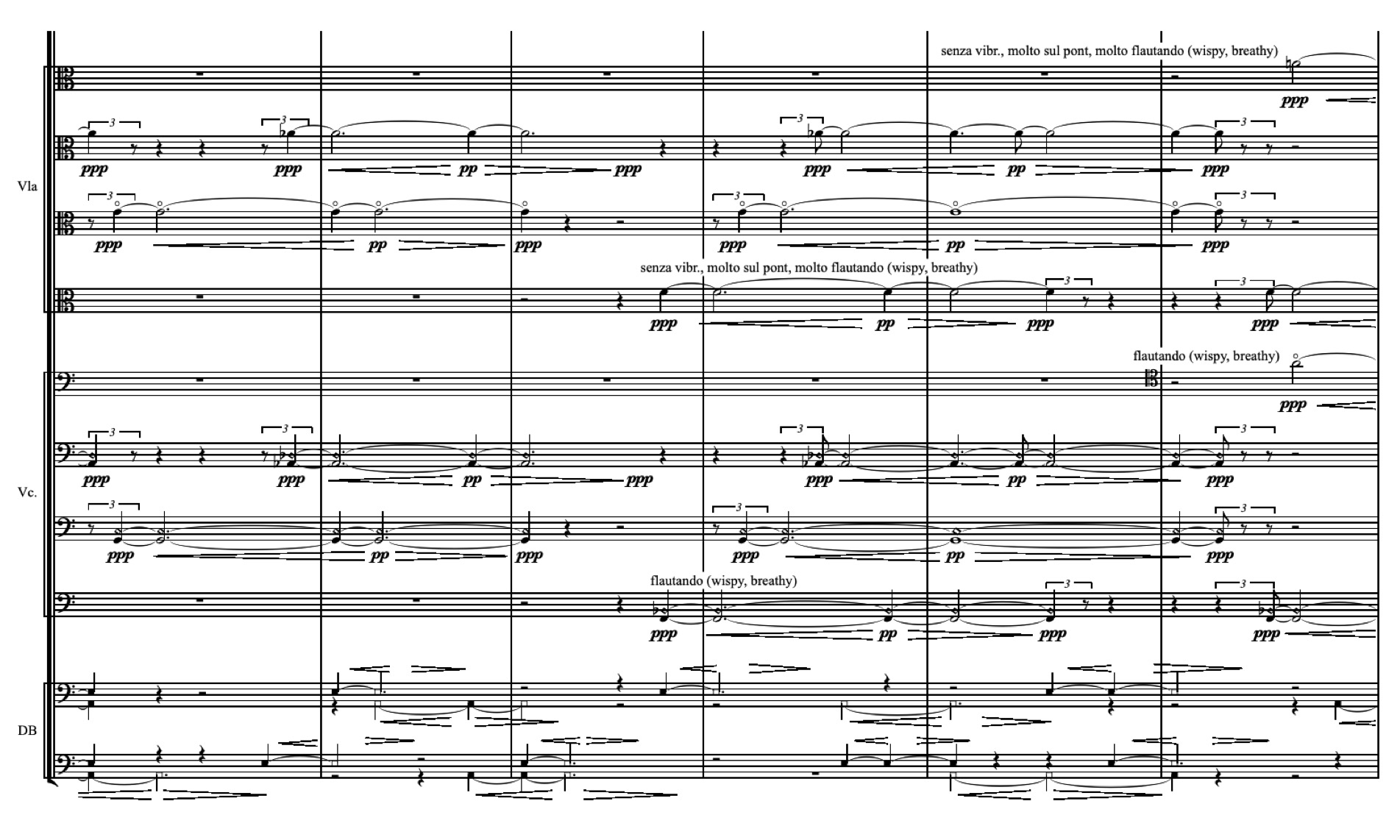
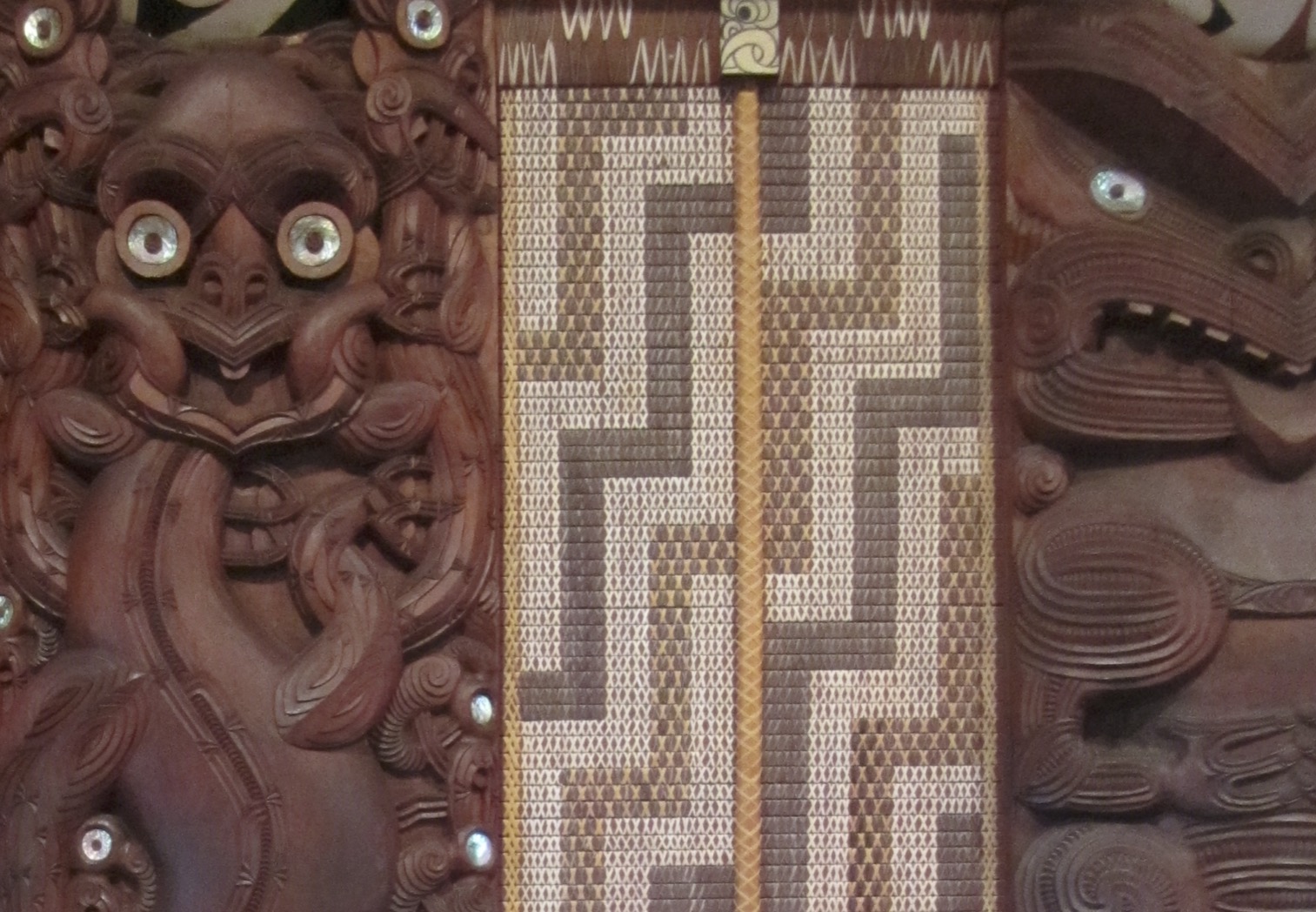
These sustained tones form strata that swell and decay independently, woven together in a manner influenced strongly by the patterns of tāniko and tukutuku. In particular, the way in which textures gradually accumulate density in staggered additions of static, sustained pitches is redolent of the poutama design (see Fig. 1).
Certain orchestral instruments are tasked with amplifying the presence of breath, thus shifting it from a fringe phenomenon into the focal core of the auditory field.13 A large woodblock, for instance, is bowed with a double bass bow; meanwhile, the double basses themselves bow laterally across their bridges in swelling and subsiding noise-bands, like the breaking of distant waves. The strings play flautando and molto sul ponticello, creating light, wispy tones—veiled and fragile. Harmonics feature prominently in strings and flutes, creating an aura of radiance around the orchestral textures.
These orchestrational choices are informed by the Māori concepts of irirangi and te wehi, terms that are difficult to translate, but are suggestive of the experience of the liminality, awe and the transcendence of te ao wairua (spirit-world). This is ‘spectral’ writing in both meanings of the word: not only do chords derived from spectral analyses of taonga puoro bubble up through the orchestra in the second half of the piece, but the ever-present timbral evanescence in both soloist and orchestra open up a space of enhanced attentiveness and listening, a frame of being in which, perhaps, we may more easily connect to the ‘spectral’ world of the wairua.
In the work’s final minute, the soloist performs ‘Wheke voice’ (whistle tones) on the pūmotomoto. Named after the daughter of Hine Raukatauri (goddess of flute music), these ‘Wheke voice’ tones are picked up and recirculated by the orchestra in a stippled interplay of high, fragile partials.14 This final texture completes the formal trajectory from the deepest notes of the taonga puoro heard at the start (the hue puruhau’s D2, c. 73Hz) to the highest harmonics of the pūmotomoto some five octaves higher (wavering around a D7, c. 2350Hz).
In contrast to the more combative, dialectical and antagonistic relationship that conventional concerto-style works adopt, Rerenga instead asks the orchestra to inhabit the role of spectral amplifier and textural diffuser of the soloist. The orchestra thus becomes a personification of he tangata māhaki (one who possesses humility) in the way that it behaves in a thoughtful, reflective fashion, as an organic ‘mirror’ to the taonga puoro’s complex spectra.
From a purely musical perspective, this relationship results in a kind of rhizomatic sonic ecology, in which sound objects sourced from the soloist are diffused and proliferated through a virtual sonic-spatial network, enacted by the orchestral sections that are often divided almost to the point of individuality. This organic ‘mycelium network’15 of distributed resonance recalls one of the key works of spectralism, Tristan Murail’s Mémoire/Érosion for horn and chamber ensemble (1976). In this piece, the ensemble imitates an endlessly recirculating tape delay with feedback that gradually ’erodes’ and transforms, echoing and refracting the horn’s gestures to form a texture that becomes denser and more complex as the piece progresses.16
In Rerenga, a similar process is expanded to much larger dimensions. The sheer physical footprint and number of players of a symphony orchestra, when combined with live electronics distributed through multiple loudspeakers surrounding the audience, contribute to the immensity of the work’s spatiomorphological proportions.17 The virtual spatial frame is extended beyond the players onstage, out towards the corners of the hall, and, by extension, beyond.
This expanded spatial frame, when combined with dense, evolving textural webs, encourages us to listen with a kind of phenomenological ‘dwelling’ upon the expressive modalities of the taonga puoro. Listeners become immersed in prolonged, spatialised strata of the instruments’ materiality—wood and bone—and the performer’s performative embodiment—his breath.
When taonga puoro that possess a particularly strong presence of breath, such as the porotiti, are subjected to the textural and timbral transformations of the live granular electronics, they begin to evoke distant environmental phenomena such as waves breaking or the susurration of trees. The resonances and remnants of wood, bone and breath are frozen in time by the electronics and orchestra, echoing and lingering in our mind’s ear in broad vistas of sonic whenua.
The paradoxical materiality of Rerenga
Rerenga develops sound-mass continua as its essential compositional vocabulary. Indistinct textural clouds of half-breath/half-tone are produced by real-time electronic transformation of the taonga puoro’s sounds. A custom-built spatial granular synthesis algorithm called spindrift~18 generates streams of grain-scale audio (20–100ms long), which are sustained for considerable periods of time—often more than 30 seconds—and overlapped with subsequent streams to build up thick sonic amalgams. The pitches produced by the soloist become intermingled with the previous strata, forming muted microtonal cluster chords enveloped in layers of shimmering breath timbres. In this way, the soloist’s material is immediately and audibly prolonged before it has left the listener’s short-term memory.
This compositional strategy of orchestral resonance, prolongation and deliberate ‘stratal blurring’ is influenced by contemporary models such as György Ligeti’s Lontano and Lux Aeterna19. In these canonic twentieth-century works, the pitches of a single cantus firmus are sustained and overlayered to form constantly evolving secundal clusters. This technique creates a sense of temporal transcendence, or even, perhaps, of vast environmental timescales, as if viewing a dark ocean from a great height. Indeed, the image of an immense marine soundscape is further enhanced in Rerenga by the imposition of swell-decay envelopes onto the electronic breath-grain layers, suggesting distant wavelike morphologies. These ‘sound(ing) waves’ are serendipitously linked to the marine provenance of two of the taonga puoro featured in the work: the porotiti heard in the opening minute is in fact created from a pilot whale’s vertebra, while the pōrutu toroa is carved out of an albatross’s wing-bone.
Rerenga’s form stems from a veiled reference to Māori creation teleologies, in which the world gradually transforms from Te Kore (the void/nothingness) and Te Pō (form/dark/night), through Te Whai-ao (the glimmer of dawn), to the coming of Te Ao Mārama (the world of light).20 The very first sound of the piece is a low D2 of the hue puruhau, said to imitate the booming of the male kākāpo. The live electronics directly sustain the hue’s note into a low bass drone that underpins the entire opening section of the work. In keeping with the central progression/process of taonga puoro → electronics → orchestra, the double basses, bass flute and bass clarinet double this D2 pitch, opening up a spatially distributed ‘void’ of darkness. Later on, the pitches of various kōauau are transformed into a contrapuntal web of desynchronised layers of breathy, spectral harmony, with their progressively higher registers suggesting the transition to and emergence of Te Ao Mārama.
All of these electronic transformations, amplifications and prolongations create a paradox, however. On the one hand, they both magnify and prolong the materials of the taonga puoro, thus reifying and foregrounding the interplay between wood, bone and breath that is a central component of the liveness and immediacy of the instruments. Yet on the other hand, they also have the effect of distancing the sonic ontology from that very intimacy and immediacy, as they become temporally blurred and objectified into a frozen, virtual ‘memory net’: they become an immense, yet spatially remote sonic abstraction.
Rerenga’s paradoxes—between the singular and many, intimacy and immensity, proximate and remote, immediate and deferred—are deliberately explored and exploited as essential poetic responses to the contemporary environment.
A web of ‘things’: rehabilitating material individuality
Projects that engage with both Western instruments and taonga puoro face challenges that are musical, logistical and ethical in nature. These mediations subvert not just conventional (read ‘Western’) performer-composer relationships, but also conventional models of the compositional process itself. This is due in no small part to the uniqueness and non-standardisation found amongst taonga puoro, which challenges the narrative of the score as, pace Nattiez, a neutral ‘trace’ to be faithfully reproduced at will by a multitude of performers.21 By way of example, taonga puoro have no common tuning system; instrument-makers work with the dimensions and densities of the material as it comes to them. Not only that, but the intrinsic variability of materials means that, for example, a pōrutu toroa in one set of instruments may very well not cover the same pitches as a pōrutu toroa in another.
In addition, the very delicate and personal balance found in a performer’s embouchure means that two performers might elicit different notes even on the same instrument. In fact, when we took Rerenga on tour, I discovered that even the same performer on the same instrument might not be able to reproduce certain notes on certain days, due to transient fluctuations in air temperature, humidity, and/or the performer’s own physiological variability. (During one afternoon soundcheck on tour, Alistair apologised, saying, ‘Sorry, Mike, that note’s just not sounding today’—but by the evening, it was there.)
Another consideration when composing for taonga puoro is that there is no standardised notation practice. Indeed, notation is generally viewed as antithetical to the more personalised practice on these instruments, which traditionally derive melodic impulses from the vocality of song, and the performer’s knowledge of and fluency with waiata and mōteatea. Composer Gillian Whitehead, in her Lilburn Lecture 2019, reflected that Richard Nunns ‘is an improvising musician—he doesn’t like working from a score, and performs better when not reading one’.22
This preference for improvisation leaves more ‘structured’ composers (such as myself) in something of a quandary. Before writing the piece, I had envisaged it as an extremely holistic texture, wherein the orchestral parts would sustain the exact pitches of the taonga puoro part, embodying this reflective, empathetic relationship with the soloist down to the level of the note. But in order to be able to achieve this, there needed to be a predictable, reproducible taonga puoro part, something that was not traditionally part of the kaupapa of taonga puoro playing. The conflicting preferences of improvisation or spontaneity from performer, and tightly controlled gestural relationships from myself, seemed initially irreconcilable.
Rather than shying away from this quandary, however, Rerenga attempts to walk a path between these two extremes of control and freedom. The highly textural nature of the writing meant that a certain degree of rhythmic freedom could be given to the soloist, in order to provide them with the impulse of spontaneity, but relatively strict control would need to be maintained over most of the pitch material. I realised that this meant the usual practice of leaving blank staves or providing approximate contour graphics in the taonga puoro part would have to be abandoned. Likewise, the fact that taonga puoro parts come with a high degree of pitch variability between different performers and instruments made the work’s ‘reproduceability’ problematic.
These realisations led to two unusual decisions taken early on in the work’s conception. Firstly, the taonga puoro part would be fully notated, albeit with a degree of rhythmic freedom provided through the use of notehead extenders and proportional notation in the soloist’s part (see Ex. 2).

As most taonga puoro performers are not experienced in reading scores, this has the effect of limiting the potential number of soloists. The more profound implication, however, was that the taonga puoro part would be composed for a specific set of instruments, those in the collection of the soloist himself. While these two decisions allowed me to proceed with the work of composing the integrated relationship between soloist and orchestra, it had the consequence that Rerenga cannot easily be reproduced by another taonga puoro performer without significant and musically detrimental compromises. I accepted this consequence as an intrinsic and positive part of working with these instruments and with this performer. For if the piece celebrates and reifies the materialist specificities of these particular objects and the unique voice of this particular soloist, then it must, by its very nature, do so at the cost of being unreproduceable on other instruments or with other players.23
This fundamental unreproduceability challenges contemporary commodity culture, with its emphasis on mass production, copy-paste processes and economies of scale. In its place, the uniqueness of these handcrafted material objects is uplifted through a compositional form and process that reflects and amplifies the distinctive sonic characteristics of the instruments. Within the space of a symphony orchestra, fetishising the ongoing reproduction of Beethoven’s symphonies yet one more time, an indigenous lens of the local and the specific is a refreshing change.
Such foregrounding of craft and whakapapa, suggesting that taonga puoro are less objects and more subjects, is in line with a recent rehabilitation of ‘thingness’ in a number of Western concert works composed in the first decades of the twenty-first century.24 This ‘material turn’ can be seen as a development of the outsider discourse that emerged in mid-twentieth-century America, whereby composers such as John Cage and Harry Partch built one-off, hand-crafted instruments as idiosyncratic sound-producers in their compositional processes.
This new emphasis on ‘things’ as unique objects recognises and indeed heightens the power of individual ‘sound-makers’ as the progenitors of singular sonic experiences. In the case of Rerenga, I believe that the work, in its inability to be ‘reproduced’ satisfactorily beyond Alistair’s own collection, uplifts their very specific mana and whakapapa, permeating the orchestra and electronics with their unique sonic characteristics.
Reflections on whakamā: a non-Māori in Māori spaces
Appropriation of indigenous cultural forms is a pernicious, ever-present part of modern globalised society.25 As Steven Feld states, the dubious moniker of ‘world music’ represents a form in which ‘musical difference has been represented, exalted and fetishized… equally routed through the public sphere via tropes of anxiety and celebration’.26 ‘Anxious narratives’ continue to resonate in contemporary discourse, pointing to the ongoing colonial project with its enduring financial and political oppression of indigenous populations. As long as white musicians find an ease to exploit indigenous cultural forms to which they can claim no legitimate whakapapa as surface-level signifiers, then these narratives are certainly relevant.
As a Pākehā composer in Aotearoa myself, then, there is a constant background sense of whakamā (guilt, shame) that inhabits my own thought and impulses, leading to an ongoing dialectic between ‘anxious’ and ‘celebratory’ narratives in my practice. On the one hand, if I do work with taonga puoro, then I become very aware of the ‘anxious narrative’ of engaging in a Māori space in which I have no whakapapa myself, whereby I may very well continue to enact the cultural imperialism and disenfranchisement that underpins this land’s past and present. On the other hand, I also become aware of the impulse underlying the ‘celebratory narrative’: that Pākehā need to act as allies to help uplift and honour these unique musical instruments.27 In particular, I have a strong conviction that well-funded, public music institutions that exist due to problematic colonial legacies have an obligation under Te Tiriti o Waitangi to develop, in partnership with tangata whenua, a vision of what concert experiences that share Pākehā and Māori perspectives might look and sound like.
In ‘Taking the Long View: Eurological Thought and Cross-Cultural Concert Music in Aotearoa New Zealand’, New Zealand composer and musicologist Celeste Oram writes about a very similar dilemma in her own creative encounters. She draws a long bow between the situation of Pākehā composers engaging in collaborations with taonga puoro players as being, on the one hand, ‘an opportunity to come to a more detailed and historically-situated understanding of their own creative aspirations and affiliations’, yet potentially ending up like Cook’s naturalist Georg Forster:
drawn to the knowledge of other cultures by well-intentioned intellectual curiosity, whose own revolutionary political leanings are compromised by the glowing approval their own work wins from the imperial establishment, who very publicly flails against the racism of the likes of Banks in an attempt to set themselves ideologically apart, whose liberal education has promised them an entitlement to absolute knowledge of anything – and who professionally and imaginatively profits from the continuing occupation of invaded territories.28
Like me, she feels the dilemma acutely: ‘It is therefore a troubling double-bind for a composer (namely, a non-Māori composer) to be creatively enriched or energised by engaging with taonga pūoro as an under-explored musical resource; it begs the question of whether this constitutes profiting from “colonial violence”’. And as with my own thoughts on the cultural and financial privilege afforded to an expensive colonial legacy—such as, say, a symphony orchestra—she points out how ‘the settler’s privilege of abstraction thus invisibilises the histories that have, for example, established a national state-funded orchestra in New Zealand and thus enabled the work’s existence.’
As alluded to above, however, I also hold the potentially conflicting view that by actively resisting any engagement with taonga puoro due to either wilful ignorance, disinterest, a sense of musical superiority or, more likely, a feeling of whakamā and cultural incompetence, white composers will continue to ‘suck all the oxygen out of the room’, dominating discourses, foregrounding the colonial legacy and advancing the narrative of European musical teleology, rather than helping take an active part in its very decolonisation, deconstruction and reframing.
I do not offer Rerenga as any kind of model here. To me, solutions lie in reconceiving power structures of centrally funded organisations through an indigenous lens, rather than what any one artwork or composer might offer. But perhaps Rerenga offers a sense of how composers might conceive of a process by which mātauranga Māori is not ‘brushed over’ a work to provide it with a patina of exoticism, but is reframed as the central progenitor of the work’s entire formal and material structures, and of its essential wairua.
Rerenga provides a brief time and space in which taonga puoro are ‘re-visibilised’ in an otherwise colonial cultural environment—namely, the classical concert hall. It draws upon the intrinsic materialities, individualities and sonic specificities of the instruments to form immersive orchestral textures that amplify, resonate and foreground the uniqueness and individuality of te reo o ngā taonga puoro.
Conclusion
In these personal reflections on a specific compositional process, the reader will no doubt detect both the ‘celebratory and anxious narratives’ of globalised musical production bubbling up to the surface. As we face up to and come to terms with our problematic colonial history, these narratives begin a constant fragile intertwining that accompanies us at every step of the creative process.
Pākehā composers who seek to work with Māori musicians and instruments need to engage in a more meaningful way than—as composer and taonga puoro musician Ruby Solly puts it—merely ‘the top layer, with no interest of delving further’.29 But I also contend here that choosing not to engage can also be viewed as part of the ongoing colonial project, and that, in particular, centrally funded music organisations in Aotearoa have an obligation to open up space for a conversation around what a true musical partnership between Pākehā and tangata whenua will look like in the future.30
I suggest here that composers looking for a way in which taonga puoro can be centralised in a traditional Western compositional process need to consider how to reframe those processes in a way that ensures the work emanates from and uplifts the voices of the performer(s), instruments and materials. This reframing, however, can be a meaningful and insightful process to discover how different techniques and approaches in the Western tradition can be sites of shared and respectful engagement between classical musicians and taonga puoro.
In composing Rerenga, for example, I not only employed a very different kind of process than in previous compositions, but also discovered links to the kinds of contemporary Western instrumental thought with which I had already been concerned. I found a compelling point of contact between the Māori concepts of irirangi and te ao wairua and the late twentieth-century Western interest in spectral liminality. In addition, I found that the twentieth-century developments of orchestral sound-mass textural composition, created using highly layered imitative counterpoint, resonance and ‘sound object proliferation’, could be applied to the taonga puoro to create new orchestral textures that flow directly from the soloist’s timbres and melodies.
Devising environments and processes through which taonga puoro might be allowed to ‘re-sound’ in Aotearoa engenders challenges, compromises and paradoxes that require deep reflection and sensitivity by non-Māori composers. This article suggests, however, that we might reframe these as essential, positive and stimulating sites for our own development as human beings, shifting the conventional paradigm of composition away from that of an individual exploring their subjective exceptionalism to one shaped more through the processes of mahi tahi, kōrero and whakaute.31 And in doing so, the composer also opens themselves up to the positive forces of change.
Acknowledgements
Many thanks to the taonga puoro musicians who have graciously shared their knowledge and expertise over the years, and who have worked tirelessly to make these unique instruments more widely heard—especially Richard Nunns, Alistair Fraser, Horomona Horo, Ariana Tikao, Jerome Kavanagh and Ruiha Turner (amongst many others). Thanks also to Brian Diettrich, Davinia Caddy, Alistair Fraser and Te Ahukaramū Charles Royal for providing insightful feedback on the drafts of this manuscript.
Glossary of Māori terms
| Aotearoa | New Zealand |
| hau | breath, vital essence |
| he tangata māhaki | a person displaying characteristics of humility |
| hue | the Polynesian bottle gourd plant (Lagenaria siceraria) |
| hue puruhau | a large gourd, played by blowing over the top opening, forming a single pitch usually around 60–65Hz |
| irirangi | spirit voice—an eerie note, harmonic or ’edge tone’ |
| kaupapa | purpose, policy, raison d’être |
| kauri | Agathis australis, the largest forest tree in New Zealand |
| kōauau | a small cross-blown flute, which can be constructed from many different materials including wood, bone and stone |
| kōauau pongaihu | a small gourd flute, played using the nostril |
| kōrero | discussion, talk |
| kōwhai | small-leaved native tree of the genus Sophora |
| mahi | work |
| mahi tahi | collaboration, cooperation |
| maire | Nestegis cunninghamii, a tall forest tree |
| mana | prestige, power, status |
| marae | meeting house |
| mataī | Prumnopitys taxifolia, a coniferous, long-lived native tree |
| mātauranga | knowledge, understanding |
| mātauranga Māori | the body of knowledge originating from Māori ancestors, including the Māori world view and perspectives, Māori creativity and cultural practices |
| mōteatea | traditional recited chant with a limited pitch range, a form of sung poetry |
| nguru | a short, semi-closed flute with a curved end |
| noho marae | an overnight stay on a marae |
| ororua | imaginary voices |
| Pākehā | European/settler |
| porotiti | disc with two holes through which a string is threaded and used to make the disc spin; the performer blows across the spinning edge to produce a tone |
| pōrutu | a long longitudinal flute, with three to six finger-holes (transliteration of the English word ‘flute’) |
| pōwhiri | welcome ceremony on a marae |
| pūkaea | a long wooden trumpet, usually 1–2m in length and made of wood and bound with vine |
| pūmotomoto | a long flute with a notched open top and a single finger hole near the end |
| pūtōrino | a unique long instrument, can be played both as a flute and a trumpet, with three apertures |
| rangirua | musically ambiguous or out of tune |
| te reo | voice(s)/language(s) |
| tangata whenua | Māori people (lit. ‘people of the land’) |
| tāniko | weaving |
| taonga puoro | The indigenous instruments of Aotearoa (lit. ‘singing treasure(s)’). There are some discrepancies as to whether ‘puoro’ should be spelled with a macron over the ‘u’—I have adopted the spelling in H. W. Williams A Dictionary of the Maori Language |
| Te Ao Mārama | ‘The world of light’, formed when Tāne (guardian of the forest and birds) separated his Sky Father Ranginui and Earth Mother Papatūānuku to create a world of light and life |
| te ao wairua | the spirit-world |
| Te Kore | nothing, void |
| Te Pō | night, darkness |
| te reo Māori | the Māori language |
| te reo wairua | spirit voice |
| Te Tiriti o Waitangi | the version of the Treaty of Waitangi in te reo Māori, first signed on 6 February 1840 by representatives of the British Crown and Māori chiefs from the North Island of New Zealand |
| te wehi | awe, fear |
| Te Whai-ao | the ‘coming of dawn’ (in Māori creation myths) |
| tikanga | protocol, convention |
| toroa | albatross |
| tukutuku | woven lattice-work used particularly between poupou (carvings around the walls of the wharenui/meeting house on a marae) |
| tutu | Coriaria arborea, |
| ūpokohue | pilot whale |
| waiata | song |
| wānanga | workshop, seminar |
| whakapapa | genealogy, descent |
| whakaute | respect |
| whenua | land |
-
One of the key figures in the revival of taonga puoro practice in Aotearoa, Nunns passed away during the writing of this article. He was a mentor of many, if not all, of the taonga puoro musicians with whom I have worked. ↩︎
-
For further discussion of tikanga Māori, see for example, Mead, Hirini, Tikanga Māori: Living by Māori Values, rev. ed. (Wellington: Huia Publishers, 2016). ↩︎
-
See, for instance, Alistair Fraser, Whakakite Ngā Taonga Pūoro: Revealing the Singing Treasures (Wellington: Winston Churchill Memorial Trust, 2017). ↩︎
-
See https://alfraser.net/nga-taonga-puoro/ for images of some of his instruments ↩︎
-
In te ao Māori, the different sounds of the instruments are referred to as ‘voices’. ↩︎
-
It is notable that Paul Wolffram’s excellent documentary of Richard Nunns and Horomona Horo is entitled Ngā Reo o te Whenua (‘Voices of the Land’) ↩︎
-
Nunns, Richard, Te Ara Puoro: A Journey into the World of Māori Music (Nelson, New Zealand: Craig Potton Publishing, 2014), 39 ↩︎
-
Nunns, Richard, and Allan Thomas, ‘the Search for the Sound of the Pūtōrino: “Me Te Wai e Utuutu Ana”’, Yearbook for Traditional Music, 37 (2005), 73 ↩︎
-
Andersen, Johannes Carl, ‘Maori Music’, Transactions and Proceedings of the Royal Society of New Zealand, 55 (1924), 699 ↩︎
-
See, for example, Edwards, Peter Ivan, ‘Object, Space, and Fragility in Luigi Nono’s “Das Atmende Klarsein”’, Perspectives of New Music, 46.1 (2008), 225–43 ↩︎
-
Fabbriciani, Roberto, ‘Walking with Gigi’, Contemporary Music Review, 18.1 (1999), 11 ↩︎
-
The original title of the work was Mātauranga (Rerenga). A revised version of the work, renamed simply Rerenga, was created in 2021. The title change reflects a refocusing of the work away from the original performance-specific context of the idea of ‘knowledge’, towards the more poetic web of meanings encapsulated in the word ‘rerenga’ (journey, flow, rising/setting of the sun, phrase). ↩︎
-
For further discussion of ‘fringe’ and ‘core’ elements in auditory phenomenology, see Aaron Helgeson, ‘What Is Phenomenological Music, and What Does It Have to Do with Salvatore Sciarrino?’, Perspectives of New Music, 51.2 (2013), 4–36 ↩︎
-
The term ‘Wheke voice’ is a problematic term. It stems from Richard Nunns, who mentions it in ‘The Search for the Sound of the Pūtōrino: “Me Te Wai e Utuutu Ana”’, Yearbook for Traditional Music, 37 (2005), 69–79, associating it with whistle-tones produced on the various flutes. He does not, however, mention the source of this association, other than a single literary one: Andersen, Johannes Carl, Māori life in Ao-tea (Christchurch, N.Z.: Whitcombe and Tombs, 1907). This book contains a brief passage that mentions the ‘sudden strange sounds’ of the voices of Hine Raukatauri and her daughter Wheke, though not in reference to musical instruments. Neither Nunns nor Andersen cite any oral sources for the character of Wheke. Andersen does, however, include an even earlier (Pākehā) literary source—John White’s Ancient History of the Maori (1887)—which mentions Wheke only once, printed on a family tree of ātua that is appended to the back cover of Volume I (yet, strangely, she is not mentioned in the body of the book at all). Furthermore, discussions with my Māori collaborators revealed that the name Wheke is unknown amongst their iwi (the word ‘wheke’ means ‘octopus’ in te reo Māori), and does not feature in any present-day mythical narratives of Hine Raukatauri. The paucity of evidence for Wheke raises questions as to whether Nunns was basing the ‘Wheke’ association on an actual oral account, or whether it was largely his own invention based on old Pākehā sources that are of dubious veracity. In any case, I have been unable to find any further evidence beyond Nunns for this association: all mentions in the literature of the idea of ‘Wheke voice’ as whistle-tones stem singlehandedly from his 2005 article. This suggests to me, though, to be fair, lacking definitive proof, that Wheke was either not a commonly known figure in Māori mythology in the late nineteenth century, or that the name ‘Wheke’ was a complete misunderstanding or mistransliteration by White and Andersen. It also suggests that the association with whistle-tones was Nunns’ own invention, based on the brief mention in Andersen. ↩︎
-
For further discussion of mycelium networks and their role in biological communication, see Sheldrake, Merlin, Entangled Life (Random House, 2020) ↩︎
-
This process is discussed in detail in Murail, Tristan, ‘the Revolution of Complex Sounds’, Contemporary Music Review, 24.2–3 (2005), 121–35 ↩︎
-
For further discussion of the term ‘spatiomorphology’, and its role in the formal articulation of sonic art, see Denis Smalley, ‘Space-Form and the Acousmatic Image’, Organised Sound, 12.01 (2007), 35–58 ↩︎
-
Available from https://www.michaelnorris.info/software/spindrift ↩︎
-
Ligeti’s own techniques were modelled on the ‘prolation canons’ of Ockeghem, Josquin and others. See, for instance, Jonathan W. Bernard, ‘Voice Leading as a Spatial Function in the Music of Ligeti’, Music Analysis, 13.2/3 (1994), 227–53 and Richard Steinitz, Gyorgy Ligeti: Music of the Imagination (Boston: Northeastern University Press, 2003). ↩︎
-
For more detail on pre-colonial Māori creation narratives, see, for instance, Marsden, Māori, ‘God, man and universe: a Maori view’, Te ao hurihuri: aspects of Maoritanga, ed. Michael King, 118–138 (Auckland: Reed, 1992). ↩︎
-
The concept of the neutral level/trace is introduced in Nattiez, Jean Jacques, Music and Discourse: Toward a Semiology of Music, trans. by Carolyn Abbate (Princeton: Princeton University Press, 1990). ↩︎
-
Whitehead, Gillian, ‘Breath of the Birds: Lilburn Lecture 2019’ (unpublished oral presentation, Te Ahumairangi Foyer, National Library of New Zealand, 2019). Transcription available here ↩︎
-
As a countermeasure to this limitation, I have an open invitation to other taonga puoro musicians whereby I agreed to adapt the score to their particular set of taonga puoro, thus creating an ‘individualised’ version of the piece. While at the time of writing, this offer has yet to be taken up, I very much look forward to this collaborative project in future. ↩︎
-
For a discussion of ‘thing theory’ in music, see Döbereiner, Luc, ‘Materiality, Contingency and Emergence of Compositional Material’, Contemporary Music Review, 39.5 (2020), 602–17. Recent examples of composers using one-off objects in their works include Katie Balch, Clara Iannotta, Olga Neuwirth, Ondrej Adámek and Panayiotis Kokoras. ↩︎
-
See, for example, Steven Feld, ‘Pygmy POP. A Genealogy of Schizophonic Mimesis’, Yearbook for Traditional Music, 28 (1996), 1–35 and Steven Feld, ‘A Sweet Lullaby for World Music’, Public Culture, 12.1 (2000), 145–71, James O. Young, ‘Art, Authenticity and Appropriation’, Frontiers of Philosophy in China, 1.3 (2006), 455–76 or Martin Stokes, ‘Globalization and the Politics of World Music’, The Cultural Study of Music: A Critical Introduction, 2003, 297, Ruby Solly, ‘Being Māori in Classical Music Is Exhausting’, E-Tangata, 2020 ↩︎
-
Feld, Steven, ‘A Sweet Lullaby for World Music’, Public Culture, 12.1 (2000), 153 ↩︎
-
At the time of writing, these conflicts were playing out in relation to (the Pākehā) singer Lorde’s 2021 EP release Te Ao Mārama, sung entirely in te reo Māori. Commentary on the EP has been divided between those congratulating her for helping in the efforts to revitalise the language and those criticising it as tokenistic and devoid of true cultural understanding. ↩︎
-
Oram, Celeste, ‘taking the Long View: Eurological Thought and Cross-Cultural Concert Music in Aotearoa New Zealand’, Naxos Musicology International 2021 ↩︎
-
Solly, Ruby, ‘Being Māori in Classical Music Is Exhausting’, E-Tangata, 2020 ↩︎
-
Te Ahukaramū Charles Royal has developed the concept of the ‘whare tapere’, and indigenous space for performing arts located within the sphere of a tangata whenua community, but in which people from other spheres may be invited to contribute and participate. See, for instance, Royal, Te Ahukaramū Charles, ‘te Whare Tapere: Towards a Model for Māori Performance Art’, PhD thesis (Victoria University of Wellington, 1998) ↩︎
-
Collaboration, discussion and respect. ↩︎